Rahul Gandhi's Shiva-Parvati post lacks scriptural context, says Hindu Dharmacharya Sabha convener
Synopsis
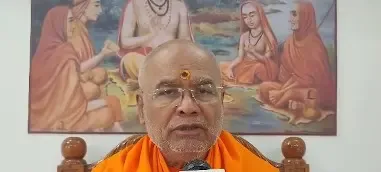
Hindu Dharmacharya Sabha Convener Swami Parmatmanand Saraswati has gone on record defending his open letter to Rahul Gandhi, calling his social media reading of a Shiva-Parvati image philosophically shallow and scripturally uninformed — and extending his criticism to Congress President Mallikarjun Kharge, whose remarks he called 'politically motivated' and deeply painful.
Key Takeaways
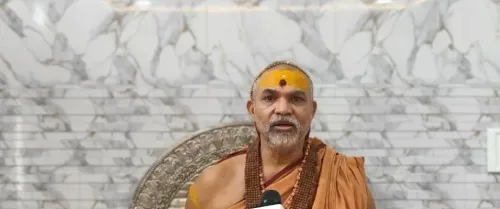
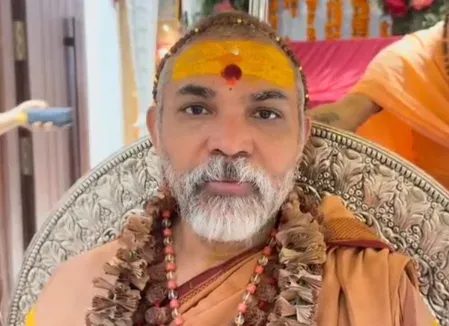
Swami Parmatmanand Saraswati , convener of the Hindu Dharmacharya Sabha , on 22 November defended his open letter to Rahul Gandhi and Priyanka Gandhi Vadra .
He objected to Rahul Gandhi's social media post featuring an image of Lord Shiva and Goddess Parvati , calling the interpretation 'fabricated' and lacking scriptural depth.
In his open letter, Saraswati invoked the Upanishads and the Uma-Maheshwara tradition to explain the deeper philosophical significance of the image.
He also criticised remarks by Congress President Mallikarjun Kharge , alleging some were 'politically motivated' and caused 'deep pain' to the Hindu community.
Saraswati urged Kharge to exercise greater restraint in public statements that touch on religious sentiments.
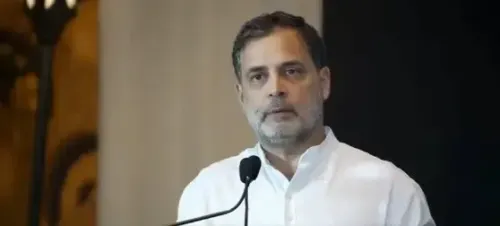
Hindu Dharmacharya Sabha Convener Swami Parmatmanand Saraswati on Sunday, 22 November defended his open letter to Lok Sabha Leader of Opposition Rahul Gandhi and Congress MP Priyanka Gandhi Vadra, asserting that depictions of Hindu deities must be understood through the broader philosophical and scriptural traditions of Sanatan Dharma. The spiritual leader, speaking from Rajkot, said he was distressed by what he described as a decontextualised reading of an image of Lord Shiva and Goddess Parvati that Rahul Gandhi had shared on social media.
The Core Objection
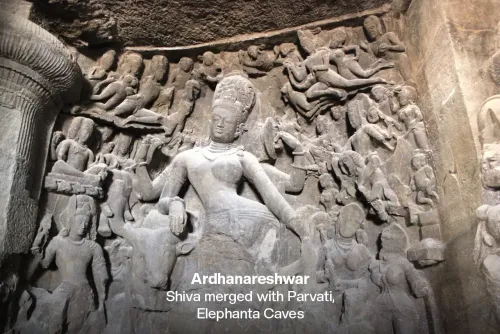
Saraswati argued that any single depiction of a Hindu deity carries a layered philosophical significance that cannot be reduced to a surface-level reading. 'The perspective is wrong. Whatever is written in our scriptures or depicted regarding our deities must be viewed with a holistic and comprehensive vision. Now, looking at a single depiction and deriving a fabricated interpretation from it — you say that Shiva and Parvati being together is a symbol of love and dating, then there is also the form of Ardhanarishvara; so why don't you tell all men and women to become Ardhanarishvara? It is not like that; there is a profound scriptural perspective behind it,' he said.
The spiritual leader's objection centred on what he characterised as an oversimplification of iconography that Hindu traditions have used for centuries to communicate metaphysical and spiritual ideas.
What Saraswati Wrote in the Open Letter
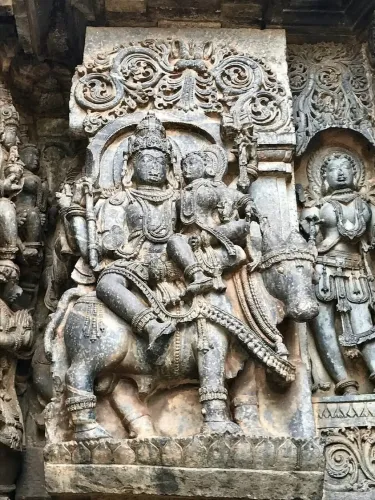
In his open letter addressed to both Rahul Gandhi and Priyanka Gandhi Vadra, Saraswati elaborated on the significance of an image showing Goddess Parvati seated on Lord Shiva's lap — the specific image Rahul Gandhi had reportedly posted on social media. 'I understand that you have posted a picture of Mata Parvati sitting on the lap of Bhagwan Shiva. I don't know what exactly you are trying to convey. However, I felt like writing. It's not just a picture. It has deep significance. It symbolises the profound wisdom of the Upanishads,' the letter read.
Referring to traditional Uma-Maheshwara depictions, Saraswati said such representations reflect the relationship between Shiva and Shakti and convey philosophical teachings that are properly understood only through the Shastras.
Remarks on Kharge and Political Context
Saraswati also expressed displeasure over statements made by Congress President Mallikarjun Kharge, saying certain remarks had caused him significant personal distress. 'Mallikarjun Kharge ji's remarks are very excessive — meaning they cause deep pain. Many depictions and statements by Rahul ji also pain us greatly. Otherwise, we do not get involved in such matters, but this caused me distress for three days, and my letter emerged out of that very pain,' he said.
He further alleged that some of Kharge's remarks made at a gathering of Muslims appeared 'politically motivated' and were unnecessary, adding that generalisations about any community should be avoided. While acknowledging Kharge's reported personal hardships, Saraswati said such experiences should not translate into statements that hurt religious sentiments.
Saraswati urged the Congress President to exercise greater restraint in public statements and to avoid comments perceived as targeting Hindu religious sensibilities.
Broader Significance
The episode follows a broader pattern of religious iconography becoming a flashpoint in Indian political discourse. Critics argue that politicians on all sides have increasingly invoked or engaged with religious symbolism in ways that religious leaders find contentious. Notably, this is not the first time a Congress leader's social media activity has drawn a formal response from a Hindu religious body. Saraswati's decision to write an open letter — rather than simply issue a statement — signals a deliberate attempt to place the critique on record. How the Congress leadership responds, if at all, is likely to shape the next round of this debate.
Point of View
Which puts Congress on the defensive without requiring a direct partisan attack. What makes this episode notable is the specificity of the objection: rather than a blanket accusation of disrespect, the critique drills into iconographic interpretation, citing Ardhanarishvara and the Upanishads. That raises the bar for any Congress rebuttal. At the same time, Saraswati's extension of criticism to Kharge — with its references to 'politically motivated' remarks at a Muslim gathering — signals that the Hindu religious establishment is watching the Congress's outreach to minority communities with acute sensitivity. The convergence of iconography, identity politics, and social media in this episode illustrates how rapidly religious discourse now escalates in India's digital public sphere.
NationPress
22 Nov 2026
Frequently Asked Questions
What was Swami Parmatmanand Saraswati's objection to Rahul Gandhi's social media post?
Saraswati objected that Rahul Gandhi's reading of an image showing Goddess Parvati seated on Lord Shiva's lap reduced a complex philosophical depiction to a surface-level interpretation. He argued that all representations of Hindu deities must be understood through the scriptural and philosophical traditions of Sanatan Dharma, including concepts like Ardhanarishvara and the wisdom of the Upanishads.
What did Saraswati write in his open letter to Rahul Gandhi?
In his open letter, Saraswati explained that the image Rahul Gandhi posted 'is not just a picture' but carries deep significance rooted in the Upanishads and the Uma-Maheshwara tradition. He wrote that the depiction symbolises the relationship between Shiva and Shakti and conveys philosophical teachings that are only properly understood through the Shastras.
Why did Saraswati also criticise Congress President Mallikarjun Kharge?
Saraswati alleged that certain remarks made by Kharge at a gathering of Muslims appeared 'politically motivated' and caused 'deep pain' to the Hindu community. He urged Kharge to exercise greater restraint and avoid generalisations about any community, while acknowledging Kharge's reported personal hardships.
Who is Swami Parmatmanand Saraswati?
Swami Parmatmanand Saraswati is the convener of the Hindu Dharmacharya Sabha, a body of Hindu religious leaders in India. He is based in Rajkot and is known for issuing public statements on matters affecting Hindu religious sentiments.
Has Congress responded to the open letter?
As of the time of reporting, neither Rahul Gandhi nor Priyanka Gandhi Vadra nor the Congress party had issued a formal public response to Saraswati's open letter or his subsequent defence of it.