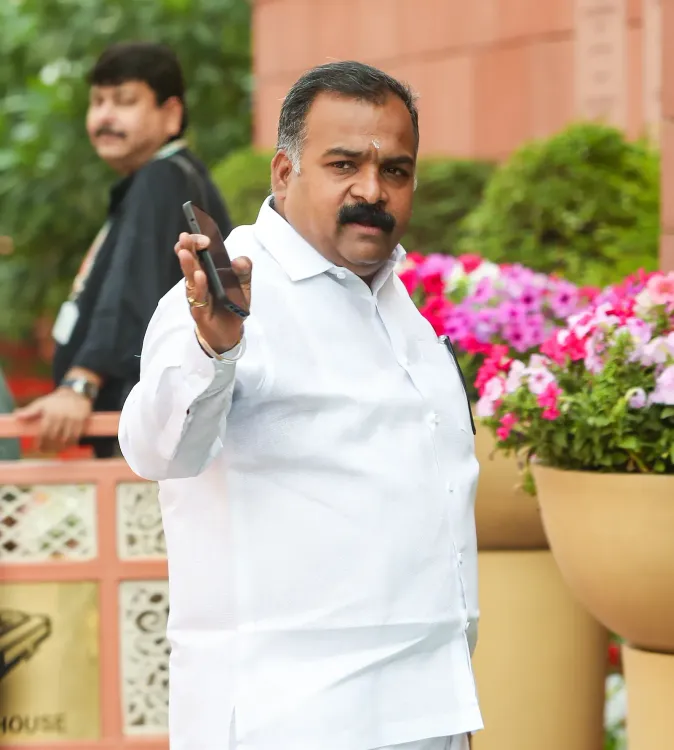
Mekedatu dam: Cong MP Manickam Tagore moves adjournment motion in Lok Sabha
Synopsis
Congress MP Manickam Tagore has moved an adjournment motion in the Lok Sabha over the Centre's position that Karnataka does not need downstream consent before building across the Cauvery — a stand that has alarmed Tamil Nadu farmers and reignited one of India's most contentious inter-state water disputes.
Key Takeaways
Manickam Tagore (Congress) filed an adjournment motion notice in the Lok Sabha on 28 July over the Centre's stand on the Mekedatu project .
The Minister of State for Jal Shakti reportedly told Parliament that Karnataka does not need downstream consent under the Supreme Court's Cauvery judgment.
Tagore argued the Centre has a constitutional obligation to protect Tamil Nadu's allocated share of Cauvery waters as determined by the Cauvery Water Disputes Tribunal .
He demanded a freeze on approvals for the Mekedatu balancing reservoir until Tamil Nadu's objections are fully considered.
Tagore called on the Centre to act as a neutral constitutional authority and uphold cooperative federalism between basin states.
Congress Lok Sabha member Manickam Tagore has submitted a notice for an adjournment motion in the Lok Sabha, seeking an urgent debate on the Centre's stance regarding construction activities across the Cauvery River — particularly the proposed Mekedatu balancing reservoir project in Karnataka — and the imperative to protect Tamil Nadu's legal rights and the livelihoods of its farmers. The notice, addressed to the Lok Sabha Secretary-General, was filed on 28 July.
Why Tagore Called It 'Grave Public Importance'
In his notice, Tagore described the matter as one of 'grave public importance', arguing that the Centre's recent parliamentary response on the Mekedatu project has triggered widespread anxiety across Tamil Nadu. He emphasised that the Cauvery is the lifeline of the state, sustaining lakhs of farmers in the delta region and serving as a critical drinking water source for millions of residents.
Tagore contended that any construction activity — whether a reservoir or a dam — that alters the river's natural flow would directly imperil Tamil Nadu's water security and agricultural economy.
What the Centre Said — and Why It Drew Criticism
The Congress MP took sharp aim at the Union Government's reply in Parliament, in which the Minister of State for Jal Shakti reportedly stated that the Supreme Court's judgment on the Cauvery dispute does not require Karnataka to obtain the consent of downstream riparian states before undertaking construction across the river.
According to Tagore, this position fails to adequately address Tamil Nadu's concerns and has deepened apprehension in the state. He argued that the core issue goes beyond the question of consent: the Centre, he maintained, bears a constitutional obligation to protect Tamil Nadu's lawful share of Cauvery waters as determined by the Cauvery Water Disputes Tribunal and subsequently modified by the Supreme Court.
Tamil Nadu's Legal and Constitutional Claim
Tagore asserted that no upstream state should be permitted to undertake projects that could diminish or adversely affect the water available to downstream states. Referring specifically to the Mekedatu project proposed by Karnataka, he said Tamil Nadu has every legal and constitutional right to oppose any development that could threaten its allocated share of Cauvery waters or the livelihoods of farmers dependent on the river.
He noted that farmers in the Cauvery delta have already endured decades of uncertainty over water releases and should not be subjected to further distress arising from unilateral decisions taken upstream. This is not the first time the Mekedatu project has sparked an inter-state flashpoint — Tamil Nadu has consistently opposed the proposal, and the dispute has periodically escalated into a political flashpoint between the two states.
What the Congress MP Demanded
In the adjournment motion, Tagore called on the Centre to immediately clarify its position on protecting Tamil Nadu's interests in the Cauvery basin. He also demanded that no approval be granted to the Mekedatu project or any other upstream proposal that could affect Tamil Nadu's allocated water share until the state's objections are fully considered.
He further alleged that the Centre's stance has created a perception that Tamil Nadu's farmers are being overlooked, and urged the Central government to act as a neutral constitutional authority, ensuring fairness between basin states and upholding the principles of cooperative federalism.
With the monsoon session of Parliament under way, the adjournment motion puts fresh pressure on the Centre to respond — and signals that the Cauvery dispute remains far from settled.
Point of View
But it is politically combustible. It hands the Congress a ready-made grievance in Tamil Nadu ahead of the next electoral cycle and puts the BJP-led Centre in the uncomfortable position of appearing to favour an upstream BJP-ruled Karnataka over a DMK-governed Tamil Nadu. The deeper problem is structural: India's inter-state river dispute framework leaves too much to judicial interpretation and too little to proactive federal mediation. The Mekedatu file has been open for years; the Centre's silence on a clear policy position has allowed anxiety to fester on both sides of the border.
NationPress
26 Oct 2026
Frequently Asked Questions
What is the Mekedatu project and why is it controversial?
The Mekedatu balancing reservoir is a proposed dam project on the Cauvery River in Karnataka, designed to store surplus water. Tamil Nadu opposes it, arguing the project could reduce the river's downstream flow and threaten the state's constitutionally allocated share of Cauvery waters.
What did the Centre say about the Mekedatu project in Parliament?
The Minister of State for Jal Shakti reportedly stated in Parliament that the Supreme Court's judgment on the Cauvery dispute does not require Karnataka to obtain the consent of downstream riparian states before undertaking construction across the river. This response has drawn sharp criticism from Tamil Nadu's political leaders.
What is Manickam Tagore demanding through the adjournment motion?
Tagore has demanded an urgent parliamentary debate on the Centre's position, an immediate clarification on protecting Tamil Nadu's water rights, and a freeze on any approval for the Mekedatu project until Tamil Nadu's objections are fully addressed.
What is the legal basis for Tamil Nadu's claim over Cauvery waters?
Tamil Nadu's water allocation is based on the award of the Cauvery Water Disputes Tribunal, which was subsequently modified by the Supreme Court. Tagore argues the Centre is constitutionally bound to uphold this allocation and prevent upstream projects that could diminish it.
Who is affected by the Cauvery water dispute?
The dispute primarily affects farmers in Tamil Nadu's Cauvery delta region, who depend on the river for irrigation, as well as millions of residents who rely on it for drinking water. Farmers in Karnataka are also stakeholders, making the dispute one of India's most politically sensitive inter-state water conflicts.