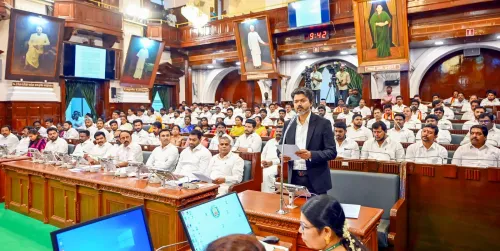
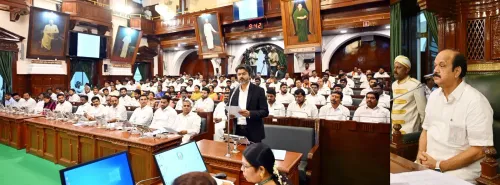
TN Assembly passes unanimous resolution against Mekedatu dam
Synopsis
The Tamil Nadu Legislative Assembly on 19 June 2026 unanimously passed a government resolution opposing Karnataka's Mekedatu dam project on the Cauvery, urging the Union Government to deny all technical and environmental clearances. The move reflects decades of downstream resistance to upstream Cauvery storage projects.
Key Takeaways
The Tamil Nadu Legislative Assembly passed a unanimous government resolution on 19 June 2026 against the Mekedatu dam project.
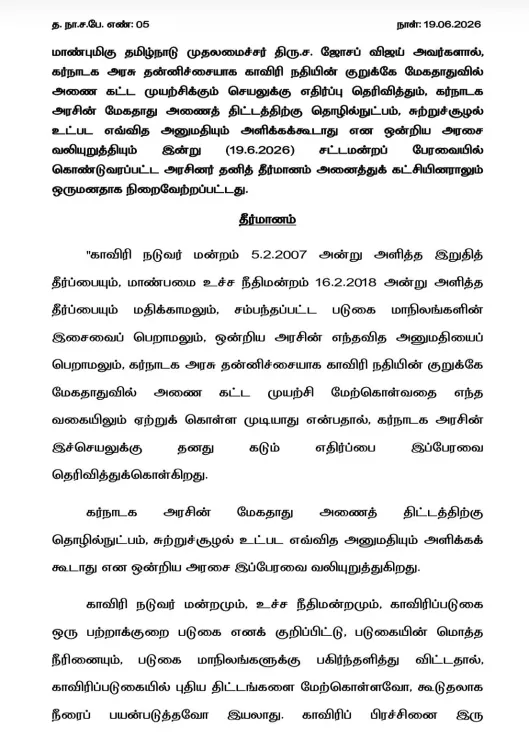
The resolution urges the Union Government to deny all technical, environmental, and other clearances to Karnataka for the project.
All parties in the Tamil Nadu Assembly supported the resolution, signalling cross-party consensus.
The Cauvery Water Disputes Tribunal (2007) award, upheld by the Supreme Court in 2018 , governs monthly water releases from Karnataka to Tamil Nadu.
Cauvery delta farmers and Chennai 's water supply are the principal stakeholders on the Tamil Nadu side.
The next critical decision rests with the Union Ministry of Environment, Forest and Climate Change on whether to grant terms of reference for a Mekedatu environmental impact assessment.
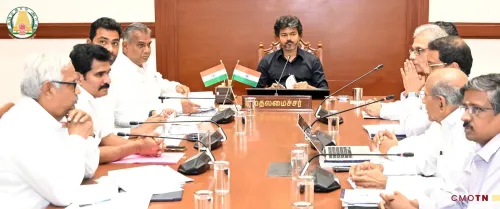
The Tamil Nadu Legislative Assembly on Friday, 19 June 2026 unanimously passed a government resolution opposing Karnataka's proposed Mekedatu dam across the Cauvery River, urging the Union Government to deny all technical and environmental clearances for the project. The resolution was moved by the Chief Minister's Office of Tamil Nadu under Chief Minister Joseph Vijay and carried with the support of all parties in the House.
What the resolution says
The resolution, described as a government special resolution (arasu thanit theermanam), opposes Karnataka's attempt to construct a dam at Mekedatu on the Cauvery without downstream consent. It specifically calls on the Central Government to withhold every category of clearance — technical, environmental, and any other — required for the project to proceed. The House passed the measure unanimously, signalling cross-party consensus on the issue.
Context: A long-running inter-state dispute
The Cauvery is an inter-state river whose waters have been contested between Tamil Nadu and Karnataka for over a century. The Cauvery Water Disputes Tribunal, constituted in 1990, delivered its final award in 2007, fixing monthly water release schedules from Karnataka to Tamil Nadu. The Supreme Court of India upheld the award with modifications in 2018, and the Cauvery Water Management Authority was subsequently constituted to oversee compliance.
Mekedatu, located in Karnataka's Ramanagara district, is a site where Karnataka has proposed a balancing reservoir and drinking water supply project. Tamil Nadu has consistently argued that any new storage structure upstream would reduce the flow guaranteed to it under the tribunal award and the Supreme Court's directions.
Policy backdrop: Clearances as the key lever
Under India's federal framework, large dam projects require clearances from multiple Union ministries — including the Ministry of Environment, Forest and Climate Change and the Central Water Commission — before construction can begin. Tamil Nadu's resolution targets precisely this stage, asking the Centre to deny the terms of reference that would allow environmental impact assessments to proceed.
This legislative strategy is well-established in Indian inter-state river politics. Downstream assemblies have repeatedly passed unanimous resolutions urging the Centre to withhold upstream clearances, using the House's moral authority to put political pressure on the Union executive. The Tamil Nadu Assembly has invoked this mechanism multiple times over the Cauvery dispute across successive governments.
Stakeholders and impact
The most directly affected stakeholders are Cauvery delta farmers in Tamil Nadu, who depend on regulated releases from Karnataka for irrigation across districts including Thanjavur, Tiruvarur, and Nagapattinam. Any reduction in guaranteed flows, they argue, would devastate samba and kuruvai paddy cultivation. The resolution also reflects concerns from Chennai's drinking water planners, who monitor Cauvery inflows into Mettur Dam.
For Karnataka, the Mekedatu project has been framed as a drinking water solution for Bengaluru and surrounding areas, making it politically significant within the state as well. The dispute thus pits the water security needs of two large state populations against each other, with the Union Government holding the decisive administrative card.
What's next
The resolution will formally be communicated to the Union Government, adding legislative weight to Tamil Nadu's standing objections. The critical decision points ahead are any ruling by the Ministry of Environment, Forest and Climate Change on whether to grant terms of reference for a Mekedatu environmental impact study, and the agenda of the next scheduled meeting of the Cauvery Water Management Authority. A Union decision either way will determine whether the project advances to the assessment stage or remains stalled.
Point of View
Chief Minister Joseph Vijay has insulated the move from domestic criticism while maximising its pressure value on New Delhi. The resolution fits a long-established pattern in Indian water politics where downstream assemblies use legislative unanimity to convert a legal dispute into a political cost for the Centre. The real test will come when the Ministry of Environment decides whether to even initiate a formal environmental review — that single administrative act will reveal how much weight the Union assigns to Tamil Nadu's legislative signal.
NationPress
18 Sept 2026
Frequently Asked Questions
What is the Mekedatu dam project?
The Mekedatu project is a proposed balancing reservoir and drinking water scheme by the Karnataka government at Mekedatu in Ramanagara district, across the Cauvery River. Karnataka has positioned it primarily as a solution for Bengaluru's drinking water needs.
Why is Tamil Nadu opposing the Mekedatu dam?
Tamil Nadu argues that any new upstream storage structure on the Cauvery would reduce the water flows guaranteed to it under the 2007 Cauvery Water Disputes Tribunal award, upheld by the Supreme Court in 2018, harming delta farmers and the state's drinking water supply.
What did the Tamil Nadu Assembly resolution say?
The resolution, passed unanimously on 19 June 2026, opposed Karnataka's unilateral attempt to build a dam at Mekedatu and urged the Union Government to deny all technical, environmental, and other clearances required for the project.
Who can stop the Mekedatu dam from being built?
The Union Government holds the decisive authority: the project requires clearances from the Central Water Commission and the Ministry of Environment, Forest and Climate Change before construction can begin. Tamil Nadu's resolution specifically targets these central clearances.
What is the Cauvery Water Management Authority?
The Cauvery Water Management Authority is a body constituted by the Union Government following the Supreme Court's 2018 order to oversee and implement the monthly water release schedules from Karnataka to Tamil Nadu as fixed by the Cauvery Water Disputes Tribunal.