TN Assembly passes resolution against Mekedatu dam project
Synopsis
Tamil Nadu's legislature has spoken with one voice: the ₹9,000 crore Mekedatu dam must not be built. Friday's unanimous resolution ratchets up political and legal pressure on the Centre at a moment when Karnataka's Congress government and Tamil Nadu's TVK-led government are on a collision course — exposing a rare intra-Congress fault line that national leadership cannot easily paper over.
Key Takeaways
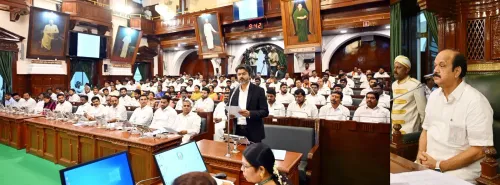
The Tamil Nadu Legislative Assembly on 19 June unanimously passed a resolution opposing Karnataka's Mekedatu dam on the Cauvery River .
The project is estimated to cost ₹9,000 crore and would generate 400 MW of hydroelectric power, according to Karnataka.
Joseph Vijay urged all parties to set aside political differences to protect Tamil Nadu's farmers and water rights.
The resolution calls on the Central Water Commission not to process Karnataka's Detailed Project Report (DPR) .
The dispute has exposed a split within the Congress : Karnataka's Congress government supports the dam; Tamil Nadu Congress leaders oppose it.
CM Vijay had earlier written to PM Narendra Modi seeking rejection of Karnataka's DPR.
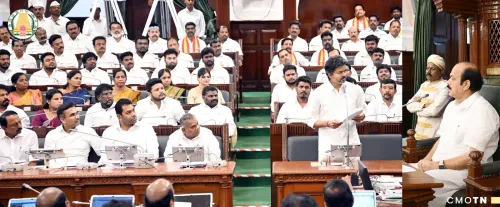
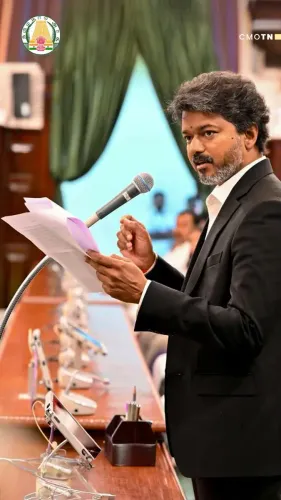
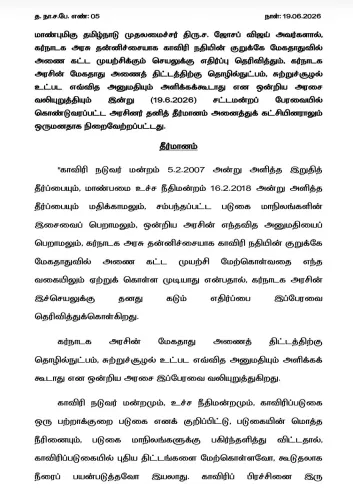
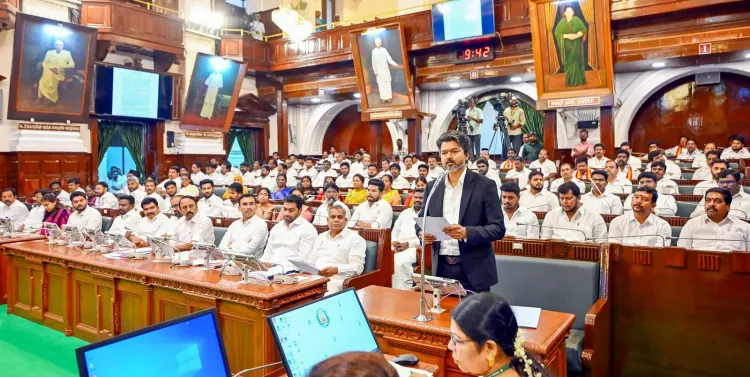
The Tamil Nadu Legislative Assembly on Friday, 19 June unanimously adopted a resolution opposing Karnataka's proposed Mekedatu dam across the Cauvery River, urging the Union Government to withhold all approvals and clearances for the ₹9,000 crore balancing reservoir project. The resolution, moved by Chief Minister C. Joseph Vijay, marks the state legislature's strongest collective statement yet on the long-running inter-state water dispute.
What the Resolution Says
The House declared Karnataka's push to advance the Mekedatu project as unilateral and contrary to existing legal and judicial provisions governing Cauvery water-sharing. Tamil Nadu argued that both the Cauvery Water Disputes Tribunal and the Supreme Court have held the Cauvery basin to be a deficit basin, with available water already allocated among riparian states.
On that basis, the resolution maintained that no new project can be undertaken in the basin that would enable additional utilisation or storage beyond allocated shares. The Assembly also urged the Central Water Commission (CWC) not to process or approve Karnataka's Detailed Project Report (DPR) for the scheme.
What Chief Minister Vijay Said
Moving the resolution, Chief Minister Vijay framed the issue as one that transcended party lines. 'Water is our basic right and resource. The responsibility to protect it rests with all of us. Political differences may exist, but when it comes to the welfare of our people and farmers, we must stand united,' he told the Assembly.
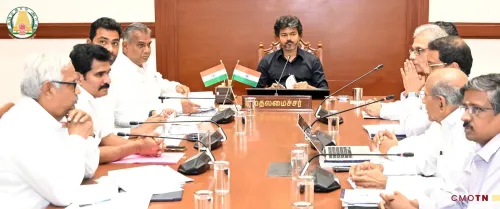
Vijay had earlier written to Prime Minister Narendra Modi seeking outright rejection of Karnataka's DPR, stressing that no new reservoir should be permitted on the Cauvery without the consent of downstream states.
Karnataka's Position and the Congress Divide
Karnataka has consistently maintained that the Mekedatu project is intended to meet Bengaluru's growing drinking water requirements and to generate 400 megawatts of hydroelectric power. The state government argues the reservoir would serve civilian needs, not divert agricultural allocations.
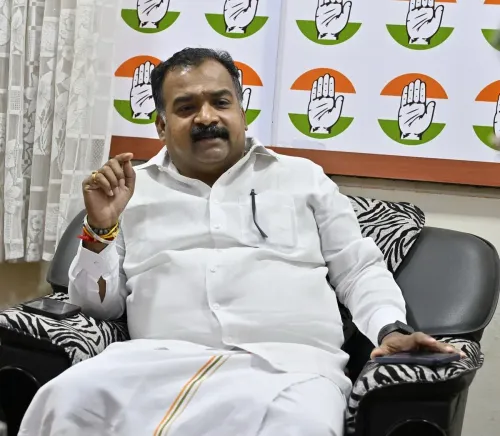
Notably, the dispute has exposed an internal fault line within the Indian National Congress (INC): Karnataka's Congress government backs the project, while Congress leaders in Tamil Nadu have aligned with the TVK-led state government's opposition. This intra-party contradiction has complicated the national Congress leadership's position on the issue.
Legal and Historical Context
The Cauvery dispute is among India's oldest inter-state water conflicts, with formal adjudication dating back decades. The Cauvery Water Disputes Tribunal's final award and subsequent Supreme Court rulings have fixed state-wise allocations, leaving little room for new upstream storage projects without downstream consent.
Tamil Nadu has consistently argued that any new structure upstream — even one framed as a drinking water project — risks reducing the flow available to its farmers during lean monsoon years. The state's delta districts, which depend heavily on Cauvery irrigation, have historically been the flashpoint of agitation whenever upstream diversions are perceived to threaten water availability.
What Happens Next
The resolution now formally places the Tamil Nadu legislature on record against the project and increases political pressure on the Centre to withhold clearances. The CWC is yet to act on Karnataka's DPR, and the Union Government's response will be closely watched. Any move to process the DPR is likely to trigger fresh legal challenges from Tamil Nadu.
Frequently Asked Questions
What is the Mekedatu dam project?
The Mekedatu dam is a proposed ₹9,000 crore balancing reservoir project on the Cauvery River in Karnataka. Karnataka says it is designed to meet Bengaluru's drinking water needs and generate 400 MW of hydroelectric power, but Tamil Nadu argues it would reduce downstream water availability for its farmers.
Why has Tamil Nadu passed a resolution against the Mekedatu project?
Tamil Nadu contends that the Cauvery basin is a deficit basin — a position upheld by both the Cauvery Water Disputes Tribunal and the Supreme Court — and that all available water has already been allocated. The state argues that any new upstream storage structure would illegally divert water from its allocated share and harm farmers in its delta districts.
What has the Tamil Nadu government asked the Centre to do?
The Assembly resolution urges the Union Government not to grant any approval or clearance for the Mekedatu project. It also calls on the Central Water Commission not to process or approve Karnataka's Detailed Project Report. Chief Minister C. Joseph Vijay separately wrote to Prime Minister Narendra Modi seeking outright rejection of the DPR.
How has the Mekedatu dispute divided the Congress party?
Karnataka's Congress government supports the Mekedatu project as a drinking water initiative, while Congress leaders in Tamil Nadu have backed the TVK-led state government's opposition to it. This intra-party split has placed the national Congress leadership in a difficult position.
What happens next in the Mekedatu dispute?
The Central Water Commission is yet to act on Karnataka's Detailed Project Report. The Union Government's response to Tamil Nadu's resolution will be the key next step. Any move to process the DPR is expected to prompt fresh legal challenges from Tamil Nadu in the Supreme Court.