Taslima Nasrin urges Bangladesh to lift Awami League ban, back Hasina's return
Synopsis
Taslima Nasrin — exiled from Bangladesh under Hasina’s own government — is now publicly demanding Hasina’s return and the lifting of the Awami League ban. Her Kolkata remarks cut across political lines: she criticised Hasina in the past, yet argues suppressing her party is undemocratic. She also claimed Hindu persecution has worsened under the Yunus government — a pointed charge that mainstream coverage has largely underplayed.
Key Takeaways
Exiled writer Taslima Nasrin called on the Bangladesh government on 2 August to lift its ban on the Awami League .
Nasrin demanded that ousted former PM Sheikh Hasina be allowed to return to Bangladesh and contest elections.
She alleged that Hindus have faced greater persecution under the Muhammad Yunus government than previously.
Nasrin said she sees no decline in the influence of fundamentalist groups, warning that Jamaat-e-Islami will now have a parliamentary presence.
Despite being exiled during Hasina’s tenure, Nasrin said banning the Awami League is ‘completely undemocratic’.
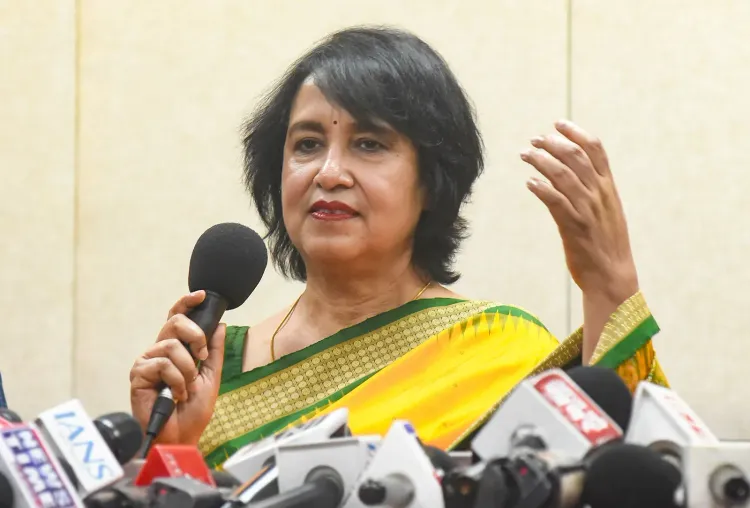
Exiled Bangladeshi writer Taslima Nasrin on Sunday, 2 August publicly called on the Bangladesh government to lift its ban on the Awami League and facilitate the return of ousted former Prime Minister Sheikh Hasina to the country. Speaking at a press conference in Kolkata, Nasrin argued that both the ouster of Hasina and the banning of her party were fundamentally undemocratic.
What Nasrin Said
“The way Awami League leader Sheikh Hasina has been ousted is wrong. This is not a democratic process. Banning Awami League is also completely undemocratic. The party should be given the opportunity to participate in the elections. I want Sheikh Hasina to return to Bangladesh,” Nasrin said.
Notably, Nasrin herself had previously criticised Hasina and was exiled from Bangladesh during Hasina’s tenure. Despite that personal history, she maintained that her opposition to the ban was rooted in democratic principles, not political loyalty.
Appeal to the BNP Government
Nasrin directed her appeal specifically at the current Bangladesh Nationalist Party (BNP) government, urging it to allow Hasina to return and lead her party into elections. She argued that the Awami League should be permitted to function as a principal opposition force rather than be suppressed entirely.
“It would have been better if the Awami League had remained the principal Opposition party,” she said, adding that Jamaat-e-Islami would now gain parliamentary representation — an outcome she appeared to view with concern.
On Hindu Persecution and Minority Rights
Nasrin levelled sharp allegations about the treatment of religious minorities in Bangladesh, claiming that Hindus have faced greater persecution during the tenure of the Muhammad Yunus government than before. She alleged that the Bangladesh government does not take adequate action against those who target Hindus.
“In fact, Hindus have faced greater persecution during Yunus’s tenure,” she said. She further claimed that hatred towards non-Muslims is taught in many madrasas and that Hindus, Buddhists, and Christians face ongoing persecution in the country.
Nasrin also drew no distinction between the Tarique Rahman government and the Muhammad Yunus government on this front, saying there was “no difference” between the two administrations in their handling of minority issues.
On Fundamentalism and Education
Nasrin expressed concern about the growing influence of fundamentalist groups in Bangladesh, saying she saw “no signs” of that influence declining. “On the contrary, it is increasing,” she said.
She called for a stronger emphasis on education over religious institution-building. “What is needed most is education. Everyone has the right to live. Instead of building more temples and madrasas, there should be greater emphasis on education,” she added.
India-Bangladesh Relations and Her Own Exile
Nasrin expressed hope that relations between India and Bangladesh would improve, acknowledging India’s historical contribution to Bangladesh’s independence. However, she noted that her own path back to Bangladesh remained blocked. “But nobody has asked me to go back. How will I go back to my country,” she said.
Her remarks come at a charged moment in Bangladesh’s political transition, with the country navigating a post-Hasina landscape that critics argue has opened space for religious nationalist forces. Whether the BNP government responds to Nasrin’s appeal remains to be seen.
Point of View
If substantiated, has serious implications for India-Bangladesh relations. The mainstream narrative of Bangladesh’s political transition as a democratic correction is being complicated by voices like Nasrin’s, and that tension is worth tracking carefully.
NationPress
2 Aug 2026
Frequently Asked Questions
Why is Taslima Nasrin supporting Sheikh Hasina’s return to Bangladesh?
Nasrin is not endorsing Hasina personally but is arguing on democratic grounds that banning the Awami League and preventing Hasina’s return is undemocratic. She stated that the party should be allowed to contest elections and serve as a principal opposition force.
What did Taslima Nasrin say about Hindu persecution in Bangladesh?
Nasrin alleged that Hindus have faced greater persecution during the Muhammad Yunus government’s tenure than before, and that the Bangladesh government does not act against those who target minorities. She also claimed that hatred towards non-Muslims is taught in certain madrasas.
Who is Taslima Nasrin and why is she in exile?
Taslima Nasrin is a Bangladeshi writer known for her criticism of religious fundamentalism. She was exiled from Bangladesh during Sheikh Hasina’s tenure and has since lived abroad, including in India.
What did Nasrin say about Jamaat-e-Islami’s growing influence?
Nasrin said she sees no signs of fundamentalist influence declining in Bangladesh and warned that Jamaat-e-Islami would now have a parliamentary presence. She said it would have been better if the Awami League had remained the principal opposition party.
What did Taslima Nasrin say about India-Bangladesh relations?
Nasrin expressed hope that relations between India and Bangladesh would improve, noting India’s significant contribution to Bangladesh’s independence. She also noted that no one had invited her to return to Bangladesh.