Anurag Thakur invokes 1975 Allahabad HC ruling to counter Congress EVM criticism
Synopsis
BJP MP Anurag Thakur invoked the 1975 Allahabad High Court verdict that nullified Indira Gandhi's election to argue that Congress's current attacks on EVMs and the Election Commission follow the same pattern of targeting any institution that rules against the party.
Key Takeaways
In June 1975 , the Allahabad High Court set aside Indira Gandhi's Rae Bareli election win on grounds of corrupt electoral practices, directly precipitating the Emergency.
Thakur quoted Indira Gandhi's call for a 'samarpit judiciary' (dedicated judiciary) as evidence of Congress's historical tendency to seek pliant institutions.
He drew a parallel between that 1975 demand and Congress's current questioning of EVMs , the Election Commission , and Election Commissioners.
EVMs have been used in all parliamentary elections since 2004 and have been upheld by the Supreme Court on multiple occasions.
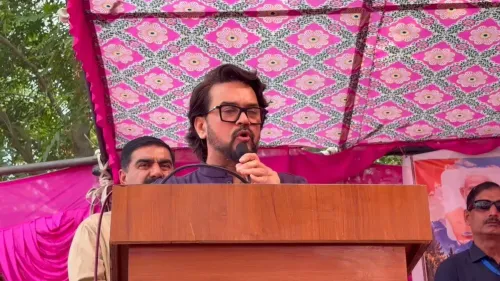
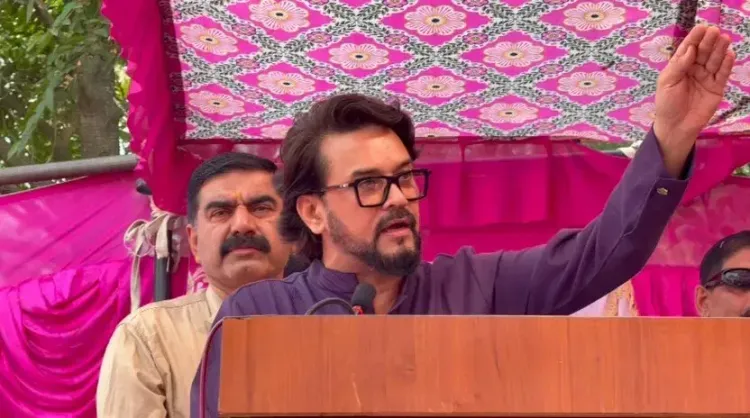
Thakur made the remarks in Himachal Pradesh , the state where he holds the Hamirpur Lok Sabha seat.
The BJP has consistently used the Emergency record to rebut Congress demands for electoral accountability.
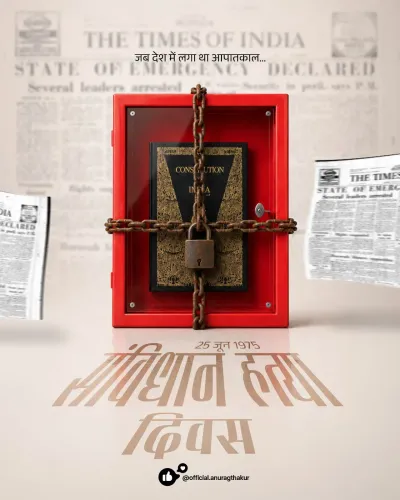
A 1975 courtroom verdict that shook Indian democracy is back at the centre of a political argument — and BJP MP Anurag Thakur is using it to turn the tables on Congress. Speaking in Himachal Pradesh, the Hamirpur MP drew a direct line from Indira Gandhi's demand for a 'dedicated judiciary' after her election was struck down, to what he called Congress's pattern of undermining every institution that does not rule in its favour.
The 1975 verdict Congress would rather forget
The backdrop Thakur invokes is unambiguous history. In June 1975, the Allahabad High Court set aside Indira Gandhi's election from Rae Bareli on grounds of corrupt electoral practices — a judgment that directly triggered the declaration of the Emergency. Thakur quotes her response to that ruling: a call for a 'samarpit judiciary' — a 'dedicated judiciary' — widely interpreted at the time as a demand for courts that would align with the ruling dispensation. The Emergency that followed suspended civil liberties, muzzled the press, and imprisoned political opponents for nearly two years.
From 'dedicated judiciary' to EVM scepticism — Thakur's through-line
Thakur's argument is pointed: Congress, he says, has always wanted institutions 'dedicated' to serving the party rather than the Constitution. He frames the party's current questioning of Electronic Voting Machines, the Election Commission of India, and individual Election Commissioners as the same instinct in a new form — challenge the referee when you lose the match. 'Congress always wants everything dedicated to itself, working for it, doing its bidding,' he said, according to the post.
The Election Commission has repeatedly and publicly defended the integrity of EVMs, citing multiple layers of technical audit, mock polls, and Supreme Court scrutiny. EVMs have been deployed across all parliamentary constituencies since the 2004 general elections, and their reliability has been upheld by the apex court on several occasions.
Why this argument lands differently in Himachal Pradesh
The Himachal Pradesh location tag on the post is not incidental. Thakur represents Hamirpur, a constituency he has held across multiple terms, and the state has been a competitive battleground between the BJP and Congress. Invoking the Emergency-era record of the Gandhi family carries particular resonance with an older electorate that lived through 1975–77, while simultaneously framing Congress as institutionally unreliable for a younger voter weighing electoral credibility.
The BJP has consistently deployed this counter-narrative whenever Congress raises EVM concerns — arguing that a party with the Emergency on its record has the weakest standing to lecture on democratic norms. Thakur's post sharpens that argument with a specific quote and a specific verdict, rather than a general accusation.
Whether Congress responds with a rebuttal on contemporary EVM audit mechanisms or pivots to a different front will signal how confident the opposition feels in pressing the institutional-accountability line heading into the next electoral cycle.
Point of View
He forces Congress to defend a record rather than press an attack. The move also signals that the BJP sees institutional credibility — of courts, election bodies, and voting technology — as a live electoral battleground, not a settled question. If Congress continues pressing the EVM line without addressing the 1975 parallel, it risks ceding the framing war even if its technical arguments have merit.
NationPress
31 Oct 2026
Frequently Asked Questions
Why did the Allahabad High Court cancel Indira Gandhi's election in 1975?
The Allahabad High Court in June 1975 set aside Indira Gandhi's victory from Rae Bareli in the 1971 general elections, finding her guilty of corrupt electoral practices including misuse of government machinery for her campaign. The ruling disqualified her from holding elected office for six years, and she responded by declaring the Emergency.
What did Indira Gandhi mean by 'dedicated judiciary'?
After the Allahabad High Court verdict voided her election, Indira Gandhi publicly called for a 'samarpit nyaypalika' — a 'dedicated judiciary' — which critics interpreted as a demand for judges loyal to the government rather than to the Constitution. It became one of the most cited phrases from the Emergency era.
What is the BJP's standard argument against Congress criticism of EVMs?
The BJP consistently argues that a party responsible for the 1975 Emergency — which suspended democratic norms and jailed opponents — has the weakest credibility to raise concerns about electoral fairness. Thakur's post is a direct example of this counter-narrative, linking the 'dedicated judiciary' demand to current Congress attacks on the Election Commission and EVMs .
When were EVMs introduced in Indian elections?
Electronic Voting Machines were deployed across all parliamentary constituencies from the 2004 general elections onward. Their use has been upheld by the Supreme Court of India on multiple occasions following challenges by opposition parties.
Who is Anurag Thakur and which constituency does he represent?
Anurag Thakur is a BJP Lok Sabha MP from Hamirpur in Himachal Pradesh . He previously served as Union Minister of Information and Broadcasting as well as Youth Affairs and Sports in the Modi government.