Anurag Thakur backs Bhagwat's warning on foreign regime-change bids
Synopsis
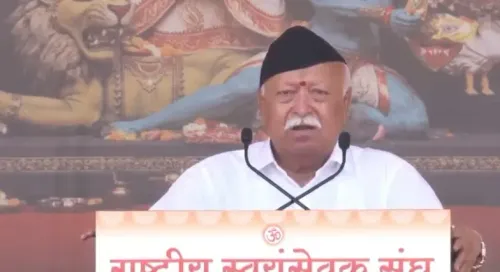
BJP MP Anurag Thakur has endorsed RSS Sarsanghchalak Dr. Mohan Bhagwat's Vijayadashami 2026 address, warning that foreign powers are installing self-serving proxies in various countries under the guise of regime change, and urging all Indians to remain vigilant against this threat to sovereignty.
Key Takeaways
BJP MP Anurag Thakur on 20 October 2026 publicly endorsed RSS Sarsanghchalak Dr.
Mohan Bhagwat's Vijayadashami address on foreign interference.
Thakur warned that 'certain foreign powers' are pursuing a deliberate policy of installing 'self-serving proxies' in other countries under the cover of regime change.
The RSS Vijayadashami address is an annual foundation-day speech — the RSS was founded in 1925 — watched closely across India's political and security establishment.
Bhagwat has led the RSS since 2009 ; the Vijayadashami platform has previously addressed geopolitical threats alongside domestic themes.
India's concern over foreign interference is rooted in the Panchsheel principles of 1954 , which enshrined non-interference as a cornerstone of its foreign policy.
Thakur, a former Union Minister of Information and Broadcasting and Youth Affairs and Sports , brings institutional credibility to the amplification of this message.
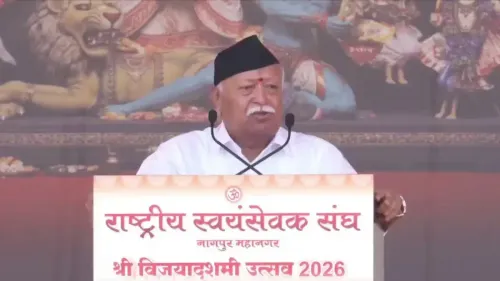
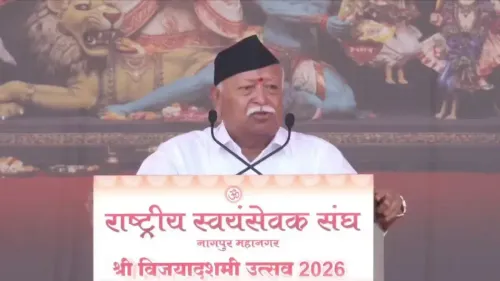
A warning from the top of the Rashtriya Swayamsevak Sangh is reverberating through India's political conversation — and BJP MP Anurag Thakur is amplifying it. On Tuesday, 20 October 2026, the Lok Sabha member from Hamirpur, Himachal Pradesh, shared his endorsement of RSS Sarsanghchalak Dr. Mohan Bhagwat's annual Vijayadashami address, calling it an 'inspiration for all of us' and flagging what he described as a deliberate strategy by 'certain foreign powers' to install compliant proxies in other countries under the banner of regime change.
Thakur's post, written in Hindi, states: 'Regime Change ke naam par kuch videshi taakaton dwara alag alag deshon mein apne swarth siddh karne wale pithhoo baithane ki jo neeti chal rahi hai, usse hum sabko savdhaan rehne ki zaroorat hai' — 'We must all stay alert to the policy, pursued by certain foreign powers, of installing self-serving proxies in different countries under the guise of Regime Change.' He described Dr. Bhagwat's Vijayadashami Utsav 2026 address as a source of inspiration for every Indian.
Bhagwat's Vijayadashami platform and what it carries
The RSS Vijayadashami address is one of the most-watched speeches in Indian public life. Delivered annually since the organisation's founding in 1925, the event marks the RSS's foundation day, and the Sarsanghchalak's remarks traditionally span domestic social concerns, national security, and geopolitical observations. Dr. Mohan Bhagwat, who has led the RSS since 2009, has used the platform before to raise concerns about external interference in India's neighbourhood and internal affairs. This year's address, according to Thakur's endorsement, squarely placed 'regime change' operations by foreign actors at the centre of the discourse.
India's sovereignty doctrine and the regime-change debate
The concern is not new to Indian foreign-policy thinking. India's foundational Panchsheel principles of 1954 — codified in its agreement with China and later adopted as a cornerstone of non-aligned diplomacy — explicitly enshrine sovereign equality and non-interference in the internal affairs of other states. Successive governments have invoked these principles when criticising external pressure on countries in South Asia, West Asia, and beyond.
What gives the warning fresh currency is a pattern visible across multiple regions: externally-backed political transitions, covert funding of civic movements, and economic leverage wielded to shift power in smaller or strategically located nations. Indian commentators across the political spectrum have, at different moments, cited these dynamics as a reason for India to guard its own strategic autonomy — a posture sometimes called 'multi-alignment.'
Thakur's amplification and its political weight
As a former Union Minister of Information and Broadcasting and Youth Affairs and Sports, Thakur carries institutional weight on questions of media, narrative, and national identity. His decision to specifically quote the Sarsanghchalak and frame the Vijayadashami address as 'inspiration' is a deliberate signal — one that ties the BJP's political messaging to the RSS's ideological framing on sovereignty. In Indian politics, such alignment between the parent organisation and its elected representatives on an issue as serious as foreign interference rarely goes unnoticed.
The message is pointed, the timing is deliberate, and the audience is unmistakably broad. When the chief of India's largest volunteer organisation speaks on regime change and a senior BJP parliamentarian immediately carries the message forward, the nation's foreign-policy establishment — and its adversaries — are expected to take note.
Point of View
Elected representatives carry it into the political mainstream. The 'regime change' framing slots neatly into India's long-standing strategic-autonomy doctrine, giving a nationalist edge to what is otherwise a widely-held concern across the Indian establishment. It also positions the BJP ahead of any parliamentary debate on foreign interference, pre-loading the narrative. Notably, the warning is kept deliberately non-specific — naming no country or operation — which maximises its rhetorical reach while minimising diplomatic friction.
NationPress
20 Oct 2026
Frequently Asked Questions
What did RSS chief Mohan Bhagwat say at Vijayadashami 2026?
The specific content of Dr. Mohan Bhagwat's Vijayadashami 2026 address has not been independently detailed in available public records, but BJP MP Anurag Thakur described it as an 'inspiration for all' and highlighted its warning about foreign powers installing proxies in other nations under the guise of regime change.
What is the RSS Vijayadashami address?
The RSS Vijayadashami address is an annual speech by the Sarsanghchalak, delivered on the occasion of the RSS's foundation day — the organisation was founded on Vijayadashami in 1925 . It traditionally covers national, social, and geopolitical themes and is closely watched across India's political and security establishment.
What does Anurag Thakur mean by 'regime change' foreign powers?
Thakur used the term to describe what he characterised as a deliberate strategy by certain foreign powers to install compliant, self-serving proxies in different countries by backing political transitions or movements, a concern he said all Indians need to be alert to.
What is India's official position on foreign interference and regime change?
India's foreign policy since the Panchsheel agreement of 1954 has been anchored in principles of sovereign equality and non-interference in the internal affairs of other states, forming the basis of its non-aligned and later multi-alignment doctrine.
Who is Anurag Thakur and why does his comment matter?
Anurag Thakur is a BJP Lok Sabha MP from Hamirpur, Himachal Pradesh , and a former Union Minister of Information and Broadcasting as well as Youth Affairs and Sports. His amplification of the RSS chief's remarks carries political weight as it ties senior BJP parliamentary voices to the RSS's ideological framing on sovereignty.