Tharoor Hails Kerala Budget for Long-Term Vision
Synopsis
Congress MP Dr. Shashi Tharoor on June 19, 2026, commended Kerala Chief Minister and Finance Minister V.D. Satheesan for a budget he said prioritises long-term economic transformation, calling the emphasis on future positioning deserving of recognition despite the state's fiscal constraints.
Key Takeaways
Shashi Tharoor , Congress MP from Thiruvananthapuram , publicly congratulated V.D.
Satheesan on the Kerala state budget on June 19, 2026 .
Tharoor praised the budget's emphasis on 'long-term economic transformation' even amid acknowledged fiscal constraints.
Kerala has historically balanced high welfare spending with infrastructure goals while managing significant debt and limited revenue sources.
Both Tharoor and Satheesan are members of the Indian National Congress , making this an expression of intra-party solidarity as well as policy endorsement.
The budget's real test will come during Kerala Legislative Assembly debates and implementation, where specific allocations will face detailed scrutiny.
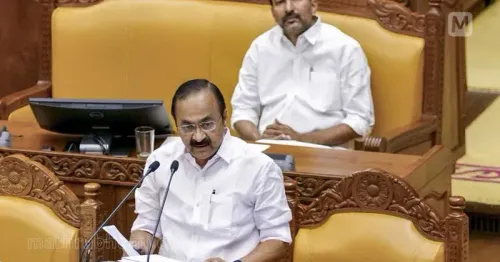
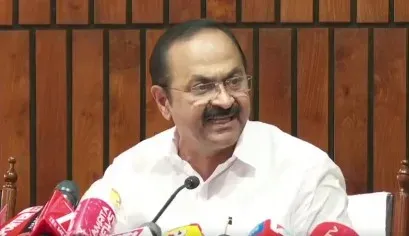
Congress MP Dr. Shashi Tharoor on Friday, June 19, 2026, congratulated V.D. Satheesan, who holds the portfolios of Chief Minister and Finance Minister, for presenting a Kerala state budget that he described as looking beyond immediate challenges to position the state for long-term economic transformation.
Context
Tharoor, the Congress MP from Thiruvananthapuram and a former Union Minister, praised the budget's forward-looking orientation even as Kerala continues to navigate well-documented fiscal constraints. In his post, he wrote that 'the emphasis on long-term economic transformation deserves recognition' — a notable commendation given the pressures the state faces on revenue and borrowing.
Kerala has historically balanced ambitious welfare spending with infrastructure investment across successive governments, earning high human development rankings while simultaneously carrying significant debt obligations and limited independent revenue sources.
Policy Backdrop
Indian state budgets routinely outline multi-year economic visions even when immediate fiscal space is constrained by central transfer formulas and borrowing ceilings set by the Finance Commission framework. Kerala in particular has faced recurring tensions between its social spending commitments and the limits imposed by central fiscal rules.
The state's economy has long depended on a combination of remittances from the Gulf diaspora, tourism, and traditional sectors — a dependence that successive administrations have sought to diversify. Budget proposals that signal structural diversification tend to draw cross-party acknowledgement when they align with shared development priorities, as Tharoor's statement illustrates.
Stakeholders and Impact
Kerala's roughly 3.5 crore residents stand as the primary stakeholders of any state budget, particularly those dependent on public services, welfare transfers, and infrastructure investment. The business community and investor ecosystem in the state will watch whether the long-term framing translates into concrete capital allocation in subsequent implementation phases.
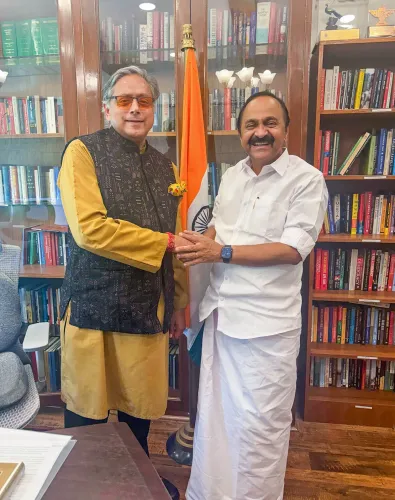
Tharoor's endorsement carries symbolic weight as a signal of intra-party solidarity, given that both he and Satheesan belong to the Indian National Congress. It also reflects a broader pattern in Indian politics where opposition or coalition figures occasionally offer measured praise when long-term economic framing transcends immediate partisan lines.
What's Next
Attention will now turn to the Kerala Legislative Assembly debates on budget implementation, where the specific allocations and schemes outlined will face scrutiny from both the ruling side and the opposition benches. Any mid-term revision to the fiscal strategy — driven by revenue shortfalls or changes in central transfers — will be a key marker of whether the long-term vision holds in practice.
For Dr. Tharoor, whose constituency of Thiruvananthapuram sits at the heart of Kerala's economic geography, the budget's execution on infrastructure and economic diversification will have direct implications for voters he represents in Parliament.
Point of View
A distinction that gives him political cover while reinforcing Congress solidarity ahead of any state-level electoral cycle. The acknowledgement of 'fiscal constraints' is significant: it implicitly surfaces Kerala's ongoing dispute with the Centre over borrowing limits and devolution, a grievance that both state and central Congress leaders have voiced in different forums. Cross-party or intra-party budget endorsements in India rarely emerge without a subtext, and here the subtext is a broader argument that state governments deserve more fiscal autonomy to pursue long-horizon economic planning. Whether the budget delivers on its stated ambition will ultimately determine whether this early endorsement strengthens or complicates Tharoor's political positioning in the state.
NationPress
18 Sept 2026
Frequently Asked Questions
What did Shashi Tharoor say about the Kerala budget 2026?
Dr. Shashi Tharoor congratulated V.D. Satheesan for presenting a Kerala budget that looks beyond immediate challenges, saying the emphasis on long-term economic transformation 'deserves recognition' even amid fiscal constraints.
Who is V.D. Satheesan?
V.D. Satheesan is a Congress MLA and serves as Chief Minister and Finance Minister of Kerala , according to Dr. Tharoor's post dated June 19, 2026 .
Why does Kerala face fiscal constraints?
Kerala faces fiscal constraints due to its high welfare and social spending commitments, significant state debt, limited independent revenue sources, and borrowing ceilings tied to central government fiscal rules.
Is Shashi Tharoor from Kerala?
Yes, Dr. Shashi Tharoor is the Congress MP from Thiruvananthapuram , the capital of Kerala , and a former Union Minister and UN Under-Secretary-General.
What is Kerala's economy dependent on?
Kerala's economy has traditionally relied on Gulf remittances, tourism, and conventional sectors, and successive governments have sought to diversify beyond these through budget allocations targeting long-term structural change.