Tharoor Shares Imagined Nehru Letter to Modi Article
Synopsis
Congress MP Dr. Shashi Tharoor on June 14 shared a satirical article by A.J. Philip in Indian Currents that imagines Jawaharlal Nehru writing a letter to PM Narendra Modi, calling it thought-provoking and a must-read, reigniting debates over India's political legacy.
Key Takeaways
Shashi Tharoor shared the article on X on June 14, 2026 , calling it 'thought-provoking and occasionally amusing.' The piece, by senior journalist A.J.
Philip , uses a fictional letter from Jawaharlal Nehru to Narendra Modi as a literary device.
It was published in Indian Currents , a weekly socio-political magazine.
Imagined Nehru-to-later-leader dialogues are a recurring form in Indian public discourse, typically probing secularism, non-alignment, and institutional norms.
Tharoor's endorsement is expected to significantly expand the article's readership and may prompt responses from BJP spokespersons.
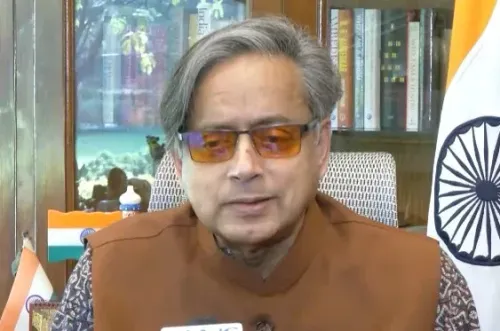
Congress MP Dr. Shashi Tharoor on Sunday, June 14, 2026, took to X to recommend a satirical opinion piece that imagines former Prime Minister Jawaharlal Nehru writing a letter to current Prime Minister Narendra Modi, calling it 'thought-provoking and occasionally amusing' and urging followers to read it.
Context
The article, authored by senior journalist and columnist A.J. Philip and published in the socio-political weekly Indian Currents, uses the fictional letter format as a literary device to juxtapose governance philosophies across two eras of Indian political leadership. Tharoor described it as a 'must read,' lending his considerable platform to the piece.
The Congress MP from Thiruvananthapuram, himself a prolific commentator on Indian history and statecraft, regularly amplifies writing that engages with questions of institutional legacy, secularism, and democratic norms — themes central to the imagined Nehru-to-Modi correspondence.
Policy Backdrop
Imagined dialogues between Nehru and later leaders have a long tradition in Indian public discourse, surfacing most often during periods of intense contestation over national icons and the direction of the republic. Such literary exercises typically probe questions of continuity or rupture across domains including secularism, non-alignment, economic planning, and the health of democratic institutions.
The Nehru legacy remains one of the most fiercely debated subjects in contemporary Indian politics. The BJP-led government under Modi has frequently sought to reframe the post-independence historical narrative, while the Indian National Congress has positioned itself as the custodian of Nehruvian values. Pieces like Philip's intervene directly in this ongoing argument.
Stakeholders and Impact
Tharoor's endorsement is likely to widen the readership of the Indian Currents article significantly, given his large following on social media and his reputation as a bridge between academic and popular political commentary. Political commentators, historians, and engaged citizens invested in debates about India's founding ideals form the primary audience.
The post is also likely to draw responses from BJP spokespersons, who have in the past pushed back sharply against what they characterise as Congress-aligned revisionism of the Modi government's record, as well as from Congress leaders who may use the article to reinforce their own messaging on institutional integrity.
What's Next
With Parliament in session and the political climate charged around questions of legacy and governance, the article is likely to circulate widely in political circles over the coming days. Follow-up commentary, rebuttals, or social media threads from leaders across party lines could extend the conversation well beyond its literary origins, turning a satirical column into a flashpoint for a broader debate about India's democratic inheritance and the competing visions its major parties hold for the republic's future.
Point of View
Using literary form to make a political argument without directly authoring it. The fictional-letter genre allows Congress-aligned voices to invoke Nehru's authority while maintaining a veneer of intellectual detachment. For the BJP, any such piece is an opportunity to reframe the narrative around what they call 'Nehru worship.' The episode illustrates how India's historical debates are increasingly prosecuted through social media endorsements as much as through formal political speech.
NationPress
13 Sept 2026
Frequently Asked Questions
What article did Shashi Tharoor share on June 14 2026?
Tharoor shared a satirical opinion piece by journalist A.J. Philip, published in Indian Currents, that imagines India's first Prime Minister Jawaharlal Nehru writing a letter to current Prime Minister Narendra Modi.
What is Indian Currents magazine?
Indian Currents is a weekly socio-political magazine that publishes commentary and analysis on Indian public affairs. It is the outlet that carried Philip's imagined Nehru-to-Modi letter.
Why do Indian commentators write imagined letters from Nehru?
The fictional-dialogue format is a long-standing tradition in Indian public discourse used to contrast Nehru-era values — secularism, non-alignment, economic planning — with present-day governance, especially during periods of intense political contestation over national icons.
What is Shashi Tharoor's political background?
Dr. Shashi Tharoor is a Congress MP from Thiruvananthapuram, a former Union Minister, and a former UN Under-Secretary-General. He is widely known for his commentary on Indian history, foreign policy, and democratic institutions.