Tharoor invokes 'purvapaksha' after Bharat Summit visa row backlash
Synopsis
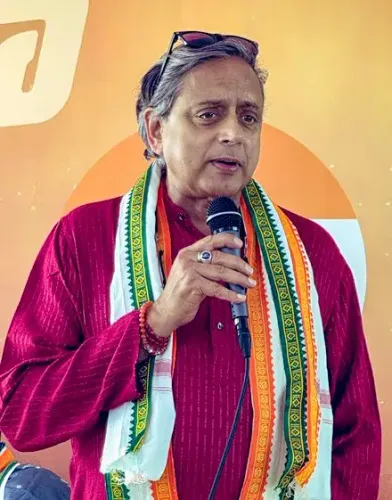
Congress MP Dr. Shashi Tharoor hit back at 'vicious' online critics who attacked his tweet on Bharat Summit visa denials, invoking the classical Hindu concepts of 'samvad' and 'purvapaksha' to argue that shutting down debate betrays the very civilisation Hindutva claims to defend.
Key Takeaways
Tharoor described the response to his tweet on #BharatSummit visa denials as 'vicious,' prompting a public philosophical rebuttal.
He invoked purvapaksha — the classical Indian practice of mastering an opponent's argument before refuting it — as a foundational Hindu intellectual tradition.
Tharoor argued that samvad (dialogue) is central to Hindu civilisation, and that rejecting it contradicts Hindutva's own cultural claims.
He cited the principle 'I disagree with what you say, but I will always defend your right to say it' as a cornerstone of any healthy political culture.
This intervention is consistent with Tharoor's long-standing public positioning, developed in his 2018 book Why I Am a Hindu , of pluralistic Hindu thought against majoritarian rhetoric.
The Bharat Summit visa denials that sparked the original tweet remain a potential flashpoint for parliamentary scrutiny.
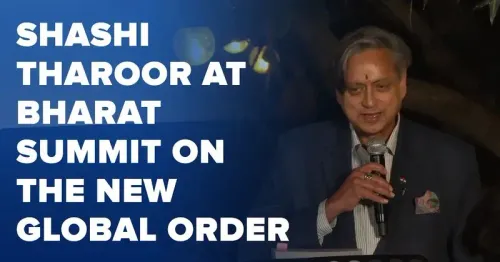
A philosopher-politician's defence of free speech collided with a storm of online outrage on Saturday, 14 November 2026, when Congress MP Dr. Shashi Tharoor pushed back hard against critics who flooded his timeline after he raised concerns about visa denials linked to the #BharatSummit.
Tharoor said he was 'taken aback by the viciousness' of the responses, and turned the moment into a pointed lesson in Hindu philosophical tradition. He invoked two classical Sanskrit concepts — samvad (dialogue) and purvapaksha (the rigorous practice of fully understanding and restating an opponent's argument before refuting it) — to challenge what he called 'so-called votaries of Hindutva.' His argument: the very civilisation they claim to defend was built on structured, open intellectual contest, not the silencing of dissent.
What 'purvapaksha' actually demands
The tradition Tharoor references is not rhetorical decoration. Purvapaksha, central to classical Indian philosophical debate, requires a debater to first present the opposing view in its strongest possible form before dismantling it — a standard of intellectual rigour that many modern Western academic traditions have only recently codified. Tharoor developed this argument at length in his 2018 book Why I Am a Hindu, where he positioned samvad and pluralistic inquiry as the bedrock of Hindu civilisational identity, distinct from the majoritarian political project he associates with the BJP. By invoking it here, he is doing something precise: he is not merely defending the speakers denied visas for the BharatSummit. He is arguing that the act of refusing to hear a contrary argument is itself a betrayal of Hindu tradition — a pointed inversion of the Hindutva critics' own framing.Tharoor's free-speech principle and its critics
The Thiruvananthapuram MP closed with a quote that carries unmistakable Voltairean resonance: 'I disagree with what you say, but I will always defend your right to say it.' It is a liberal democratic principle that sits in productive tension with the question of who, in practice, gets to decide which voices are granted a platform — or a visa. That tension is precisely what his original tweet on the #BharatSummit visa denials appears to have opened up. Tharoor's repeated use of social media to contrast a pluralistic reading of Hindu thought with majoritarian political rhetoric is a consistent strategic posture, not a one-off intervention. The viciousness he reports receiving is equally consistent: these exchanges have become a reliable flashpoint, with each cycle sharpening the battle lines between his vision of a debating, dialogic Hindu civilisation and his critics' demand for cultural and political solidarity over intellectual openness. Whether the specific visa denials at the heart of this dispute escalate into a parliamentary question or a wider public debate over cultural gatekeeping will be the next pressure point to watch.Point of View
He denies his critics the ability to frame open debate as an anti-Hindu position. This posture — developed systematically since his 2018 book — represents a liberal-pluralist counter-narrative to Hindutva's claim to sole ownership of Hindu identity. The visa-denial angle adds a concrete, policy-adjacent grievance that could elevate what might otherwise be a social-media skirmish into a question about the state's role in cultural gatekeeping. How the ruling establishment responds — or chooses not to — will reveal how much political cost it currently attaches to being seen as restricting intellectual exchange.
NationPress
14 Nov 2026
Frequently Asked Questions
What is 'purvapaksha' and why is Tharoor talking about it?
'Purvapaksha' is a classical Indian philosophical practice that requires a debater to fully understand and accurately restate an opponent's argument before attempting to refute it. Tharoor invoked it to argue that dismissing contrary views violates the intellectual traditions at the heart of Hindu civilisation.
What is the Bharat Summit visa controversy Tharoor mentioned?
Tharoor's original tweet, which triggered the backlash he is responding to, raised concerns about visa denials linked to the Bharat Summit. Specific details of the summit and those denied visas have not been officially confirmed.
What did Tharoor say about Hindutva in his post?
Tharoor challenged 'so-called votaries of Hindutva,' arguing that their hostility to open debate contradicts the very Hindu civilisational traditions — particularly 'samvad' (dialogue) and 'purvapaksha' — they claim to represent.
Has Tharoor written about Hindu philosophy before?
Yes. In his 2018 book 'Why I Am a Hindu,' Tharoor explored Hindu traditions of pluralism, dialogue, and intellectual debate, arguing they represent a fundamentally different vision of Hinduism from majoritarian political rhetoric.
What free-speech principle did Tharoor quote in his tweet?
Tharoor cited the principle 'I disagree with what you say, but I will always defend your right to say it,' framing it as a fundamental requirement of any healthy political culture and implicitly criticising his online attackers for abandoning it.