Tharoor quizzed by Ambassadors on global order, UN chief race
Synopsis
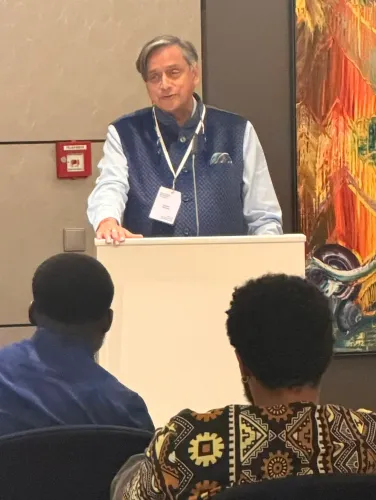
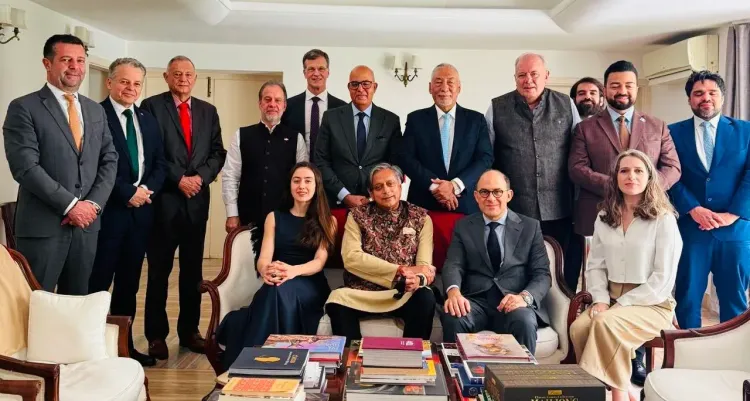
Congress MP Dr. Shashi Tharoor joined Argentine Ambassador Mariano Caucino and a dozen envoys in New Delhi for a wide-ranging diplomatic discussion on the global order and the upcoming UN Secretary-General election, drawing on his tenure as UN Under-Secretary-General.
Key Takeaways
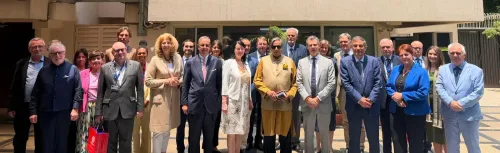
Shashi Tharoor attended a lunch hosted by Argentine Ambassador Mariano Caucino at his New Delhi residence on 22 August 2026 .
Around a dozen ambassadors accredited to India were present and quizzed Tharoor on his views.
Topics ranged from the state of the global order to the election of the next UN Secretary-General .
Tharoor served as UN Under-Secretary-General from 2002 to 2007 and contested the 2006 Secretary-General race , giving him rare institutional credibility on UN leadership questions.
The UN Secretary-General selection process is expected to be a live diplomatic issue through 2026 .
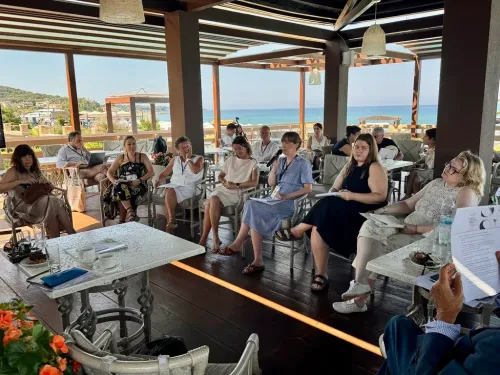
Over lunch at the Argentine Ambassador's residence in New Delhi, Congress MP Dr. Shashi Tharoor found himself at the centre of a rare diplomatic salon — a dozen ambassadors to India pressing him for his read on a world in flux, from the fracturing of the global order to the race for the next United Nations Secretary-General.
Tharoor shared the exchange on Saturday, 22 August 2026, noting the discussion ranged widely before the post trails off — a characteristic half-sentence that leaves the punchline to the imagination. The host, Argentine Ambassador Mariano Caucino, convened the gathering at his official residence, drawing envoys from across the diplomatic community accredited to India.
Why Tharoor is the room's go-to voice on the UN
The invitation is not incidental. Tharoor served as UN Under-Secretary-General for Communications and Public Information from 2002 to 2007, and famously contested the 2006 race for UN Secretary-General, finishing second to Ban Ki-moon in Security Council straw polls. Few sitting Indian parliamentarians carry that kind of institutional memory of Turtle Bay's inner workings.
That biography makes him a natural interlocutor for ambassadors navigating the next leadership transition at the United Nations, a process expected to gather momentum through 2026 as the global diplomatic community begins canvassing candidates to succeed the incumbent Secretary-General.
Informal salons, serious stakes
Ambassador gatherings of this kind — off-the-record, residential, deliberately small — are a well-worn feature of New Delhi's diplomatic circuit. They allow envoys to take the temperature of Indian political figures in a setting where candour is possible. A former senior UN official who also sits on the Parliamentary Standing Committee on External Affairs is precisely the kind of interlocutor ambassadors seek out when the agenda is multilateral architecture, not bilateral trade.
The breadth of the agenda Tharoor describes — 'the state of global order' to UN leadership — signals the gathering was less a courtesy lunch and more a working session on the shape of the post-2025 international system, at a moment when multilateral institutions face sustained pressure from great-power competition.
Tharoor's fluency in both the political and the procedural dimensions of UN affairs keeps him in demand as a commentator and interlocutor — a role he clearly relishes, even when the conversation runs long past the dessert course.
Point of View
Away from formal parliamentary or ministry channels. The fact that the UN leadership transition is already drawing this level of diplomatic traffic in mid-2026 signals that the race is becoming a live variable in New Delhi's foreign-policy calculus.
NationPress
6 Oct 2026
Frequently Asked Questions
Why did ambassadors invite Shashi Tharoor to discuss the UN Secretary-General election?
Tharoor served as UN Under-Secretary-General from 2002 to 2007 and contested the 2006 Secretary-General race, making him one of the few Indian politicians with direct experience of UN leadership dynamics.
Who is Mariano Caucino?
Mariano Caucino is Argentina's Ambassador to India and hosted the diplomatic lunch at his New Delhi residence where Tharoor spoke with around a dozen envoys.
When is the next UN Secretary-General elected?
The UN Secretary-General selection process is expected to gather momentum through 2026, as the diplomatic community begins canvassing candidates to succeed the incumbent.
What is Shashi Tharoor's background with the United Nations?
Tharoor served as UN Under-Secretary-General for Communications and Public Information from 2002 to 2007 and finished second to Ban Ki-moon in Security Council straw polls during the 2006 leadership race.
What did Shashi Tharoor discuss at the Argentine Ambassador's lunch?
Tharoor discussed his views on the current state of the global order and the election of the next UN Secretary-General with around a dozen ambassadors to India.