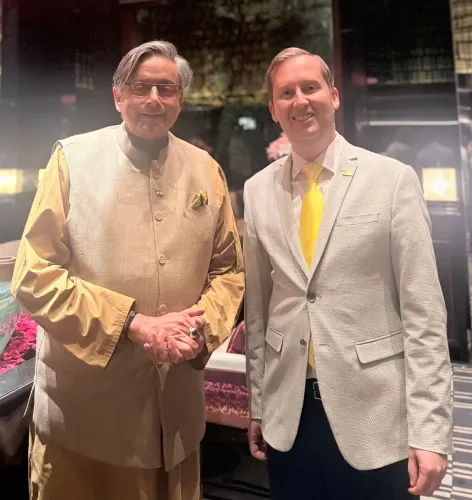
Tharoor Meets India's Nepal Envoy Naveen Srivastava
Synopsis
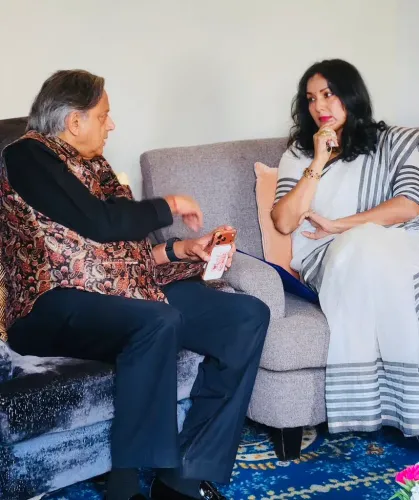
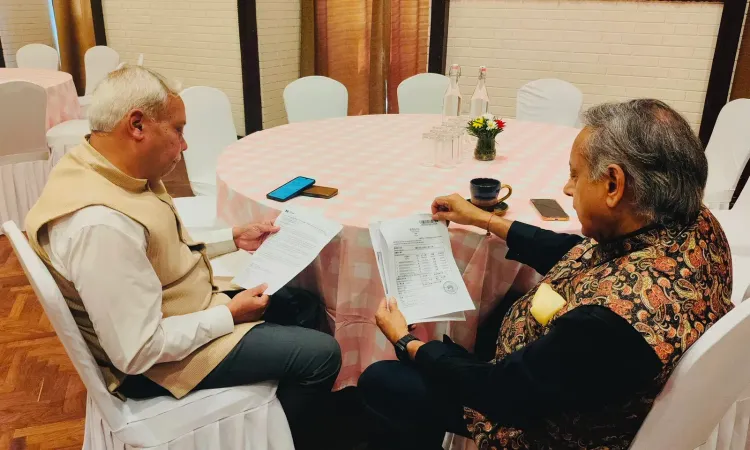
Congress MP Dr. Shashi Tharoor met India's Ambassador to Nepal, Naveen Srivastava, calling the exchange 'excellent and constructive' and crediting Srivastava's four-year Kathmandu posting for sharpening his read on the bilateral relationship. The meeting underscores parliament's role in staying informed on neighbourhood diplomacy.
Key Takeaways
Shashi Tharoor held a meeting with India's Ambassador to Nepal, Naveen Srivastava .
Tharoor described the meeting as 'excellent and constructive,' specifically valuing Srivastava's insights shaped by four years of service in Kathmandu .
Nepal remains a strategic priority for India, sharing an open border and governed by the foundational 1950 Treaty of Peace and Friendship .
The meeting reflects a broader practice of Indian parliamentarians — across parties — engaging serving ambassadors for independent foreign-policy briefings.
Tharoor, a former UN Under-Secretary-General and ex-Union Minister, has a long track record of engaging on neighbourhood and foreign-policy issues.
A four-year posting gives an ambassador a rare depth of reading on a bilateral relationship — and Congress MP Dr. Shashi Tharoor made a point of tapping exactly that knowledge when he sat down with India's Ambassador to Nepal, Naveen Srivastava, for what he described as an 'excellent and constructive' meeting.
Tharoor noted that Srivastava's insights into the state of India-Nepal bilateral relations are 'informed through four years of service in Kathmandu' — a tenure that spans diplomatic friction, post-pandemic recovery, and the ongoing recalibration of one of South Asia's most consequential neighbourhoods.
Why the India-Nepal Relationship Demands Attention
Nepal is not a routine bilateral file. The two countries share an open border, deep cultural and civilisational ties, and a foundational framework in the 1950 Treaty of Peace and Friendship — a document that has been both celebrated as a symbol of special ties and contested as an unequal inheritance. Geography alone makes Nepal central to India's neighbourhood-first policy: it sits between India and China, making every shift in Kathmandu's alignments a matter of strategic consequence in New Delhi. For an opposition parliamentarian like Tharoor — a former UN Under-Secretary-General and ex-Union Minister with deep foreign-policy credentials — meeting a serving ambassador is a way to stay close to ground truth on neighbourhood affairs, independent of what the government chooses to brief parliament.Parliamentarians, Ambassadors, and the Continuity of Diplomacy
Such exchanges are a quiet but important feature of Indian democratic practice. Ambassadors brief lawmakers across the aisle, ensuring that foreign-policy knowledge does not become the exclusive property of the ruling party. It is a form of institutional continuity — the kind that keeps parliamentary debate on external affairs grounded in fact rather than rhetoric. Tharoor, who represents Thiruvananthapuram in the Lok Sabha and chairs or participates in parliamentary committees touching on external affairs, has made such engagements a consistent part of his legislative work. The meeting adds to a pattern worth watching: as India-Nepal ties navigate complex terrain — from hydropower cooperation to border management to the evolving geopolitics of the Himalayan neighbourhood — the quality of information flowing to parliament matters. An envoy with four years on the ground in Kathmandu is among the sharpest lenses available.Point of View
Sitting as it does between India and China, means such informal knowledge-gathering by senior lawmakers carries real weight. For Tharoor specifically, it reinforces his positioning as the Congress party's most credible voice on international affairs at a time when the opposition is sharpening its critique of the government's neighbourhood-first record. The emphasis on Srivastava's four-year tenure signals that depth of field — not just access — is what Tharoor is seeking.
NationPress
28 Aug 2026
Frequently Asked Questions
Who is Naveen Srivastava, India's Ambassador to Nepal?
Naveen Srivastava is India's Ambassador to Nepal, based in Kathmandu, with approximately four years of service in that posting according to Dr. Shashi Tharoor's account of their meeting.
Why did Shashi Tharoor meet the Indian Ambassador to Nepal?
Tharoor met Ambassador Naveen Srivastava to gain informed insights into the state of India-Nepal bilateral relations, describing the exchange as 'excellent and constructive.'
What is the 1950 Treaty of Peace and Friendship between India and Nepal?
The 1950 Treaty of Peace and Friendship is the foundational agreement governing India-Nepal relations, establishing the framework for their open border, free movement of people, and special bilateral ties — though it has also been a subject of periodic debate in Nepal.
Can Indian opposition MPs meet serving ambassadors for briefings?
Yes. Indian parliamentarians across party lines regularly meet serving ambassadors as part of their legislative and committee responsibilities, ensuring foreign-policy knowledge is not confined to the ruling government.
What is Shashi Tharoor's background in foreign policy?
Dr. Shashi Tharoor is a Congress MP from Thiruvananthapuram, a former Union Minister, and a former UN Under-Secretary-General, giving him one of the most extensive foreign-policy backgrounds in the Indian parliament.