Tharoor Raises Hard Questions on Democracy and Street Protests
Synopsis
Congress MP Dr. Shashi Tharoor responded on October 7 to a piece by journalist Varghese K. George with incisive questions about whether abandoning democratic institutions for street protest can actually rescue an 'endangered democracy,' and whether the state will respond to such pressure at all.
Key Takeaways
Shashi Tharoor posted on October 7, 2026 in response to a piece shared by journalist Varghese K.
Tharoor called the piece 'extremely thought-provoking' and 'far-reaching in its implications.' He raised direct questions about whether mass protests can substitute for Parliament and elections in a democracy under stress.
He questioned whether the state has shown any 'spasm of conscience' that would make street pressure effective.
His post tagged @INCIndia , signalling the questions are directed at the party's broader strategic conversation.
The questions challenge both the ruling establishment and those within the opposition who have embraced an 'extraordinary politics' framing.
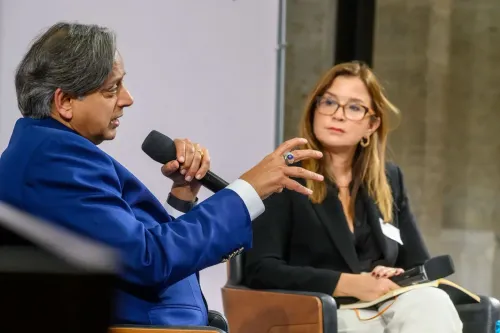
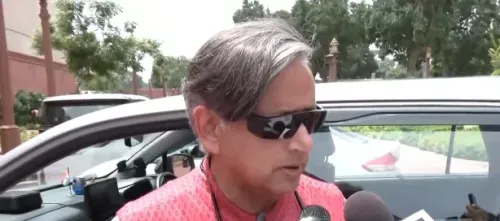
When a senior Congress MP starts asking whether saving democracy might require abandoning its own institutions, the question cuts to the bone of India's current political moment. Congress MP Dr. Shashi Tharoor, on Wednesday, October 7, 2026, responded to a piece shared by journalist Varghese K. George with a volley of pointed, uncomfortable questions about the limits of protest politics and the health of Indian democracy.
Tharoor called the piece 'extremely thought-provoking' and 'far-reaching in its implications,' before turning its logic back on itself with a sharp series of questions: 'If ordinary politics is no longer possible, then what are the options? Indefinite mass protests? What happens to Parliament? And elections?' The questions were not rhetorical decoration — they were a structured challenge to a growing strand of political thinking that frames conventional democratic participation as insufficient or exhausted.
The 'Ordinary Politics Is Dead' Argument — and Its Risks
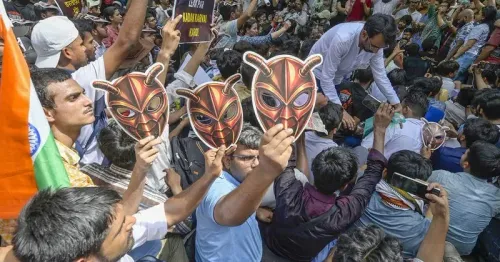
The framing Tharoor is engaging with — that routine electoral and parliamentary politics can no longer deliver accountability — has gained traction in several democracies under stress. The argument holds that when institutions are captured, elections are distorted, and legislatures become rubber stamps, citizens must turn to the street. But Tharoor's pushback is precise: the street is not a substitute for a ballot box, and the logic of 'extraordinary' action carries its own dangers.
His most pointed question lands here: 'Can we save our endangered democracy by abandoning its procedures and institutions for the street?' It is a question that cuts both ways — a challenge to those who have given up on institutions, but also an implicit indictment of the conditions that drove them there.
Tharoor's Warning: The State Has Shown No Spasm of Conscience
Tharoor did not spare the state either. He asked pointedly: 'Are we expecting the state to respond with a sudden spasm of conscience, of which it has not so far displayed any sign?' This is the skeptic's corner of the debate — the argument that street pressure works only if power is listening, and that a government comfortable with confrontation may simply wait out any protest movement.
The closing question — 'How does this extraordinary narrative end?' — is perhaps the most unresolved and the most important. It signals that Tharoor is not dismissing the urgency felt by those who believe ordinary politics has failed; he is demanding a credible theory of change from those who advocate going beyond it.
For a party like the Indian National Congress, which must simultaneously contest elections, hold space in Parliament, and respond to a restive base that feels democratic processes are stacked against them, these questions are not academic. They sit at the center of a strategic argument the opposition has not yet fully resolved — and Tharoor, with characteristic precision, has just put it on the record.
Point of View
And a strategic imperative to win through those very institutions. The reference to 'endangered democracy' without naming the government directly is a calibrated move — it legitimises the alarm without committing to a strategy of confrontation the party may not be ready to sustain. Whether this amounts to a principled defence of procedural democracy or a caution against overreach from his own side is a question Tharoor deliberately leaves open.
NationPress
7 Oct 2026
Frequently Asked Questions
What did Shashi Tharoor post about democracy and protests on October 7?
On October 7, 2026, Dr. Shashi Tharoor posted a series of sharp questions in response to a piece by journalist Varghese K. George, asking whether mass street protests can replace Parliament and elections if 'ordinary politics' is declared impossible, and whether the state can be expected to respond to such pressure.
Who is Varghese K. George and why did Tharoor respond to him?
Varghese K. George is an Indian journalist. Tharoor responded to a piece George shared that argued ordinary democratic politics may no longer be viable, describing it as 'extremely thought-provoking' before challenging its logic with a set of pointed questions about where such a narrative leads.
Is Shashi Tharoor supporting or opposing protests against the government?
Tharoor's post does not take a clear side — he neither endorses indefinite mass protests nor defends the current state of institutions. He raises strategic and philosophical questions about the efficacy and risks of abandoning democratic procedures for street action.
What does 'ordinary politics is no longer possible' mean in the Indian context?
The phrase refers to an argument gaining ground in some opposition and civil society circles that elections, Parliament, and legal channels have become insufficient or compromised as tools of accountability, making extra-institutional pressure — such as mass protests — a necessary response.
Why did Tharoor tag @INCIndia in his post about democracy?
By tagging the official Indian National Congress handle, Tharoor signalled that the questions he raised are relevant to the party's strategic debate — not just a personal observation — about how the opposition should frame and pursue its challenge to the ruling establishment.