CM Pema Khandu launches Viksit Arunachal @ 2047 vision drive
Synopsis
Arunachal Pradesh CM Pema Khandu has launched the Viksit Arunachal @ 2047 initiative, inviting citizens, CBOs, and NGOs to submit development ideas via viksitarunachal2047.in by 31 October 2026, framing the frontier state as central to India's centenary vision.
Key Takeaways
CM Pema Khandu has formally launched the Viksit Arunachal @ 2047 public consultation on 7 October 2026 .
Citizens, CBOs, and NGOs can submit ideas at viksitarunachal2047.in until 31 October 2026 .
Khandu cited a doubling of per capita income and significant gains in connectivity, schools, and healthcare over the past decade.
The vision targets a state where geography no longer determines opportunity and where development harmonises with environmental conservation.
The exercise is framed around Jan Bhagidari — citizen participation — as a core governance principle aligned with the national Viksit Bharat @ 2047 framework.
Arunachal Pradesh is positioned as a strategic frontier state , biodiversity custodian, and emerging green energy hub in the national vision.
With India's centenary of Independence as the horizon and Prime Minister Narendra Modi's Viksit Bharat framework as the compass, Arunachal Pradesh Chief Minister Pema Khandu has launched a public consultation to co-author the state's long-term development blueprint — inviting every citizen, village, tribe, CBO, and NGO to shape what he calls Viksit Arunachal @ 2047.
A frontier state's outsized role in a national vision
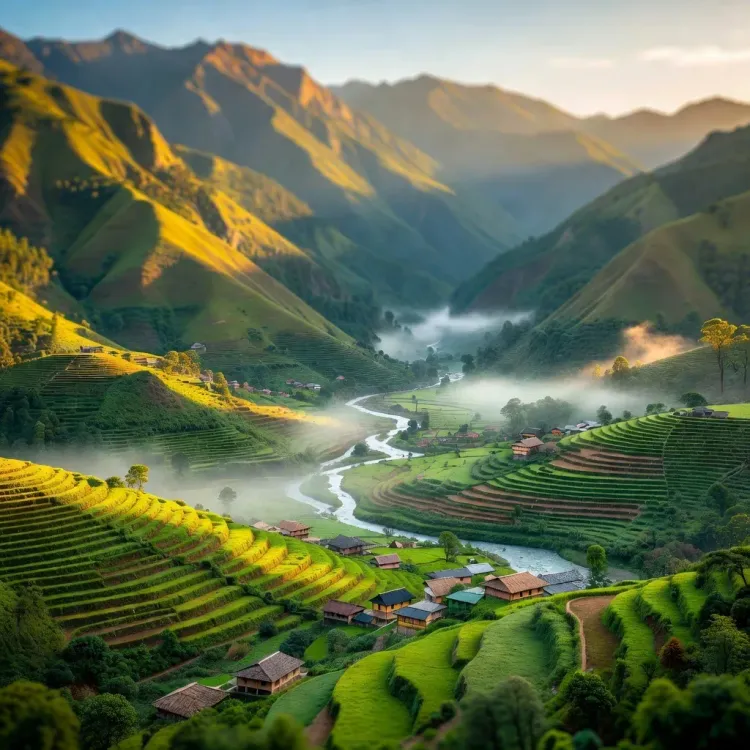
Khandu's post, shared on Wednesday, 7 October 2026, frames Arunachal Pradesh not merely as a beneficiary of national ambition but as a cornerstone of it. He highlights the state's triple identity — a strategically critical frontier, a custodian of some of the planet's richest biodiversity, and an emerging green energy hub — as the foundation of its unique contribution to Viksit Bharat. The 'land of the rising sun,' he argues, is uniquely positioned to lead, not follow.
The Chief Minister pointed to a decade of measurable gains: an economy that has 'grown many fold,' per capita income that has doubled, and steadily improving connectivity, schools, and healthcare. Crucially, he credited these gains not to government alone but to 'farmers, women, students and youth, teachers, health workers, entrepreneurs, elders, Community Based Organisations, civil servants and our institutions.'
What the Viksit Arunachal portal is asking citizens to do
The centrepiece of the announcement is a dedicated digital portal — viksitarunachal2047.in — through which citizens can submit ideas and suggestions until 31st October 2026. The deadline is tight, giving residents barely three and a half weeks to contribute. Khandu assured that 'each and every idea and suggestion will be examined and deliberated on' before the final vision document is sealed.
The aspiration articulated is sweeping: a state where geography no longer determines opportunity, every child is educated, every citizen is healthy, every young person carries a marketable skill, and every skill translates into economic empowerment. Alongside that human-capital vision sits an equally firm commitment to conservation — 'development that harmonises with conservation,' rooted in Arunachal's indigenous heritage and mountain-river ecology.
Jan Bhagidari as governance architecture
Khandu explicitly invokes Jan Bhagidari — people's participation — as the governing philosophy behind the exercise, echoing the broader BJP-led Central government's framing for citizen-state co-creation. The move signals that Itanagar intends to build political ownership into the vision document from the ground up, making it harder for any future government to dismiss the roadmap as a top-down bureaucratic exercise.
The consultation model also carries a practical hedge: a crowd-sourced mandate reduces dependence on any single policy technocrat's assumptions about a state that spans dramatic geographical, ethnic, and linguistic diversity — from the high-altitude Tawang region to the plains of Namsai.
The clock is running. Arunachal Pradesh's citizens have until 31 October 2026 to write the first draft of their own future — and Khandu is betting that this time, the vision document will carry the fingerprints of the people it is meant to serve.
Point of View
Packaging a top-down ideological goal as grassroots co-creation. For a state with acute geographical fragmentation and over 26 major tribes, a publicly owned mandate could provide critical policy legitimacy that a cabinet-drafted document simply cannot. The green energy and biodiversity framing is equally strategic — Arunachal's hydropower and ecological assets are increasingly contested in diplomatic and federal contexts, and embedding them in a people's vision document builds domestic political capital around those resources. Whether the portal consultation translates into a genuinely binding policy architecture, or remains a participatory veneer over a pre-written blueprint, will be the real test.
NationPress
7 Oct 2026
Frequently Asked Questions
What is Viksit Arunachal @ 2047?
Viksit Arunachal @ 2047 is a long-term development vision initiative launched by Arunachal Pradesh Chief Minister Pema Khandu, aimed at building a prosperous, self-reliant, and environmentally sustainable state by India's centenary of Independence in 2047, aligned with PM Modi's Viksit Bharat framework.
How can citizens contribute to the Viksit Arunachal 2047 vision document?
Citizens, CBOs, and NGOs can submit their ideas and suggestions through the dedicated portal at viksitarunachal2047.in. The deadline for submissions is 31 October 2026, after which the inputs will be deliberated upon to finalise the vision document.
What progress has Arunachal Pradesh made in the last decade according to CM Khandu?
CM Khandu stated that Arunachal Pradesh's economy has grown 'many fold,' per capita income has doubled, connectivity has significantly improved, and schools, healthcare systems, and enterprises have been steadily strengthened over the past decade.
Why is Arunachal Pradesh described as strategically important for Viksit Bharat?
Arunachal Pradesh is a frontier state bordering China with significant strategic importance, home to some of India's richest biodiversity, an emerging green energy hub, and host to diverse indigenous communities — factors that give it a unique role in India's national development vision.
What does Jan Bhagidari mean in the context of this initiative?
Jan Bhagidari means 'people's participation.' CM Khandu has invoked it as the governing philosophy of the Viksit Arunachal @ 2047 consultation, emphasising that every citizen's voice — from every village, town, and tribe — should form an integral part of the state's governance and development model.