Tharoor raises plight of 6,500 landowners in Lok Sabha
Synopsis
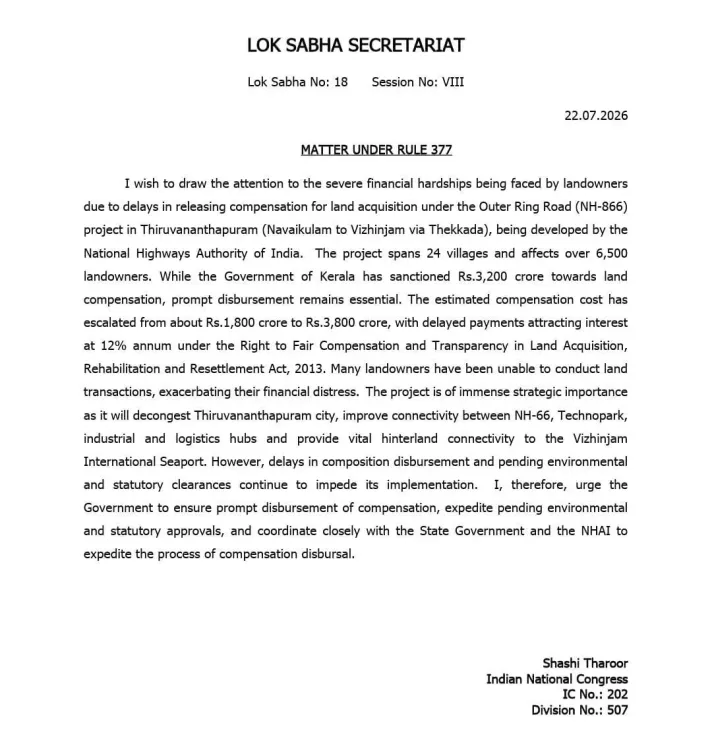
Congress MP Dr. Shashi Tharoor raised the delayed compensation of over 6,500 landowners under the NH-866 Outer Ring Road project in Thiruvananthapuram through a Rule 377 submission in the Lok Sabha on 23 July 2026, putting pressure on the Ministry of Road Transport and Highways to respond.
Key Takeaways
Shashi Tharoor filed a Rule 377 submission in the Lok Sabha on 23 July 2026 , formally recorded in the House.
The submission highlights the plight of over 6,500 landowners awaiting compensation under the Outer Ring Road (NH-866) project in Thiruvananthapuram .
The NH-866 project is intended to ease traffic congestion in Thiruvananthapuram , Kerala 's capital city.
Land acquisition compensation is governed by the Right to Fair Compensation and Transparency in Land Acquisition, Rehabilitation and Resettlement Act, 2013 .
Compensation delays in highway projects are a recurring national issue, compounded in Kerala by high population density and fragmented land holdings.
The Ministry of Road Transport and Highways is now expected to respond to the parliamentary submission.
Congress MP Dr. Shashi Tharoor raised the issue of delayed land acquisition compensation under the Outer Ring Road (NH-866) project in Thiruvananthapuram in the Lok Sabha on Wednesday, 23 July 2026, filing a submission under Rule 377 that was laid on the Table of the House.
Context
In his Rule 377 submission, Dr. Tharoor drew attention to the plight of 'over 6,500 landowners' who are awaiting compensation under the NH-866 Outer Ring Road project, a proposed bypass and ring road infrastructure initiative designed to ease chronic traffic congestion in Thiruvananthapuram, the capital city of Kerala. Rule 377 of Lok Sabha procedure allows members to raise matters of urgent public importance that cannot be raised through other procedural avenues, and submissions made under it are formally recorded in the House.
Dr. Tharoor, who has represented Thiruvananthapuram as a Member of Parliament since 2009, has consistently used parliamentary mechanisms to flag constituency-level infrastructure and governance concerns. The NH-866 project, while widely acknowledged as critical for urban mobility in the city, has been accompanied by unresolved compensation claims from affected landowners.
Policy Backdrop
Land acquisition compensation in India is governed by the Right to Fair Compensation and Transparency in Land Acquisition, Rehabilitation and Resettlement Act, 2013, which replaced the colonial-era Land Acquisition Act of 1894. The 2013 law mandates time-bound compensation, rehabilitation, and resettlement for all landowners displaced by public projects, including national highway development.
Delays in disbursing such compensation have been a recurring problem in highway and ring-road projects across Indian states. These delays reflect a structural tension between the pace of accelerated highway construction under programmes such as Bharatmala and the procedural safeguards enshrined in the 2013 Act. Kerala's urban projects face additional complications owing to high population density and fragmented land holdings, making acquisition and compensation processes more complex than in less densely populated states.
Stakeholders and Impact
The most immediate stakeholders are the 6,500-plus landowners whose properties have been acquired or are in the process of acquisition for the NH-866 corridor. Prolonged delays in compensation can leave families without either their land or the financial resources to resettle, often forcing them into litigation or protest.
Residents of Thiruvananthapuram at large also have a stake in the project's timely completion: the Outer Ring Road is intended to divert heavy traffic away from the city's congested interior roads, improving daily commutes and reducing pollution. Stalled compensation proceedings risk delaying construction timelines, deferring those broader civic benefits.
What's Next
The submission now formally places the matter on the parliamentary record, creating an obligation for the Ministry of Road Transport and Highways to respond to the concerns raised. Observers will watch for a ministerial statement or written reply addressing the status of pending compensation claims under the NH-866 project.
The issue could also surface during a Public Accounts Committee review of National Highways Authority of India (NHAI) projects, or during the next Lok Sabha session if compensation disbursals remain stalled. Dr. Tharoor's intervention signals that the matter is likely to remain under parliamentary scrutiny until affected landowners receive their due settlements.
Point of View
The gap between acquisition and disbursement has become a political flashpoint in land-scarce states like Kerala. Whether the intervention produces a concrete ministerial timeline or remains a paper record will test the practical effectiveness of Rule 377 as a redressal tool.
NationPress
24 Jul 2026
Frequently Asked Questions
What is Rule 377 in the Lok Sabha?
Rule 377 allows Lok Sabha members to raise matters of urgent public importance that cannot be addressed through other procedures; submissions are laid on the Table of the House and formally recorded, creating a basis for ministerial response.
What is the NH-866 Outer Ring Road project in Thiruvananthapuram?
NH-866 is a proposed outer ring road and bypass project in Thiruvananthapuram, Kerala, designed to reduce urban traffic congestion and improve connectivity in the state capital.
Why are landowners still awaiting compensation under NH-866?
Delays in disbursing land acquisition compensation are a recurring issue in national highway projects across India, often caused by administrative bottlenecks, valuation disputes, and the procedural requirements under the Land Acquisition Act of 2013.
What law governs land acquisition compensation in India?
The Right to Fair Compensation and Transparency in Land Acquisition, Rehabilitation and Resettlement Act, 2013 governs compensation, rehabilitation, and resettlement for landowners displaced by public infrastructure projects.
What happens after a Rule 377 submission is made in Parliament?
Once a Rule 377 submission is laid on the Table of the House, it is formally on parliamentary record and the concerned ministry is expected to provide a written or oral response addressing the matter raised.