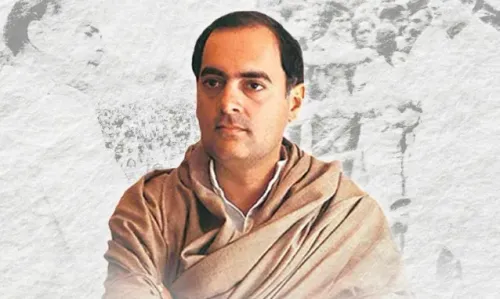
Tharoor Remembers Rajiv Gandhi as Architect of India's Tech Future

Synopsis
On Rajiv Gandhi's birth anniversary, Congress MP Dr. Shashi Tharoor hailed India's youngest PM as the architect of its tech future, citing the 1984 C-DOT telecom push and the 1986 Computer Software Policy as foundational legacies that preceded and enabled India's later economic rise.
Key Takeaways
Shashi Tharoor paid tribute to Rajiv Gandhi on his birth anniversary, August 20 , calling him the man who built India's bridge to the 21st century.
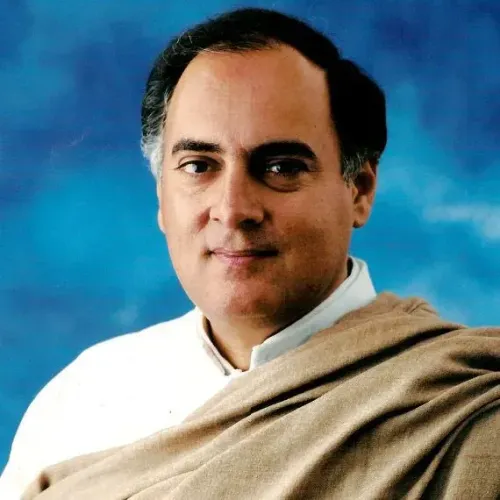
Rajiv Gandhi served as Prime Minister from 1984 to 1989 and remains India's youngest-ever PM, taking office at age 40 .
His government established C-DOT in 1984 to develop indigenous telecommunications technology at a time of severe infrastructure scarcity.
The Computer Software Policy of 1986 liberalised the IT sector and promoted exports, laying groundwork for India's later software industry boom.
Tharoor's tribute reflects the Congress party's consistent argument that Rajiv Gandhi's 1980s reforms were the intellectual foundation for the landmark 1991 liberalisation .
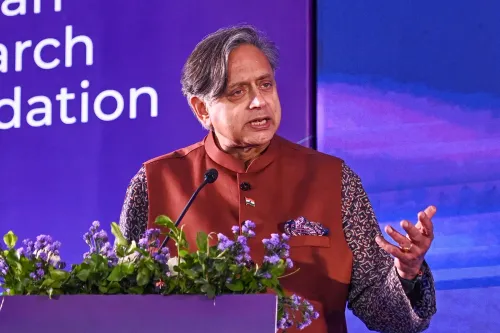
On what marks Rajiv Gandhi's birth anniversary, August 20, Congress MP Dr. Shashi Tharoor paid tribute to India's youngest Prime Minister, calling him the man who 'built India its bridge to the 21st century' — a leader whose brief tenure left a technological imprint the country is still living inside.
The Youngest PM Who Bet on Computers
Rajiv Gandhi served as Prime Minister from 1984 to 1989, stepping into office at 40 — the youngest person ever to hold the post. In an era when most Indian government offices still ran on typewriters and red tape, his administration made a deliberate, almost contrarian wager on technology as the engine of national transformation.
Tharoor's post names telecommunications, computers, and 'thinking about the future' as the principal legacies of that tenure — and the record backs him up. C-DOT (Centre for Development of Telematics) was established in 1984, tasked with building indigenous telecom technology at a time when India had fewer telephone connections than Manhattan. The Computer Software Policy of 1986 opened the sector to liberalisation and actively promoted IT exports — a quiet policy move whose downstream effects would eventually produce the Bengaluru software boom of the 1990s and beyond.
A Foundation Laid Before 1991
The standard story of India's economic transformation begins with the 1991 liberalisation. But Tharoor's tribute — and the Congress party's recurring political argument — is that the intellectual and institutional groundwork was laid a full decade earlier, under Rajiv Gandhi's watch. The argument carries weight: without the software export framework of 1986 and the telecom infrastructure push of the mid-1980s, the 1991 reforms would have had far thinner soil to grow in.
It is a framing that fits a broader pattern. Congress leaders have consistently used Rajiv Gandhi's anniversaries to anchor the party's identity as the force that first oriented India toward the digital future — a claim that carries particular resonance in parliamentary debates on digital infrastructure, where the lineage of policy choices matters.
Tharoor's Place in That Lineage
Few Congress voices carry this argument with more personal credibility than Dr. Tharoor, himself a former UN Under-Secretary-General and a writer whose books have engaged directly with questions of technology, governance, and India's place in the modern world. His tribute is not a routine party post — it is a reminder, from someone who thinks in decades, that consequential leadership is often only legible in hindsight.
As India's digital economy now ranks among the world's largest, the anniversary offers a moment to trace the line back to a Prime Minister who, in Tharoor's words, was 'hugely inspiring, and consequential' — even if history has sometimes buried that chapter beneath louder events.
The bridge Rajiv Gandhi began building in the 1980s is the one India is still crossing.
Point of View
He pushes back against narratives that date India's tech transformation exclusively to 1991 or later. The framing positions Rajiv Gandhi not as a tragic figure cut short, but as a visionary whose institutional choices compounded over decades. For Congress, keeping this lineage visible is an ongoing argument about which party has the longer and deeper claim to India's modernisation.
NationPress
20 Aug 2026
Frequently Asked Questions
Why is Rajiv Gandhi remembered on August 20?
August 20 is Rajiv Gandhi's birth anniversary . He was born on this date and the day is observed by the Congress party and his supporters as a moment to recall his contributions to India's development.
What did Rajiv Gandhi do for technology in India?
Rajiv Gandhi's government established C-DOT in 1984 to build indigenous telecom infrastructure and introduced the Computer Software Policy of 1986 , which liberalised the IT sector and promoted software exports — policies widely credited with seeding India's later tech industry.
Why does Shashi Tharoor call Rajiv Gandhi India's youngest Prime Minister?
Rajiv Gandhi became Prime Minister in 1984 at the age of 40 , making him the youngest person ever to hold the office in India's history — a distinction Tharoor highlights to underscore the scale of his ambition at a young age.
What is C-DOT and why does it matter?
C-DOT (Centre for Development of Telematics) was set up in 1984 under Rajiv Gandhi to develop affordable, locally built telephone exchange technology. It is considered a turning point in India's effort to expand telecom access beyond urban elites.
How does the 1986 Computer Software Policy connect to India's IT boom?
The 1986 Computer Software Policy removed import restrictions on hardware used for software exports and created a framework for IT companies to operate more freely. Analysts and historians credit it as an early structural enabler of the Bengaluru-led software export industry that scaled through the 1990s.