Tharoor Sets Record Straight on MPLADS Fund Utilisation

Synopsis
Congress MP Dr. Shashi Tharoor has rebutted viral Kerala media claims that MPs received ₹25 crore under MPLADS and left most unspent, explaining that the scheme allocates ₹5 crore annually, funds are held by the government, and spending is controlled by the District Collector — not the MP.
Key Takeaways
Shashi Tharoor rebutted viral Kerala media claims that MPs received ₹25 crore under MPLADS and spent less than a quarter of it.
Under MPLADS, each MP is entitled to recommend projects worth ₹5 crore per year — not a lump-sum of ₹25 crore — and the funds are held by the government, not the MP.
Actual spending, contractor selection, and disbursement are controlled by the District Collector through government tenders, not by the MP.
Tharoor stated that ₹10 crore allotted to him since the current term began has been fully utilised at the recommendation stage, with Administrative Sanction already granted.
MPLADS was launched in December 1993 and has a long history of generating public perception gaps because its multi-stage approval design separates recommendation from execution.
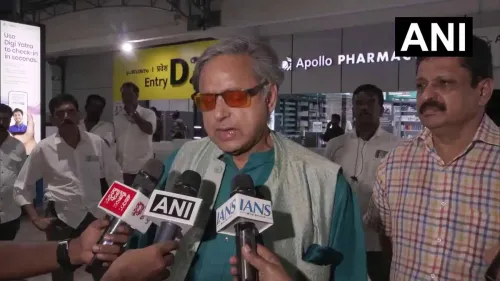
A viral claim in Kerala's media ecosystem — that MPs are sitting on mountains of unspent public money — has drawn a sharp, detailed rebuttal from Congress MP Dr. Shashi Tharoor, who represents Thiruvananthapuram and took to X on Friday, August 14, 2026, to dismantle what he called a 'fundamentally incorrect' narrative circulating through news stories and memes.
What the viral claim got wrong about MPLADS
The circulating stories alleged that every MP had received ₹25 crore for public works and spent less than a quarter of it. Tharoor called this wrong 'in every detail.' Under the Member of Parliament Local Area Development Scheme (MPLADS), an MP receives an entitlement of ₹5 crore per year — not a lump-sum of ₹25 crore — to recommend development projects across their constituency. The money never passes through the MP's hands.
The funds are held by the government and released only after administrative and technical sanction is granted by the District Collector. The MP's role ends at recommending which projects to support. Execution, contractor selection — done through government tenders — and actual disbursement are all functions of district administration, not the elected representative.
Tharoor's own MPLADS record since the current term
On his personal position, Tharoor stated that a total of ₹10 crore has been allotted to him since the start of the current term, and that these funds have been fully utilised at the recommendation stage. Administrative Sanction has been accorded by the District Collector. The actual spending, he emphasised, 'is not in my hands' — a structural reality of the scheme, not an exception.
A perception gap baked into MPLADS design since 1993
MPLADS was launched in December 1993 with an initial annual allocation of just ₹1 crore per MP, later revised upward to the current ₹5 crore. The scheme's architecture has always separated the MP's power to recommend from the government's power to execute — a deliberate design choice to prevent political interference in procurement and contracting.
That same design, however, routinely generates public confusion. When aggregate unspent balances are reported without explaining the multi-stage approval pipeline, the gap between 'allotted' and 'disbursed' looks like negligence. Tharoor's clarification is part of a recurring pattern: MPs across parties have had to explain this distinction whenever utilisation data surfaces without context.
The scheme falls under the Ministry of Statistics and Programme Implementation, which publishes annual utilisation reports — the primary official record against which any media claim should be benchmarked.
The real story here is not one MP's spending record — it is a scheme design that was built for accountability but keeps generating the opposite impression every time raw numbers travel faster than explanations.
Point of View
Designed to insulate procurement from political influence, has consistently generated perception gaps that opposition campaigns and social media exploit. For the ruling establishment, it is a reminder that governance transparency requires not just data release but active public education on how schemes actually function. The episode also signals that as the 2026 political cycle intensifies, MPLADS utilisation figures will remain a recurring flashpoint in constituency-level accountability debates.
NationPress
14 Aug 2026
Frequently Asked Questions
What is MPLADS and how much money does an MP get?
MPLADS — the Member of Parliament Local Area Development Scheme — entitles each MP to recommend development projects worth ₹5 crore per year in their constituency. The scheme was launched in December 1993 with an initial allocation of ₹1 crore, later revised upward.
Does an MP directly receive and spend MPLADS funds?
No. Under MPLADS, the funds are held by the government and released only after administrative and technical sanction by the District Collector . The MP can only recommend projects; execution, contractor selection, and disbursement are handled by district authorities through government tenders.
What did Shashi Tharoor say about his own MPLADS spending?
Tharoor stated that ₹10 crore has been allotted to him since the start of the current term and that these funds have been fully utilised at the recommendation stage, with Administrative Sanction already granted by the District Collector.
Why do reports often show large unspent MPLADS balances?
Because 'allotted' and 'disbursed' are two different stages. An MP can recommend and allot funds, but actual spending only happens after multi-stage government approvals — creating a gap that looks like unspent money when reported without context.
Which ministry oversees MPLADS in India?
MPLADS is administered by the Ministry of Statistics and Programme Implementation , which publishes annual utilisation reports tracking project recommendations and actual expenditure across all constituencies.