Tharoor Shares Banyan Tree Straddling Two Nations' Border
Synopsis
Congress MP Dr. Shashi Tharoor shared images of a banyan tree physically straddling an international border, observing that its branches spread shade equally across two countries — a natural metaphor for shared geography that resonates with South Asian border diplomacy and cultural continuity.
Key Takeaways
Shashi Tharoor , Congress MP from Thiruvananthapuram , posted images of a banyan tree straddling an international border on 27 June 2026 .
The tree's branches spread shade equally into two countries, as noted by Tharoor in his reply on X.
The specific border and countries involved were not identified in the post.
Tharoor is a former UN Under-Secretary-General and Union Minister of State for External Affairs known for commentary on international affairs.
Indian political figures have a recurring tradition of using natural metaphors to frame discussions on South Asian borders and shared heritage.
No official government or foreign ministry response has been recorded as of the time of posting.
Congress MP Dr. Shashi Tharoor on Saturday, 27 June 2026 shared a striking image on X of a banyan tree whose branches spread across an international border, offering shade simultaneously to two countries — a natural metaphor that quickly drew attention for its resonance with South Asian border diplomacy and shared heritage.
Context
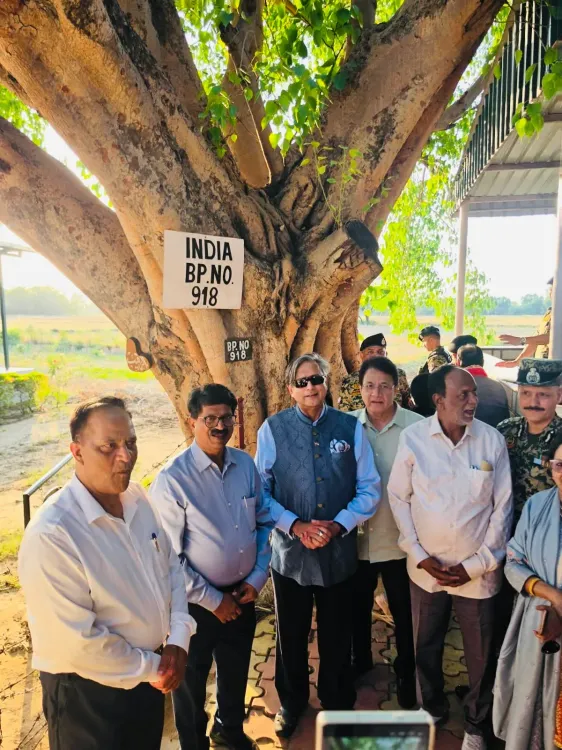
The post, a reply on X, features two images of a banyan tree that physically straddles an international boundary. Tharoor noted that the tree's 'branches equally spread their shade in two countries' — a quietly evocative observation about nature's indifference to political demarcations. The specific border and the countries involved have not been identified in the post.
Dr. Tharoor, who represents Thiruvananthapuram in the Lok Sabha and previously served as UN Under-Secretary-General and Union Minister of State for External Affairs, is known for weaving cultural and literary sensibility into his commentary on international affairs.
Policy Backdrop
Indian political figures have long employed natural metaphors when discussing borders with neighbouring states, particularly to underscore shared geography, ecology, and heritage alongside formal diplomatic processes. Rivers, mountains, and now trees have all served as rhetorical anchors in conversations about South Asian border management and people-to-people ties.
Banyan trees carry deep symbolic weight in the subcontinent — they are associated with shelter, continuity, and community, and appear prominently in both Indian and neighbouring countries' cultural traditions. A tree that literally bridges two sovereign territories distils that symbolism into a concrete, visual fact.
Stakeholders and Impact
Border communities on both sides of whichever boundary the tree straddles are the most immediate human stakeholders — people whose daily lives are shaped by the intersection of natural landscape and political geography. For them, such images are not metaphor but lived reality.
The post also speaks to a broader audience of foreign-policy watchers, environmentalists, and citizens interested in how India's relationships with its neighbours are framed in public discourse. Tharoor's reach on social media means the image and its implicit message circulate well beyond specialist circles.
What's Next
It remains to be seen whether the post prompts any formal response from relevant foreign ministries or surfaces in parliamentary discussions on border diplomacy. Tharoor's subsequent replies or clarifications — if any — may identify the specific border or the broader conversation that prompted the share.
More broadly, the post adds to a recurring pattern in Indian public discourse: the use of shared natural landmarks to assert that geography and culture do not end at the surveyor's line, even as formal diplomacy manages what does.
Point of View
With its deep subcontinental symbolism of shelter and rootedness, is a carefully chosen vehicle. Whether intentional or incidental, the post lands at a moment when border management remains a live issue across several of India's frontiers, giving the image a political charge beyond its aesthetic appeal.
NationPress
27 Jun 2026
Frequently Asked Questions
What did Shashi Tharoor post about a banyan tree?
Tharoor shared two images of a banyan tree that physically straddles an international border, noting that its branches spread shade equally across two countries. The post was made on 27 June 2026 as a reply on X.
Which border does the banyan tree in Tharoor's post straddle?
The specific border and the two countries involved were not identified in Tharoor's post. The research background also flags this detail as unverified.
Why is a banyan tree significant in the context of India's borders?
The banyan tree carries deep cultural symbolism in South Asia, representing shelter, continuity, and community. A tree that physically bridges two sovereign territories makes that symbolism tangible, which is why Indian political figures often use such natural imagery in border-diplomacy discourse.
What is Shashi Tharoor's background in foreign policy?
Dr. Shashi Tharoor is the Congress MP from Thiruvananthapuram. He previously served as UN Under-Secretary-General and as Union Minister of State for External Affairs, giving him substantial standing in foreign-policy commentary.
Has any government or foreign ministry responded to Tharoor's banyan tree post?
No official response from any foreign ministry or government body has been recorded in connection with this post as of the time of publication.