CM Dhami: 4.89 Lakh Women Empowered via Uttarakhand SHGs
Synopsis
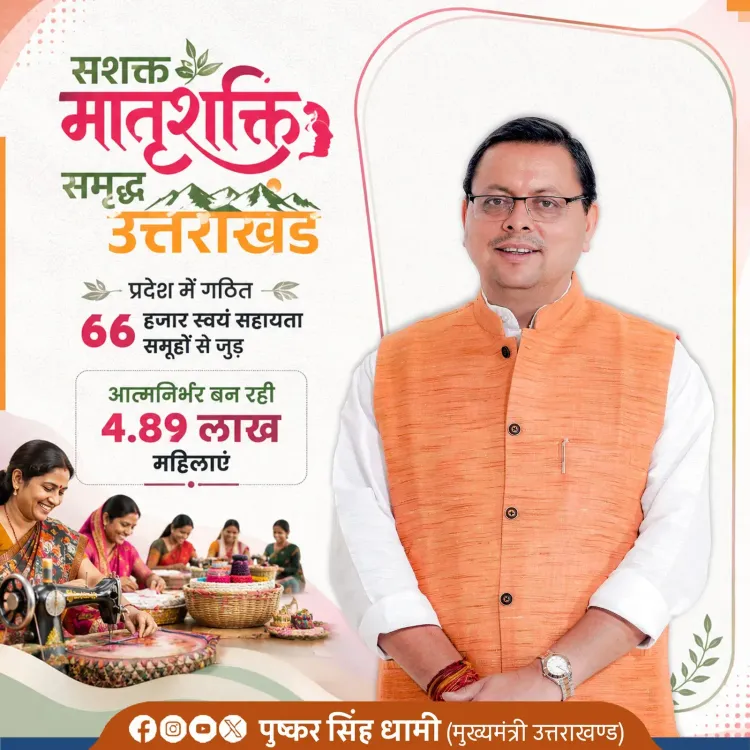
Uttarakhand CM Pushkar Singh Dhami announced on 27 June 2026 that 4.89 lakh women across 66,000 Self Help Groups in the state are actively contributing to the Atmanirbhar Bharat vision through self-employment and livelihood initiatives backed by the state government.
Key Takeaways
4.89 lakh women in Uttarakhand are enrolled in 66,000 Self Help Groups (SHGs) as of June 2026.
CM Pushkar Singh Dhami described women's economic and social empowerment as the 'highest priority' of his government.
SHGs are being used to connect women to self-employment, microcredit, and livelihood opportunities across the state.
The initiative is framed as part of the national Atmanirbhar Bharat programme launched in 2020 .
The policy lineage traces back to the National Rural Livelihoods Mission (2011) , expanded as DAY-NRLM in 2015 .
Uttarakhand's SHG model integrates with the state's key sectors including tourism and horticulture.
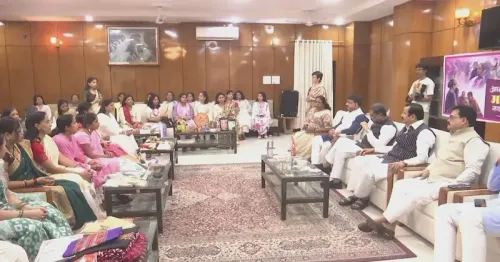
Uttarakhand Chief Minister Pushkar Singh Dhami on Saturday, 27 June 2026 highlighted his government's commitment to the economic and social empowerment of women, stating that 4.89 lakh women across the state are now active members of 66,000 Self Help Groups (SHGs), contributing to the national vision of Atmanirbhar Bharat (self-reliant India).
Context
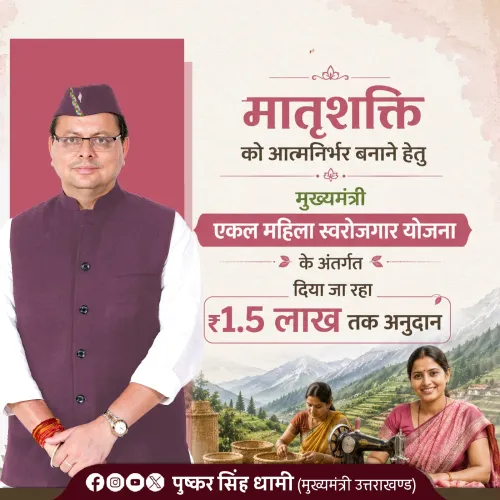
In his post, CM Dhami wrote that his government is working with 'highest priority' on the economic and social empowerment of matrishakti (women). He stated that women are being empowered by connecting them to self-employment, livelihood, and self-reliance through Self Help Groups. The post underscores that 4.89 lakh women linked to 66,000 SHGs in Uttarakhand are playing an 'important role in realising the resolve of Atmanirbhar Bharat.'
Policy Backdrop
The SHG model in India has its roots in the 1999 Swarnjayanti Gram Swarozgar Yojana, which was later restructured into the National Rural Livelihoods Mission (NRLM) in 2011. The mission was expanded as Deendayal Antyodaya Yojana-NRLM (DAY-NRLM) in 2015, with enhanced budgetary allocations and state-level convergence to promote women's self-employment and access to microcredit.
Uttarakhand's rural development strategy integrates SHG-based livelihood support with the state's key sectors, including tourism and horticulture. The Atmanirbhar Bharat programme, launched nationally in 2020, has provided a broader policy framework within which states like Uttarakhand present SHG achievements as contributions to household-level economic self-reliance.
Stakeholders and Impact
The primary beneficiaries are rural women across Uttarakhand, who gain access to pooled savings, microcredit, and small enterprise opportunities through SHG membership. For many women in the state's hilly and remote regions, SHGs serve as a critical first step toward formal financial inclusion and independent income generation.
At the policy level, the figures cited by CM Dhami indicate the scale of the state government's outreach under the DAY-NRLM framework. Successful SHG mobilisation also has downstream effects on children's education and household nutrition, as women's financial agency within families tends to improve spending on social goods.
What's Next
Uttarakhand's next state budget presentation will be a key moment to watch for SHG-linked financial allocations and any upward revision of targets. The state's engagement with the Ministry of Rural Development on NRLM performance benchmarks will also signal how the government plans to scale or deepen the programme beyond the current 4.89 lakh women already enrolled.
As multiple BJP-governed states have used the SHG model to demonstrate progress on the Atmanirbhar Bharat agenda, Uttarakhand's approach may serve as a reference point in the broader national conversation on women-led rural economic development ahead of the next cycle of NRLM reviews.
Point of View
A pattern common across BJP-governed states seeking to demonstrate grassroots delivery of central policy goals. The SHG model is a decades-old, cross-party instrument, but its framing as a BJP-era achievement reflects a broader electoral communication strategy ahead of state and national review cycles. The scale cited — 4.89 lakh women across 66,000 groups — if sustained, would represent meaningful penetration of the DAY-NRLM framework in a state with significant rural and terrain-related access challenges. The announcement also signals that women's economic empowerment will remain a central plank of the Dhami government's public messaging through the next budget cycle.
NationPress
27 Jun 2026
Frequently Asked Questions
How many women are part of Self Help Groups in Uttarakhand?
According to CM Pushkar Singh Dhami's post on 27 June 2026, 4.89 lakh women are enrolled across 66,000 Self Help Groups in Uttarakhand.
What is the role of Self Help Groups in Uttarakhand?
Self Help Groups in Uttarakhand connect rural women to self-employment, microcredit, and livelihood opportunities under the DAY-NRLM framework, helping them achieve financial independence.
What is Atmanirbhar Bharat and how does it relate to SHGs?
Atmanirbhar Bharat is a national self-reliance programme launched in 2020 . SHG-based women's empowerment is presented by the Uttarakhand government as contributing to this goal by fostering household-level economic independence.
What has CM Dhami said about women's empowerment in Uttarakhand?
CM Pushkar Singh Dhami stated on 27 June 2026 that his government treats women's economic and social empowerment as its highest priority, with SHGs serving as the primary vehicle for self-reliance and livelihood generation.