Shashi Tharoor warns on China's border behaviour, calls for 'predictable' trade ties
Synopsis
Congress MP Shashi Tharoor has gone on record saying China supplied real-time satellite data to Pakistan during Operation Sindoor — a 'hostile act' — while simultaneously expanding its exports to India and cutting them off at will. His call for 'predictable relationships' captures a wider dilemma: New Delhi is deeply trade-dependent on a neighbour it fundamentally cannot trust.
Key Takeaways
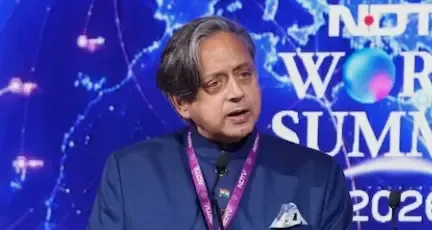
Congress MP Shashi Tharoor on 23 October warned about China's border behaviour and its 'overt support' to Pakistan during Operation Sindoor at the NDTV World Summit .
Tharoor alleged China provided real-time satellite data to Pakistan during the conflict, calling it 'a hostile act.' He described the India-China economic tie as 'interdependence without trust,' noting India's dependence on China is 'far greater' than vice versa.
China reportedly suspended exports of Rare Earths and large-size tunnel-boring machines — 100 per cent of which came from China — for a period, disrupting India's infrastructure projects.
Tharoor called for 'predictable relationships' where trade dependencies cannot be 'weaponised' against India.
Remarks came amid a political row over ITBP chief Shatrujeet Kapur's purported comments about a China face-off in Arunachal Pradesh .
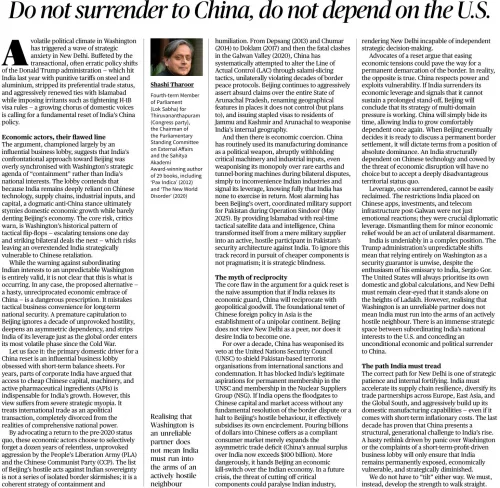
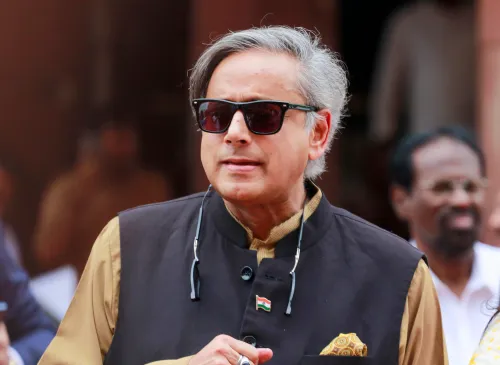
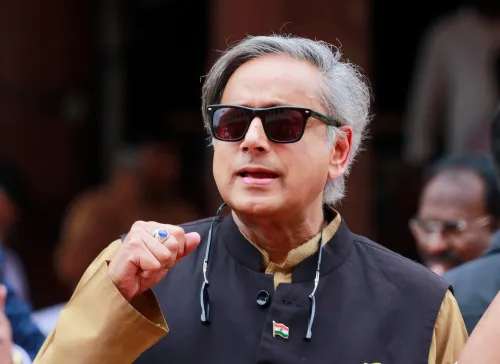
Congress MP Shashi Tharoor on Friday, 23 October sounded a sharp note of caution over China's conduct on India's borders and Beijing's overt support to Pakistan during Operation Sindoor, urging that bilateral trade relationships must never be 'weaponised' against New Delhi. Tharoor made the remarks at an interactive session at the NDTV World Summit, calling for 'predictable relationships' with China even as fresh tensions simmer over reported face-offs in Arunachal Pradesh.
Tharoor's Core Concerns on Border Behaviour
Tharoor did not mince words on China's recent conduct. 'The way in which China has behaved on our borders, the way in which they've nibbled away at our territory, their overt support for Pakistan during the brief conflict (Operation Sindoor) between our two countries last year is worrying,' he said.
Going further, he alleged that Beijing's involvement went beyond conventional arms supply during the conflict. 'China not only supplied a vast amount of weapons, which is their legal right to do, but also supplied real-time data while the conflict was going on from their satellite spot above our territory, which was actually a hostile act,' Tharoor added. The remarks came amid a political row triggered by Indo-Tibetan Border Police (ITBP) chief Shatrujeet Kapur's purported comments that the Army is successfully managing a 'face-off (with China) in Arunachal Pradesh.'
Interdependence Without Trust: The Trade Dilemma
Tharoor described the India-China economic relationship as one of 'interdependence without trust' — and suggested even that framing was generous. 'I can't even say interdependence because our dependence on China is far greater than theirs on us and yet can we trust them?' he questioned.
He recalled the Galwan Valley clash as one among several incidents where China 'unilaterally upended' longstanding bilateral understandings on border tranquillity. 'It was initially supposed to be in their interest that the border situation remains tranquil while they dramatically expanded their exports to us. The exports are still expanding and they're still giving us a rough time,' Tharoor noted. This comes amid a broader strategic concern in New Delhi that China may be using economic leverage as a coercive foreign policy tool.
China's Track Record of Turning Off Trade Taps
Tharoor pointed to concrete instances where China had weaponised trade dependencies. He cited Beijing's suspension of Rare Earth exports to India for 'a couple of years' and its decision to halt the supply of large-size tunnel-boring machines — 100 per cent of which were reportedly being sourced from China. 'We could no longer bore holes into hillsides and construct our highways and so on for a couple of years until they chose to turn the tap back on again,' he said.
The examples underscored a structural vulnerability that critics argue New Delhi has been slow to address despite years of warnings about single-source dependencies in critical infrastructure sectors.
The Call for Predictable Relationships
Despite his sharp critique, Tharoor stopped short of advocating economic decoupling, instead calling for guardrails. 'We need, as far as possible, predictable relationships. Relationships which won't be weaponised, and trade dependencies which won't be weaponised against us,' he said.
The remarks reflect a growing consensus within sections of the Indian political establishment — cutting across party lines — that the country must diversify supply chains and reduce strategic exposure to Chinese imports, particularly in sectors with national security implications. How that diversification unfolds, and at what pace, remains a live policy debate in New Delhi.
Point of View
But stringing them together as a pattern of deliberate weaponisation is a more aggressive framing than New Delhi usually tolerates publicly. The core contradiction he identifies — India's trade exposure to China growing even as the border remains contested — is the central strategic failure neither the current government nor its predecessors has resolved. Calling for 'predictable relationships' is sensible but sidesteps the harder question: predictability requires leverage, and India currently has little of it.
NationPress
23 Oct 2026
Frequently Asked Questions
What did Shashi Tharoor say about China and Operation Sindoor?
Tharoor alleged that China not only supplied weapons to Pakistan during Operation Sindoor but also provided real-time satellite data over Indian territory during the conflict, which he described as 'a hostile act.' He made these remarks at the NDTV World Summit on 23 October 2026.
Why does Tharoor describe India-China relations as 'interdependence without trust'?
Tharoor used the phrase to highlight that India's economic reliance on Chinese imports — including critical materials and machinery — is far greater than China's dependence on India, creating a structural vulnerability that Beijing has reportedly exploited by selectively cutting off exports.
What examples did Tharoor give of China 'weaponising' trade against India?
Tharoor cited two instances: China suspending Rare Earth exports to India for a couple of years, and halting the supply of large-size tunnel-boring machines, 100 per cent of which were sourced from China, stalling highway construction projects until Beijing reversed the decision.
What is the Arunachal Pradesh face-off that Tharoor's remarks are linked to?
Tharoor's comments came amid a political controversy over ITBP chief Shatrujeet Kapur's purported statement that the Indian Army is successfully dealing with a face-off with China in Arunachal Pradesh. The reported remarks have sparked debate about the current state of the India-China border.
What solution did Tharoor propose for India-China relations?
Tharoor called for 'predictable relationships' — bilateral ties where trade dependencies cannot be weaponised against either country. He stopped short of advocating full decoupling, instead urging structural guardrails to reduce India's strategic exposure to Chinese supply chains.