Tinsukia becomes Assam's 13th Surakshit District on HIV targets
Synopsis
Tinsukia has earned Assam's 13th 'Surakshit District' tag by achieving the UNAIDS 95-95-95 HIV targets through healthcare workers, NGOs, and community efforts. The state's district-by-district certification drive continues toward an HIV-free Assam by 2030.
Key Takeaways
Tinsukia is now Assam's 13th 'Surakshit District' after meeting the UNAIDS 95-95-95 HIV targets .
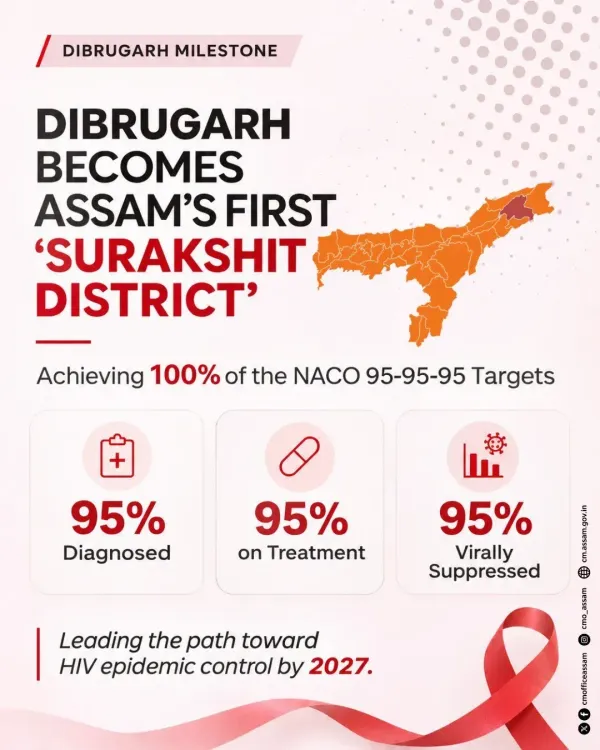
The targets require 95% of people with HIV to know their status, 95% on treatment, and 95% achieving viral suppression.
Achievement was credited to coordinated efforts among healthcare workers, NGOs, and local communities in Tinsukia.
Assam's approach mirrors India's National AIDS Control Programme , which has been operational since 1992 .
The state has committed to sustaining certification gains and pressing toward an HIV-free Assam aligned with the UNAIDS 2030 goal.
One district at a time, Assam is quietly rewriting its public health story. Tinsukia has become the state's 13th 'Surakshit District' after meeting the globally benchmarked 95-95-95 HIV targets — a milestone the Chief Minister's Office of Assam announced on Tuesday, 17 November 2026, crediting the coordinated push by healthcare workers, NGOs, and local communities.
What the 95-95-95 benchmark actually demands
The 95-95-95 framework was set by UNAIDS as the global standard for HIV epidemic control: 95% of people living with HIV must know their status, 95% of those diagnosed must be on sustained antiretroviral treatment, and 95% of those on treatment must achieve viral suppression. Hitting all three cascades simultaneously is a high bar — it demands not just testing drives but functional supply chains, consistent follow-up, and community trust that keeps patients in care long enough to suppress the virus.
Clearing that bar at the district level, in a geographically complex, border-adjacent part of eastern Assam, is a meaningful operational achievement — not a paperwork exercise.
Tinsukia's place in Assam's district-by-district map
Tinsukia, situated in the far east of Assam near the borders with Arunachal Pradesh and Nagaland, joins 12 other districts that have already earned the 'Surakshit District' designation under the Assam government's structured rollout. The northeastern region has historically required targeted HIV interventions — specific vulnerability patterns linked to migration, border trade, and historically limited healthcare access made blanket national strategies insufficient on their own. The state leaned heavily on NGOs and community health workers to bridge those gaps, and Tinsukia's certification reflects that model delivering results.
From certification to an HIV-free Assam
Achieving 'Surakshit' status is the beginning of a harder phase, not the finish line. The CMO's statement was explicit on this: 'The State remains committed to sustaining this progress and moving steadily towards an HIV-free Assam.' Public health experts consistently flag that districts can slip back below the 95-95-95 thresholds if community outreach retreats and routine testing drops off — a pattern seen globally after initial scale-up success.
Assam's district-by-district certification approach mirrors India's National AIDS Control Programme (NACP), which has run successive phases since 1992 to expand testing and treatment nationally. The goal of ending AIDS as a public health threat by 2030 — aligned with the UNAIDS global roadmap — now depends on states converting district-level wins into sustained, system-wide performance. With 13 of Assam's districts now certified, the pressure — and the template — is squarely on the remaining districts to follow.
Point of View
Verifiable public health milestones. Tinsukia's achievement is politically significant for the state government because it delivers a tangible, globally benchmarked outcome — not just spending or coverage numbers. The harder test, however, is the maintenance phase: retaining 'Surakshit' status requires sustained funding and community engagement after the certification spotlight fades. With the 2030 UNAIDS deadline now less than four years away, how quickly Assam can certify its remaining districts will determine whether the state's HIV-free ambition becomes a model for other northeastern states or stalls at two-thirds completion.
NationPress
17 Nov 2026
Frequently Asked Questions
What is a 'Surakshit District' in Assam?
A 'Surakshit District' is an Assam government designation for districts that have met the UNAIDS 95-95-95 HIV targets — meaning 95% of people living with HIV know their status, 95% of those are on treatment, and 95% of those on treatment are virally suppressed.
What are the UNAIDS 95-95-95 HIV targets?
The UNAIDS 95-95-95 targets are global benchmarks that require 95% of people with HIV to know their status, 95% of diagnosed individuals to be on antiretroviral treatment, and 95% of those on treatment to achieve viral suppression — the gold standard for HIV epidemic control.
How many Surakshit Districts does Assam now have?
As of November 2026, Assam has 13 Surakshit Districts, with Tinsukia being the most recent to earn the designation.
Why does northeastern India need targeted HIV interventions?
Northeastern states like Assam face specific vulnerability patterns linked to migration, border trade routes, and historically limited healthcare infrastructure, making community-driven and NGO-partnered approaches essential alongside national programmes.
What is India's target for ending HIV?
India, in alignment with the UNAIDS global roadmap, aims to end AIDS as a public health threat by 2030. Assam's Surakshit District programme is part of that broader national push under the National AIDS Control Programme.