Tamil Nadu revamps Pongal 2027 dhotis and sarees: new colours, better fabric
Synopsis
Tamil Nadu's Pongal gift scheme gets its first major overhaul in over a decade — new fabric blends, a pre-washed dhoti, and a fresh green shade for sarees. With ₹642.88 crore on the line and ₹300 crore already released, the state is betting on quality and weaver welfare ahead of Pongal 2027.
Key Takeaways
The Tamil Nadu government has revamped its Pongal gift scheme for 2027 — the first major upgrade in over a decade.
Sarees will use an 80:20 polyester-cotton blend (up from 90:10); dhotis will use a 65:35 blend (up from 80:20).
Green has been added as a new saree colour alongside light blue, pink, and ivory white; dhotis will be supplied pre-washed for the first time.
Production targets remain at 177.64 lakh sarees and 177.22 lakh dhotis , unchanged from the past three years.
Total scheme cost is estimated at ₹642.88 crore ; ₹300 crore has already been released as the first instalment.
Unsold 2026 Pongal stock will be distributed to old-age pension beneficiaries during Deepavali 2025 .
The Tamil Nadu government has announced the first major overhaul of its annual Pongal gift scheme in over a decade, upgrading the fabric quality, durability, and colour range of the free dhotis and sarees to be distributed for Pongal 2027. The revamp, formalised through a Government Order issued by the Department of Handlooms and Khadi on 1 July, is expected to benefit both the millions of recipients and the state's cooperative handloom sector.
New Fabric Specifications
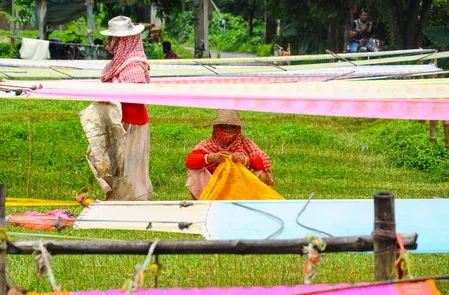
The redesigned sarees will be woven using improved 60s poly-cotton yarn with an 80:20 polyester-cotton ratio, replacing the earlier 90:10 blend. The higher cotton content is intended to make the garments more comfortable, particularly during summer. Sarees will retain their standard dimensions of 5.5 metres in length and 45 inches in width, and will feature silver or copper-coloured polyester borders. A new shade — green — has been added to the existing palette of light blue, pink, and ivory white.
The dhotis have also been upgraded: they will now use 40s grey poly-cotton yarn with a 65:35 polyester-cotton ratio, up from the earlier 80:20 mix. Each dhoti will measure two metres in length and 50 inches in width, feature coloured polyester borders, and — for the first time — will be supplied pre-washed.
Production Targets and Procurement
The production target for Pongal 2027 has been retained at 177.64 lakh sarees and 177.22 lakh dhotis, unchanged from the previous three years. District collectors had reportedly sought more than 2.27 crore sarees and 2.25 crore dhotis based on projected demand, but the government decided against scaling up production, citing limited time available to introduce the new designs.
Garments will be produced through handloom and powerloom weavers' cooperative societies. Co-optex and the Tamil Nadu Textile Corporation will procure the garments from these societies and supply them to the Tamil Nadu Civil Supplies Corporation for distribution. The government has also permitted yarn procurement through short-term tenders to ensure timely production.
Scheme Cost and Budget Allocation
The total cost of the Pongal 2027 scheme has been estimated at ₹642.88 crore. Of the ₹606.94 crore earmarked in the 2026-27 State Budget, the government has already released ₹300 crore as the first instalment to kick-start production. Officials noted that the early fund release would help ensure timely payments to weavers.
Handling Unsold Stock and Weaver Response
Unsold stock from the 2026 Pongal scheme will be distributed to old-age pension beneficiaries during Deepavali this year, with remaining stock directed toward other government purposes. Handloom weavers in Salem welcomed the initiative, saying the redesigned garments would improve overall appeal and that the early release of funds would benefit both producers and the public receiving the Pongal gift package.
This comes amid a broader state push to revitalise cooperative weaving societies, with officials saying the improved specifications would also increase yarn production in cooperative spinning mills and streamline manufacturing. All eyes are now on whether the upgraded scheme can be executed within the compressed production timeline ahead of Pongal 2027.
Point of View
But the quality of the garments has rarely kept pace with the scale of the promise. This upgrade — the first in over a decade — is notable less for the fabric tweak and more for what it signals: the state is trying to convert a welfare handout into a handloom revival lever. The decision to retain production targets despite district-level demand projections running nearly 28% higher, however, points to a persistent gap between political ambition and supply-chain capacity. Whether cooperative weaving societies can absorb the new specifications and still meet the Pongal 2027 deadline is the real test — and the compressed timeline leaves little room for error.
NationPress
7 Jul 2026
Frequently Asked Questions
What changes has Tamil Nadu made to the Pongal 2027 free sarees and dhotis?
Tamil Nadu has upgraded the fabric blend of both garments — sarees now use an 80:20 polyester-cotton ratio (up from 90:10) and dhotis use a 65:35 blend (up from 80:20). Sarees will be available in a new green shade, and dhotis will be supplied pre-washed for the first time.
What is the total cost of the Tamil Nadu Pongal 2027 gift scheme?
The total cost of the Pongal 2027 scheme has been estimated at ₹642.88 crore. Of the ₹606.94 crore budgeted for 2026-27, ₹300 crore has already been released as the first instalment to begin production.
How many sarees and dhotis will be produced for Pongal 2027?
The production target stands at 177.64 lakh sarees and 177.22 lakh dhotis, unchanged from the previous three years. District collectors had sought over 2.27 crore sarees and 2.25 crore dhotis, but the government retained the existing target citing limited time for the new designs.
Who will produce and distribute the Pongal 2027 garments?
Garments will be produced by handloom and powerloom weavers' cooperative societies. Co-optex and the Tamil Nadu Textile Corporation will procure them and supply to the Tamil Nadu Civil Supplies Corporation for distribution to beneficiaries.
What will happen to unsold stock from the 2026 Pongal scheme?
Unsold stock from the 2026 Pongal scheme will be distributed to old-age pension beneficiaries during Deepavali this year. Any remaining stock will be used for other government purposes.