Will TN conduct a hornbill population survey in key forests, including tiger reserves?
Synopsis
Discover the Tamil Nadu government's ambitious Hornbill Conservation Initiative aiming to assess the population of four hornbill species across major forest landscapes. This survey, pivotal for long-term conservation, emphasizes the ecological importance of hornbills and their habitats. Join the journey towards safeguarding these vital species and their environment.
Key Takeaways
The population survey aims to assess four hornbill species.
It will focus on key habitats in Tamil Nadu's tiger reserves.
The timing coincides with the hornbill breeding season for accurate data collection.
Training programs for forest staff enhance conservation efforts.
Hornbills play a vital role in seed dispersal and forest health.
Chennai, Dec 16 (NationPress) In alignment with the Tamil Nadu government’s Hornbill Conservation Initiative, which was initiated in March, the Forest Department is set to launch an extensive population survey targeting four distinct hornbill species across significant forest regions in the state.
This survey is slated to kick off by the end of December and is anticipated to wrap up by late March or the first week of April 2026, as stated by officials.
As per senior officials in the Forest Department, the initial phase of the survey will encompass all ranges within the three tiger reserves: Anamalai, Srivilliputhur-Megamalai, and Kalakkad-Mundathurai, in addition to the Karamadai and Mettupalayam forest ranges that fall under the Coimbatore forest division.
These specified areas have been deemed crucial for hornbill presence based on earlier observations and the suitability of the habitat.
The primary aim of the survey is to gauge the size and density of the hornbill population while establishing a scientific baseline for future conservation strategies.
The timing of this assessment coincides with the hornbill breeding season, which enhances detection rates. While most species finish breeding by April, the Great Hornbill may continue nesting until May.
In the next phase, similar surveys will be executed across various forest divisions in Tamil Nadu.
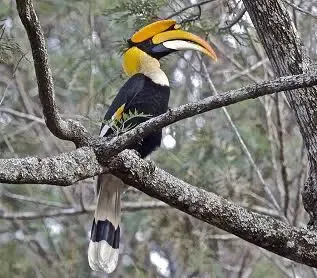
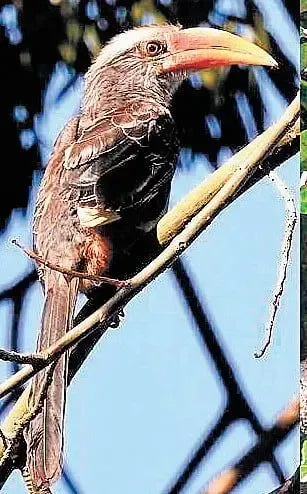
The identified regions host four hornbill species: the Great Hornbill, Malabar Grey Hornbill, Indian Grey Hornbill, and Malabar Pied Hornbill. This field survey will be conducted collaboratively by Forest Department personnel, biologists, and researchers utilizing the line transect method to cover several kilometers daily within the designated hornbill habitats.
Data will be collected through direct sightings and call identifications.
As a component of capacity building under the initiative, scientists from the Nature Conservation Foundation (NCF) have recently trained forest staff at Attakatty near Valparai. This training emphasized hornbill identification, recognizing nesting sites, and understanding their feeding ecology.
An NCF scientist highlighted that similar survey methods have previously yielded reliable outcomes in hornbill habitats within the Anamalai Tiger Reserve. Hornbills are known for their longevity, with smaller grey hornbills living up to 15-16 years, whereas the Great Hornbill can survive for nearly two decades. Being entirely frugivorous, they consume fruits from over 100 tree species native to the Western Ghats.
Often referred to as “feathered foresters,” hornbills are integral to seed dispersal and forest regeneration. Their reliance on large, hollow-bearing trees for nesting underscores the importance of mature forest preservation, a key focus of the state’s conservation efforts.
Point of View
The comprehensive survey of hornbill populations in Tamil Nadu is a significant step in wildlife conservation. It underscores the importance of ecological research and proactive measures in preserving biodiversity. As we face increasing environmental challenges, such initiatives exemplify the commitment needed to protect our natural heritage.
NationPress
30 Sept 2026
Frequently Asked Questions
What is the purpose of the hornbill population survey?
The survey aims to estimate the population size and density of hornbills and establish a scientific baseline for long-term conservation planning.
Which hornbill species are included in the survey?
The survey includes the Great Hornbill, Malabar Grey Hornbill, Indian Grey Hornbill, and Malabar Pied Hornbill.
When is the survey expected to start and finish?
The survey is scheduled to commence by the end of December and is expected to conclude by the end of March or in the first week of April 2026.
How will the data be collected during the survey?
Data will be collected through direct sightings and identification of hornbills by their calls.
Who is conducting the survey?
The field survey will be conducted collaboratively by Forest Department staff, biologists, and researchers.