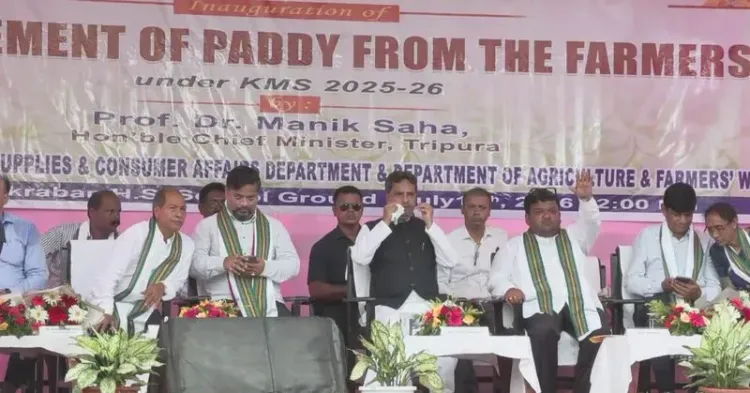
Tripura CMO inaugurates paddy procurement at Kakraban, Udaipur
Synopsis
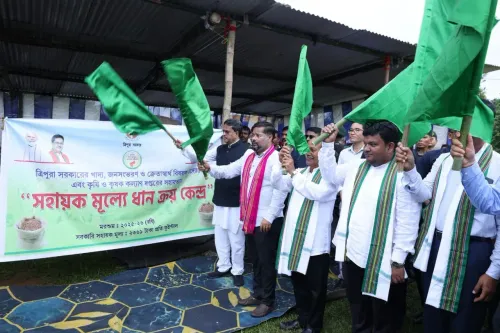
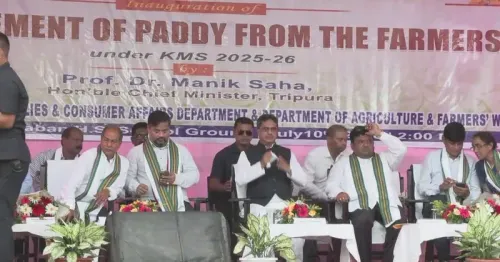
The Chief Minister's Office of Tripura inaugurated paddy procurement from farmers at Kakraban, Udaipur on 10 July 2026, opening the kharif-season MSP buying cycle in Gomati district and extending formal price support to local smallholders.
Key Takeaways
The Chief Minister's Office of Tripura announced the inauguration of paddy procurement at Kakraban, Udaipur on 10 July 2026 .
The procurement operates under the central Minimum Support Price (MSP) framework coordinated with the Food Corporation of India .
Udaipur subdivision in Gomati district is among Tripura's active agricultural zones, and Kakraban serves as a local collection point.
The move aims to protect paddy farmers from distress sales to private traders at below-MSP rates.
State agriculture authorities are expected to publish procurement targets and payment data as the kharif season unfolds.
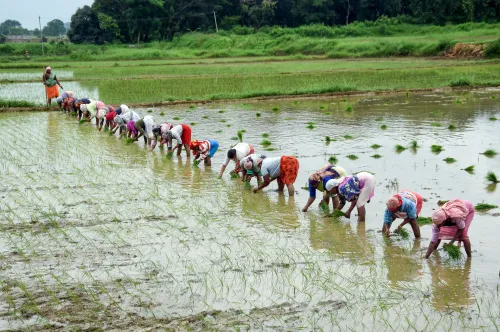
The Chief Minister's Office of Tripura announced on Friday, 10 July 2026, the inauguration of paddy procurement from farmers at Kakraban in Udaipur, marking the formal opening of the seasonal grain-buying operation in the Gomati district.
Context
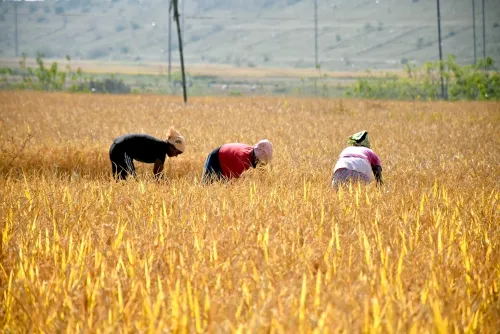
The inauguration signals the start of the kharif-season paddy procurement cycle in Udaipur subdivision, one of Tripura's agriculturally active zones. Kakraban, a village area within the subdivision, serves as a local collection point where farmers bring their harvest for formal purchase under the central Minimum Support Price framework.
Such inaugurations are typically presided over by senior state government representatives and mark the point at which farmers can begin presenting paddy at officially sanctioned procurement centres, shielding them from distress sales to private traders at below-MSP rates.
Policy Backdrop
Paddy procurement in Tripura operates under the national MSP mechanism coordinated by the Food Corporation of India (FCI), which has worked alongside the state since at least the early 2000s to bring Northeastern farmers into formal foodgrain supply chains. The MSP for paddy is fixed annually by the central government and is binding on all procurement agencies.
Northeastern states have incrementally expanded procurement infrastructure over successive kharif seasons to reduce the dependence of smallholders on informal markets. Tripura, under Chief Minister Manik Saha, has continued this policy direction as part of broader farmer-welfare commitments.
Stakeholders and Impact
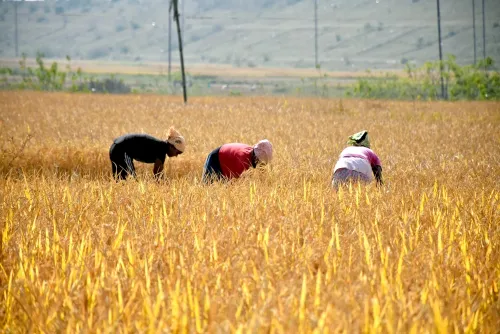
The primary beneficiaries are paddy farmers in and around Kakraban and the wider Udaipur area, who gain access to guaranteed price support rather than being forced to sell at whatever rate private buyers offer at harvest time. Smallholders, who form the bulk of Tripura's agricultural community, stand to benefit most from proximity to an active procurement centre.
The state agriculture department and the FCI are the key operational agencies responsible for logistics, quality checks, and timely payment to farmers. Smooth functioning of these centres directly affects farmer income and the state's foodgrain contribution to central buffer stocks.
What's Next
The state agriculture department is expected to release procurement targets, daily arrival figures, and payment disbursement data as the kharif season progresses. Performance at centres like Kakraban will indicate how effectively the state is integrating its farming communities into the formal MSP ecosystem.
Observers will watch whether the Tripura government expands the number of active procurement points this season and whether payment timelines to farmers improve compared to previous years, both key metrics for evaluating the welfare impact of the programme.
Point of View
Such events serve a dual purpose: reinforcing its pro-farmer credentials ahead of any electoral calendar and demonstrating operational alignment with central MSP policy. The real test, however, lies in procurement volumes actually achieved, speed of payment to farmers, and whether the number of active centres grows season-on-season. Until those metrics are publicly reported, the inauguration remains a policy signal rather than a measurable outcome.
NationPress
9 Oct 2026
Frequently Asked Questions
What is the MSP for paddy in Tripura in 2026?
The Minimum Support Price for paddy is set annually by the central government and applies uniformly across all states including Tripura; the specific 2026 rate would be notified by the Cabinet Committee on Economic Affairs and can be checked on the official agriculture ministry portal.
Who inaugurated paddy procurement at Kakraban Udaipur?
The inauguration was announced by the Chief Minister's Office of Tripura on 10 July 2026; the event was held at Kakraban in Udaipur subdivision of Gomati district.
What is the role of the Food Corporation of India in paddy procurement?
The Food Corporation of India is the central nodal agency that coordinates MSP-based paddy procurement across states, manages storage, and ensures the grain enters the national buffer stock; in Tripura it works alongside the state agriculture department.
Where is Kakraban located in Tripura?
Kakraban is a village area within Udaipur subdivision, which is the headquarters of Gomati district in southern Tripura, known for both agriculture and temple tourism.
How does MSP paddy procurement help farmers in Tripura?
MSP procurement guarantees farmers a floor price fixed by the central government, preventing distress sales to private traders at lower rates, and integrates smallholders into the formal foodgrain supply chain with assured and timely payment.