Why Are There Protests in Agartala Against Atrocities on Hindus in Bangladesh?
Click to start listening
Synopsis
Protests erupted in Agartala as the Sanatani Hindu Sena condemned the lynching of a Hindu man in Bangladesh. Activists are raising awareness about the systemic violence against Hindus. Will this spur governmental action to protect minorities?
Key Takeaways
- Protests highlight violence against minorities.
- Dipu Chandra Das was a victim of mob lynching.
- Sanatani Hindu Sena organized the demonstration.
- Heavy police presence was noted during the protest.
- Calls for governmental accountability are growing.
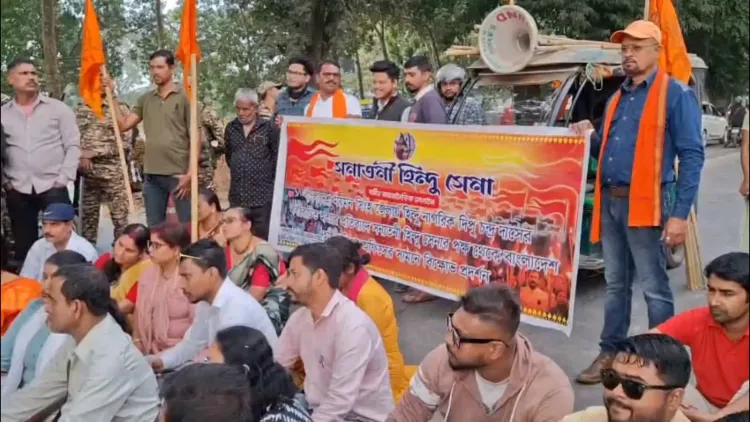
Agartala, Dec 20 (NationPress) Members of the Sanatani Hindu Sena organized a demonstration outside the Bangladesh Assistant High Commission in Agartala on Saturday. They condemned the reported lynching of a Hindu man in Bangladesh and criticized the government there for its inability to prevent violence against religious minorities.
The protest was triggered by the tragic death of Dipu Chandra Das, a 27-year-old who was allegedly lynched in Mymensingh over accusations of blasphemy, with reports indicating that his remains were set ablaze.
On December 18, Das was killed by a mob, and his body was subsequently cremated in flames, raising alarms about the targeted violence against minorities in Bangladesh. Activists chanted slogans against the current government, highlighting the systematic oppression faced by Hindus.
When demonstrators attempted to approach the Bangladesh Assistant High Commission, they were met with a substantial police presence, led by senior officials. Gautam Laskar, the district president of the Sanatani Hindu Sena, asserted that Hindus in Bangladesh are consistently under threat, drawing parallels with similar occurrences in certain regions of India.
Laskar condemned the brutality of the Mymensingh incident, questioning the humanity involved in such actions against minority communities. Despite their grievances, he emphasized that the protest was conducted peacefully, refraining from violence.
He cautioned that if attacks against Hindus in Bangladesh do not cease, there may be stronger responses in the future. The protest ended without incident, though security was tight.
Meanwhile, reports from the interim government of Bangladesh, as quoted by Chief Adviser Muhammad Yunus, indicated that the Rapid Action Battalion (RAB) had detained seven suspects linked to Das's death.
There has been a notable surge in violence against minorities, including Hindus, under the leadership of Yunus, provoking outrage both domestically and internationally among human rights organizations.
Following the death of Sharif Osman Hadi, a spokesperson for the radical group Inqilab Mancha, violence has intensified across Bangladesh, including in the capital, Dhaka. Hadi was shot by masked assailants while leaving a mosque and succumbed to his injuries on December 18 after being transported to Singapore for treatment.
On December 17, India’s Ministry of External Affairs summoned Bangladesh's High Commissioner to India, Riaz Hamidullah, to express New Delhi’s serious concerns regarding the deteriorating security conditions in Bangladesh.
The current state of violence and lawlessness in Bangladesh has sharply increased under the interim government led by Muhammad Yunus.
Point of View
It is crucial to recognize the growing concerns surrounding minority rights in Bangladesh. The protests in Agartala reflect a broader demand for accountability and protection for vulnerable communities. It is essential that we, as a nation, advocate for the rights of all individuals, regardless of their faith, and ensure that such incidents do not go unaddressed.
NationPress
22/12/2025
Frequently Asked Questions
What triggered the protest in Agartala?
The protest was triggered by the lynching of Dipu Chandra Das in Bangladesh, who was killed over accusations of blasphemy.
Who organized the protest?
The protest was organized by the Sanatani Hindu Sena.
What are the protesters demanding?
The protesters are demanding immediate action to stop the violence against Hindus and other minorities in Bangladesh.
Has the Bangladesh government responded to the incident?
Yes, the Rapid Action Battalion (RAB) has arrested seven suspects in connection with the incident.
What is the current situation regarding minorities in Bangladesh?
Violence against minorities, particularly Hindus, has seen an alarming rise under the interim government led by Muhammad Yunus.