Could Trump Really Be the Acting President of Venezuela?
Synopsis
In a bold move, President Trump declared himself the 'Acting President of Venezuela' amidst the ongoing political chaos in the country. This unprecedented statement has sparked reactions worldwide. As Venezuela navigates its political landscape, what does this mean for international relations and the future of leadership?
Key Takeaways
Trump's declaration raises questions about international authority.
Venezuela's political situation remains complex and contentious.
Historical instances of dual leadership exist, but they differ significantly from unilateral claims.
The legitimacy of governments is often challenged in turbulent political climates.
International relations must prioritize respect for sovereignty.
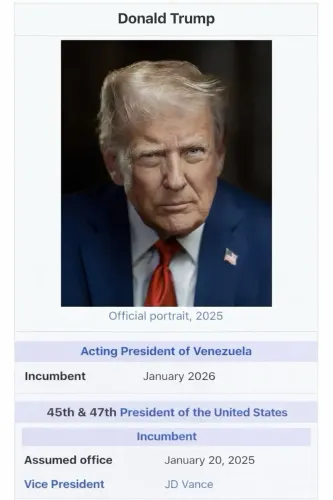
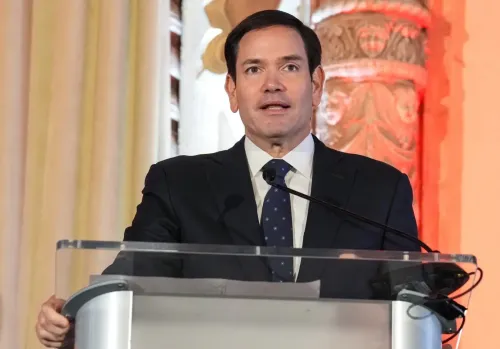
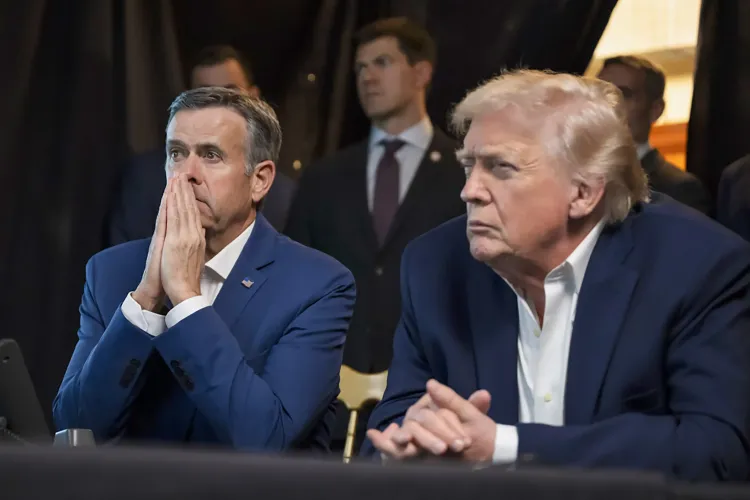
New Delhi, January 12 (NationPress) As the week commenced, international media was abuzz with reports of US President Donald Trump proclaiming himself the "Acting President of Venezuela" in a message posted on his social media platform, Truth Social.
This post, which included the President’s "Official portrait, 2025", referred to him as "Acting President of Venezuela Incumbent January 2026" while also designating him as the "45th 47th President of the United States" who "Assumed Office January 2025".
The announcement, made on the platform established by Trump four years ago, has understandably elicited a range of reactions, from disbelief to strong criticism. This declaration follows shortly after the US executed a raid in Venezuela, resulting in the capture of its President, Nicolas Maduro.
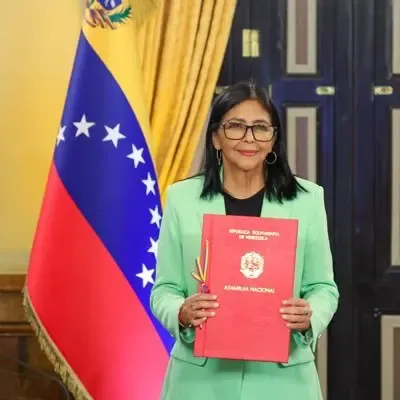
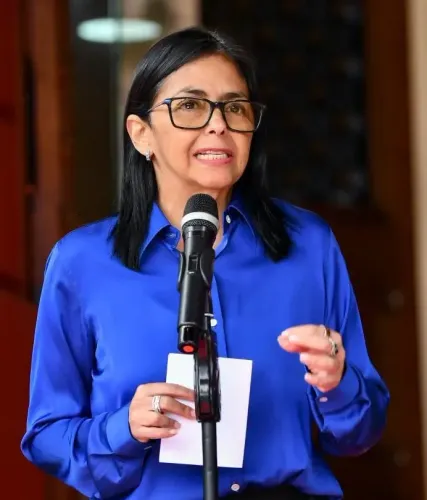
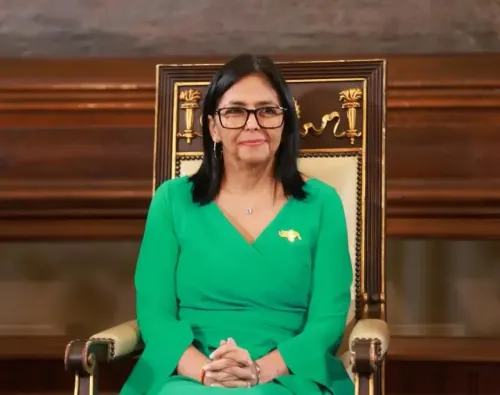
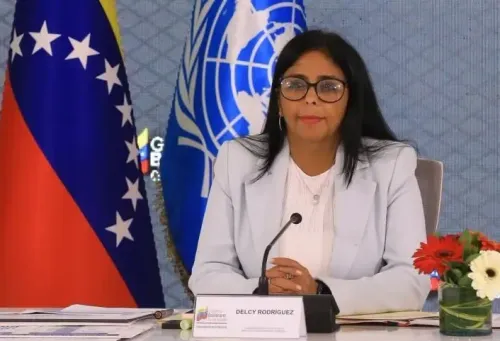
In the meantime, Delcy Rodriguez, the former Vice President of Venezuela, has been sworn in as interim President according to the nation’s constitution. She has dismissed Washington’s claims of authority, demanding the prompt release of Maduro, as reported.
While there are no exact parallels in contemporary global politics, instances of dual leadership have occurred in various forms.
Historical examples of sequential leadership include instances of Prime Ministers from the colonial era of Bengal transitioning to roles in Pakistan following the Partition of India. Notably, Abul Kasem Fazlul Huq (1873-1962), the inaugural and longest-serving Prime Minister of Bengal (1937–1943) under British rule, later became the Chief Minister of East Bengal and then held the position of Home Minister of Pakistan, although he did not ascend to the role of Prime Minister.
Similarly, Khawaja Nazimuddin (1894-1964), the second Prime Minister of undivided Bengal, was also the second Prime Minister of Pakistan.
Moreover, Huseyn Shaheed Suhrawardy (1892-1963), who served as the last Prime Minister of Bengal from 1946 to 1947, held the position of Pakistan’s fifth Prime Minister from 1956 to 1957. Pakistan’s third Prime Minister, Syed Mohammad Ali Chowdhury Bogra, had previously served in various ministerial capacities within Suhrawardy's government in undivided Bengal.
Notably, Pakistan's first Prime Minister, Liaquat Ali Khan, was the final Finance Minister of undivided India.
Internationally, there have been occasions where monarchs governed multiple nations, such as King George VI, who was simultaneously the monarch of the United Kingdom and several independent Commonwealth realms. While the British monarch is understood to symbolically occupy the highest office as the head of state in several Commonwealth nations, this arrangement is a legitimate constitutional one, rather than a unilateral declaration.
In other historical contexts, some revolutionary leaders claimed authority across borders without widespread international recognition. For instance, Simon Bolívar (1783-1830), a prominent figure in the South American independence movement, served as the president of Gran Colombia and held leadership roles in Peru and Bolivia. Unlike Bolívar, President Trump has not formally held a position in Venezuela, where there is already an interim replacement for the presidential office.
Point of View
The declaration made by Trump raises significant questions about international norms and respect for sovereign nations. While historical precedents exist for dual leadership, such unilateral claims without genuine constitutional backing challenge the foundation of international diplomacy. We must navigate this situation with a focus on the principles of sovereignty and mutual respect for nations.
NationPress
20 Sept 2026
Frequently Asked Questions
What does Trump's declaration mean for Venezuela?
Trump's self-proclamation as 'Acting President of Venezuela' could complicate diplomatic relations and further polarize the political situation in Venezuela, especially as Maduro's government continues to assert its legitimacy.
Is there a precedent for dual leadership in history?
Yes, historical instances exist where leaders have held power in multiple nations, particularly during colonial times or in cases of monarchs ruling different territories.
How has Venezuela responded to Trump's claim?
The Venezuelan government, represented by interim President Delcy Rodriguez, has rejected Trump's claims, asserting the constitutional legitimacy of their current leadership and demanding Maduro's release.