Uttarakhand Cabinet clears 24 proposals: ₹200 crore skill scheme, rule overhaul
Synopsis
Uttarakhand's Cabinet met in the border district of Champawat on Sunday and cleared 24 proposals in one sitting — anchored by a ₹200 crore skill scheme targeting over one lakh students and a sweeping rewrite of private university rules that scraps the ₹5 crore guarantee fund and changes the land threshold. The breadth of decisions, from poultry DBT subsidies to annual property disclosures for state employees, signals an unusually active governance push from Chief Minister Dhami.
Key Takeaways
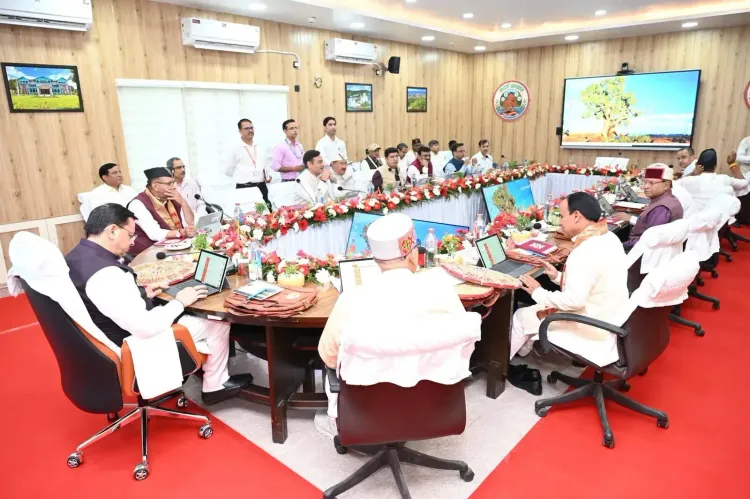
The Uttarakhand Cabinet approved 24 proposals at its Banbasa, Champawat meeting on 4 October 2026 , chaired by Chief Minister Pushkar Singh Dhami .
A ₹200 crore skill development scheme was cleared to connect youth with employment-oriented training; skill diploma courses are expected to benefit over one lakh students .
A special package of ₹66 crore was approved for the Tarai Development Corporation Ltd (TDC) .
Group A and Group C employees must now submit property details annually; Group B employees must do so every five years .
Private university land requirements changed from 10 acres to 20,000 sq metres ; the ₹5 crore guarantee fund has been removed.
A DBT poultry subsidy scheme was cleared for hill areas, expected to benefit around 2,000 beneficiaries.
The Uttarakhand Cabinet, meeting in Banbasa, Champawat on Sunday, 4 October 2026, approved 24 proposals spanning employment, education, land revenue, administrative accountability, and private university regulations. Chief Minister Pushkar Singh Dhami chaired the border-district session, which yielded a ₹200 crore skill development scheme and several structural governance changes.
Skill Development and Employment Push
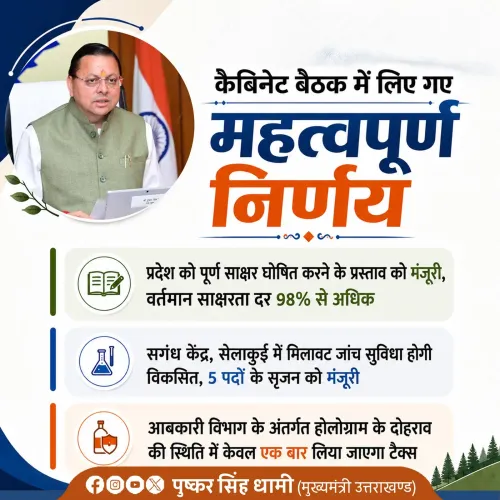
The most significant financial commitment from the meeting was the approval of a ₹200 crore skill development scheme under the Higher Education Department. The initiative is designed to link young people with employment-oriented training programmes across the state. Alongside this, the Cabinet approved the introduction of skill diploma courses for students — a move expected to benefit more than one lakh students by allowing them to acquire vocational skills alongside their regular academic programmes.
The Cabinet also approved a special package of ₹66 crore for the Tarai Development Corporation Ltd (TDC), aimed at bolstering development activity in the Tarai belt.
Employee Accountability and Service Rule Changes
In a significant administrative step, the Cabinet approved revisions to employee conduct rules. Group A and Group C employees will now be required to submit property details on an annual basis. For Group B employees, the same disclosure will be mandatory once every five years under the revised provisions.
The Cabinet also approved a proposal enabling Provincial Armed Constabulary (PAC) officers to be appointed to Group B posts, offering a structured promotion pathway for eligible officers. Additionally, the stipend provided to doctors in the medical sector was approved for an increase, though the revised amount was not disclosed.
Private University Rules and Nazul Land Regularisation
The rules governing the establishment of private universities in Uttarakhand have been substantially revised. The earlier minimum land requirement of 10 acres has been replaced with a threshold of 20,000 square metres, while the earlier mandatory guarantee fund of ₹5 crore has been removed entirely. Officials indicated the changes are intended to encourage investment in higher education infrastructure in the state.
The Cabinet also moved on Nazul land regularisation, approving the process to be taken forward in Khatima, Banbasa, Champawat, and other areas of the state.
Poultry Farming, Forest Land, and Other Decisions
To support livelihoods in mountain communities, the Cabinet approved a subsidy scheme for poultry farming in hill areas, to be delivered via Direct Benefit Transfer (DBT). The scheme is expected to benefit around 2,000 beneficiaries. Separately, the government decided to set up Project Management Units (PMUs) and appoint nodal officers to streamline forest land matters and improve inter-departmental coordination.
Other decisions included creating the post of Director General for the Animal Husbandry, Dairy and Fisheries departments and approving the opening of a Sub-Registrar's office in Narendranagar. Taken together, Sunday's Cabinet session represents one of the more wide-ranging administrative exercises in Uttarakhand this year, with the next steps contingent on departmental implementation timelines.
Point of View
But the more consequential shift may be in the private university rules: removing the ₹5 crore guarantee fund and cutting the land threshold could invite a wave of new institutional applications, raising valid questions about quality control and regulatory oversight. The annual property disclosure mandate for state employees is a welcome accountability measure, but its value depends entirely on enforcement — past property-disclosure regimes in several states have produced filings that were never audited. The real test of Sunday's decisions will be in implementation, not announcement.
NationPress
4 Oct 2026
Frequently Asked Questions
What was approved at the Uttarakhand Cabinet meeting on 4 October 2026?
The Uttarakhand Cabinet approved 24 proposals at its meeting in Banbasa, Champawat, on 4 October 2026. Key decisions included a ₹200 crore skill development scheme, a ₹66 crore package for the Tarai Development Corporation, revised employee conduct rules, and an overhaul of private university regulations.
What is the ₹200 crore skill development scheme approved by Uttarakhand?
It is a state-funded initiative under the Higher Education Department aimed at connecting young people with employment-oriented skill training. The scheme also introduces skill diploma courses expected to benefit more than one lakh students alongside their regular academic programmes.
How have Uttarakhand's private university rules changed?
The Cabinet replaced the earlier 10-acre land requirement for establishing a private university with a new threshold of 20,000 square metres, and scrapped the mandatory ₹5 crore guarantee fund. The changes are intended to encourage greater private investment in higher education infrastructure in the state.
What new property disclosure rules apply to Uttarakhand government employees?
Group A and Group C state employees must now submit property details every year, while Group B employees are required to do so once every five years. The revised conduct rules are aimed at improving administrative accountability.
Who benefits from the poultry farming subsidy approved by the Uttarakhand Cabinet?
The subsidy, to be delivered via Direct Benefit Transfer (DBT), targets beneficiaries engaged in poultry farming in the hill areas of Uttarakhand. Around 2,000 beneficiaries are expected to gain from the scheme, which is designed to support livelihood opportunities in mountainous regions.