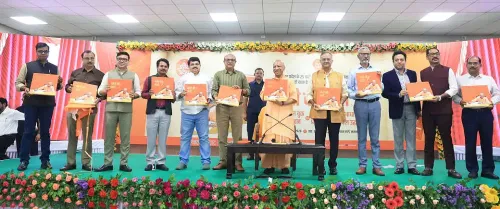
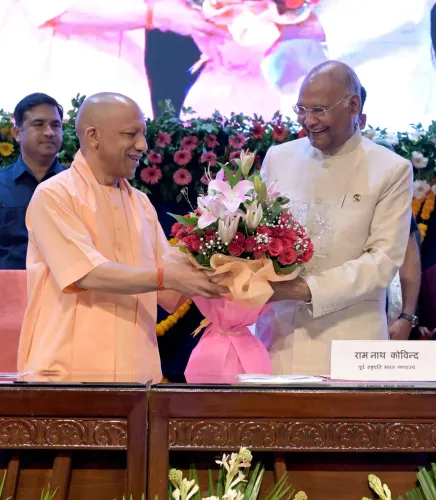
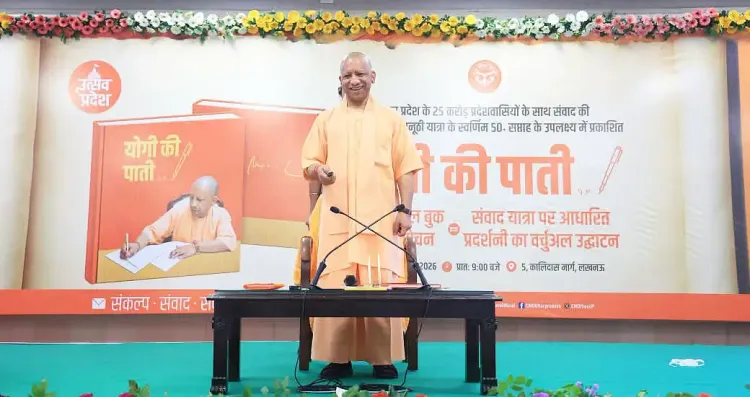
Yogi Adityanath unveils 'Yogi Ki Paati' book marking 50 weeks of public dialogue
Synopsis
Yogi Adityanath's 'Yogi Ki Paati' is more than a coffee table book — it is a 50-week record of a Chief Minister attempting to document governance as a moral act. From Vantangia forest settlers denied rights for 120 years to encephalitis deaths he fought as an MP, the book frames welfare delivery not as political generosity but as constitutional duty — a distinction that carries weight in a state heading towards 2027 assembly elections.
Key Takeaways
UP CM Yogi Adityanath unveiled coffee table book 'Yogi Ki Paati' at his official residence in Lucknow on 16 November 2026 .
The book marks over 50 weeks of a public dialogue initiative with the state's 25 crore citizens.
Adityanath recounted his decades-long efforts for the Vantangia community , whose rights were formally recognised after a Centre law amendment in 2007–08 but implemented in UP only from 2017 ; today 54 settlements have basic facilities.
He claimed continuous government action has completely eliminated encephalitis deaths among children in eastern Uttar Pradesh.
Nearly 1.60 crore children in Basic Education Council schools now receive uniforms, bags, books, shoes and socks via Direct Benefit Transfer (DBT) .
Operation Kayakalp has achieved nearly 96% saturation of basic facilities in government schools through public participation.
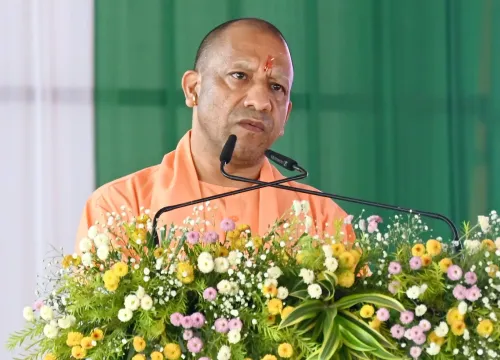
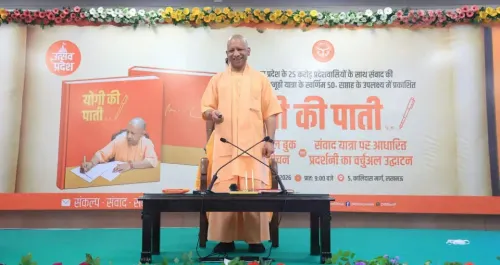
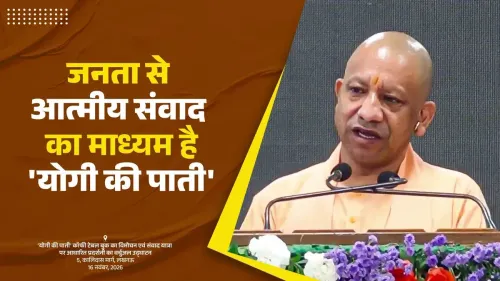
Uttar Pradesh Chief Minister Yogi Adityanath on Monday, 16 November 2026, unveiled the coffee table book 'Yogi Ki Paati' at his official residence in Lucknow, marking over 50 weeks of what his government describes as a unique, sustained dialogue with the state's 25 crore citizens. The Chief Minister also virtually inaugurated an exhibition documenting the journey behind the initiative.
What 'Yogi Ki Paati' Represents
Speaking at the event, Chief Minister Yogi Adityanath described the book as a medium of sensitivity, concern, and intimate public dialogue. He said the purpose was to surface aspects of community life that remain largely unknown to wider society — drawing on nearly three decades of his public engagement with marginalised groups across the state.
'Yogi Ki Paati is a medium of this sensitivity, concern and intimate dialogue,' he said. The Chief Minister emphasised that ensuring government scheme benefits reach the most disadvantaged citizens is not a favour but a constitutional duty: 'The state government has not bestowed any favour or grace; it has only discharged its duties.'
The Vantangia Community: A Case Study in Neglect and Redress
The Chief Minister devoted considerable time to recounting the history of the Vantangia community, forest settlers whose ancestors were brought in by the British nearly 120 years ago to replant railway-cleared forests in exchange for land rights — a promise that was never honoured. Even after Independence in 1947, these families reportedly lived without permanent housing, electricity, water, ration cards, or the right to elect a village head across settlements in Maharajganj, Gorakhpur, Siddharthnagar, Balrampur, Gonda, Lakhimpur Kheri, and Pilibhit.
Adityanath recalled witnessing a barefoot procession of Vantangia families in Maharajganj in 2005–06, marching to protest at the district headquarters. He said he arranged food and shelter through local workers, helped prepare a memorandum, and subsequently met then Prime Minister Manmohan Singh and then Environment Minister Jairam Ramesh to push for amendments to the forest rights law. The Centre amended the law in 2007–08, but Adityanath said effective implementation in Uttar Pradesh was delayed until 2017. Today, he said, thousands of families across 54 Vantangia settlements enjoy basic civic amenities and rights.
Other Marginalised Communities: Musahar, Kol and Beyond
The Chief Minister also recalled that during the tenure of then Chief Minister Mulayam Singh Yadav, nearly a dozen people from the Musahar community had died of hunger in Kushinagar amid a foodgrain scam. He said he had protested and submitted a memorandum to the then Governor at the time. Under the current administration, he said, Musahar families have been given land pattas, houses, and linked to government schemes.
Similarly, in Chitrakoot, he noted that many Kol community families continued to live in thatched mud-wall huts more than seven decades after Independence. Under the Chief Minister Awas Yojana, he said, these families have now been provided pucca houses. 'Every individual has the right to a life of dignity and to the benefits of government programmes,' he stated.
Encephalitis, Education, and Scheme Delivery
Adityanath cited the elimination of encephalitis in eastern Uttar Pradesh as another marker of sensitive governance. He recalled that for years, thousands of children fell ill and hundreds died every year between mid-July and mid-November. As a Member of Parliament, he had personally arranged 100 beds, mattresses, air conditioners, fans, and bedsheets for the overcrowded BRD Medical College in Gorakhpur. He said continuous government effort has now completely eliminated encephalitis deaths in the state.
On education, he said that before 2017, a large number of Basic Education Council schools lacked teachers and had dilapidated buildings, with 60–70% of children, especially girls, attending barefoot. Today, he said, nearly 1.60 crore children receive two uniforms, school bags, books, shoes and socks, with funds transferred directly to parents via Direct Benefit Transfer (DBT). He added that Operation Kayakalp has achieved nearly 96% saturation of basic facilities in government schools through public participation.
Bridging the Information Gap
The Chief Minister underscored that even when schemes exist, many eligible citizens cannot access them due to lack of awareness. He cited programmes such as Ayushman cards, ration cards, and destitute women pension as examples requiring repeated public outreach. 'Yogi Ki Paati' is intended to serve as that bridge — ensuring information about government schemes and state achievements reaches the last person in society. The initiative is expected to continue as a regular channel of public communication from the Chief Minister's office.
Point of View
And the book's framing of welfare as duty rather than patronage is a deliberate counter-narrative to opposition charges of selective governance. The examples Adityanath chose — forest settlers, hunger deaths under a rival's tenure, children dying in hospitals he personally provisioned as an MP — are not random; they are a carefully constructed arc of continuity between the saffron monk and the sitting Chief Minister. What the book cannot answer is whether the structural gaps it documents have closed for all 25 crore citizens or for the specific communities that made it onto its pages. Independent verification of claims such as the 'complete elimination' of encephalitis or 96% school saturation would sharpen the accountability this initiative otherwise invites.
NationPress
16 Nov 2026
Frequently Asked Questions
What is 'Yogi Ki Paati' and why was it launched?
'Yogi Ki Paati' is a coffee table book unveiled by Uttar Pradesh Chief Minister Yogi Adityanath on 16 November 2026, marking over 50 weeks of a sustained public dialogue initiative with the state's 25 crore citizens. The book aims to document marginalised communities and government efforts to reach them, while also publicising welfare schemes to those who remain unaware of their entitlements.
Who are the Vantangia and what did Yogi Adityanath do for them?
The Vantangia are a community of forest settlers whose ancestors were brought by the British nearly 120 years ago to replant forests cleared for railway lines, in exchange for land rights that were never granted. Adityanath said he advocated for their rights from 2005–06, helped push a central forest rights law amendment in 2007–08, and after becoming Chief Minister in 2017, prioritised implementation — with thousands of families across 54 settlements now having basic civic amenities.
What did Yogi Adityanath say about encephalitis in Uttar Pradesh?
Adityanath recalled that for years, thousands of children fell ill and hundreds died annually between mid-July and mid-November due to encephalitis in eastern Uttar Pradesh. He said continuous government effort has now completely eliminated encephalitis deaths in the state, citing this as an example of sensitive governance.
How have primary schools in Uttar Pradesh changed since 2017, according to the CM?
Chief Minister Adityanath said that before 2017, many Basic Education Council schools lacked teachers, had dilapidated buildings, and 60–70% of children attended barefoot. As of now, nearly 1.60 crore children receive two uniforms, school bags, books, shoes and socks, with funds sent directly to parents via DBT. Operation Kayakalp has reportedly achieved 96% saturation of basic school infrastructure through public participation.
What is the purpose of the exhibition inaugurated alongside the book?
Chief Minister Yogi Adityanath virtually inaugurated an exhibition based on the dialogue journey that underpins 'Yogi Ki Paati'. The exhibition documents the 50-plus weeks of public engagement and the communities and issues the initiative has covered, serving as a visual complement to the book.