UP Deputy CMs slam Akhilesh Yadav over 'Radhe Radhe' remark, cite Sanatan ignorance
Synopsis
A BJP campaign slogan invoking 'Radhe Radhe' has ignited a sharp political row in Uttar Pradesh, with SP chief Akhilesh Yadav turning the devotional phrase into a farewell metaphor for the ruling coalition — and both UP Deputy CMs firing back with references to the 1990 Ayodhya karsevak firing. With the 2027 state polls on the horizon, the exchange signals that the battle for religious and cultural legitimacy in UP has begun in earnest.
Key Takeaways
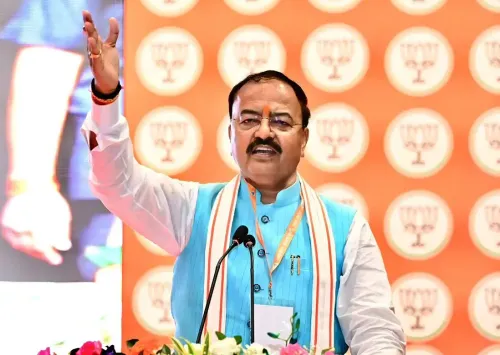
UP Deputy CMs Brajesh Pathak and Keshav Prasad Maurya attacked SP President Akhilesh Yadav on 22 November over his remarks on the BJP slogan 'Radhe Radhe, Kamal Khila De' .
Yadav had argued that 'Radhe Radhe' is a farewell phrase, suggesting the BJP's departure in the 2027 UP Assembly elections is imminent.
Pathak linked Yadav's remark to a perceived lack of Sanatan knowledge, citing the 1990 Ayodhya karsevak police firing and accusing the SP of 'appeasement politics'.
Maurya defended 'Radhe Radhe' as an expression of devotion, not merely a slogan, and predicted a BJP win in 2027 for a third consecutive term.
Maurya claimed the SP would not come to power until 2047 , as the BJP braces for an early culture-and-faith-led campaign.
Uttar Pradesh Deputy Chief Ministers Brajesh Pathak and Keshav Prasad Maurya on Sunday, 22 November launched a sharp attack on Samajwadi Party (SP) President Akhilesh Yadav, accusing him of lacking knowledge of Sanatan culture — a day after Yadav mocked the Bharatiya Janata Party's (BJP) campaign slogan 'Radhe Radhe, Kamal Khila De' at a press conference in Lucknow.
What Akhilesh Yadav Said
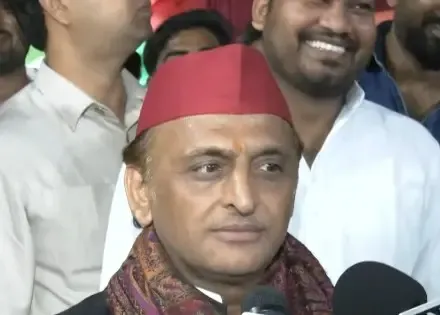
Addressing reporters on Saturday, Yadav had taken a pointed swipe at the BJP slogan, noting that 'Radhe Radhe' is traditionally uttered as a farewell expression — and arguing that the phrase was therefore apt, since the ruling coalition's exit in the 2027 Uttar Pradesh Assembly elections was inevitable. He also claimed the BJP's electoral symbol, the lotus, had begun to 'wither'. Yadav doubled down on the remark, saying: 'Even at the time of farewell, they say Radhe-Radhe. This time, the public will give the BJP a grand farewell.'
BJP Hits Back: 'Appeasement Politics'
Deputy Chief Minister Brajesh Pathak rejected Yadav's interpretation of the phrase, drawing a direct link to what he called a troubling historical record. 'If Akhilesh Yadav had even basic knowledge of Sanatan culture, police firing on unarmed karsevaks would not have taken place during their regime, he would have gone to Ayodhya to seek the blessings of Lord Ram and would have also offered prayers at Krishna Janmabhoomi,' Pathak said. He was referring to the 1990 police firing on karsevaks in Ayodhya — an episode that continues to be wielded as political ammunition by the BJP against the SP. Pathak further accused Yadav of practising 'appeasement politics', adding: 'What does he have to do with saying Ram Ram or Radhe Radhe?'
Maurya: 'Radhe Radhe Is Devotion, Not a Slogan'
Deputy Chief Minister Keshav Prasad Maurya echoed Pathak's criticism, arguing that Yadav's reaction was driven by fear of the BJP's electoral momentum. 'When the slogan Jai Shri Ram is raised, who gets nervous? Now that the slogan Radhe Radhe is being raised, who is getting worried? Radhe Radhe is not just a slogan; it is a way of expressing devotion,' Maurya stated. He further turned the 'puncture' metaphor back on the SP: 'When we said Radhe Radhe, Kamal Khila de...they failed to notice that their own bicycle had a puncture and, instead, he is talking about the lotus withering. So it is they who have a problem in their eyes and should get treated.' Maurya expressed confidence that the BJP would secure a third consecutive term in the state, asserting: 'The lotus has already bloomed and will bloom even further. We will form a government for the third time with a landslide victory.'
2027 Assembly Elections: The Backdrop
The war of words underscores the early mobilisation ahead of the 2027 Uttar Pradesh Assembly elections, with both parties seeking to define the cultural and political narrative well in advance. The BJP has leaned into religious symbolism as an electoral identity, while the SP has sought to reframe it as divisive. Notably, this exchange follows a broader pattern of the BJP deploying devotional slogans as campaign branding — a strategy that has drawn both strong support and sharp criticism in the state's deeply plural religious landscape. Maurya went further, asserting: 'The SP is not going to come to power till 2047, and the BJP will not step down from power.' The coming months will reveal whether this early sparring translates into a lasting electoral advantage for either side.
Point of View
Controlling the vocabulary of faith is a precondition for controlling the vote. The BJP's move to embed devotional phrases into campaign slogans is a deliberate strategy to make any SP pushback look like cultural hostility, a trap Yadav may have walked into. The 1990 Ayodhya reference, invoked by Pathak, is not coincidental; it is a well-worn instrument the BJP deploys whenever it needs to remind voters of the SP's most damaging historical liability. What the exchange actually reveals is that both sides are already in campaign mode — and the 2027 election, still more than a year away, will increasingly be fought on this symbolic terrain.
NationPress
22 Nov 2026
Frequently Asked Questions
What did Akhilesh Yadav say about the BJP's 'Radhe Radhe' slogan?
Akhilesh Yadav argued at a press conference on Saturday that 'Radhe Radhe' is traditionally uttered as a farewell expression, using it to suggest that the BJP-led ruling coalition would receive a 'grand farewell' from voters in the 2027 Uttar Pradesh Assembly elections. He also claimed the BJP's lotus symbol had started to 'wither'.
How did UP Deputy CMs Brajesh Pathak and Keshav Prasad Maurya respond?
Both Deputy Chief Ministers accused Yadav of lacking Sanatan cultural knowledge. Pathak cited the 1990 Ayodhya karsevak police firing and alleged 'appeasement politics', while Maurya described 'Radhe Radhe' as an expression of devotion and predicted a third consecutive BJP government after the 2027 polls.
What is the significance of the 1990 Ayodhya reference made by Brajesh Pathak?
Pathak was referring to the police firing on unarmed karsevaks in Ayodhya in 1990, which occurred under a government in which the SP's predecessor parties were involved — an incident the BJP has historically used to question the SP's credentials on Hindu religious issues.
How does this row connect to the 2027 Uttar Pradesh elections?
The exchange marks an early escalation in the battle for cultural and political legitimacy ahead of the 2027 UP Assembly elections. Deputy CM Maurya asserted the BJP will win a third term with a 'landslide victory', while Yadav has signalled the SP intends to make the BJP's religious branding a central point of attack.
What is the BJP slogan 'Radhe Radhe, Kamal Khila De'?
It is a BJP campaign phrase combining a devotional greeting — 'Radhe Radhe', an invocation of Radha, consort of Lord Krishna — with an electoral call to action meaning 'let the lotus bloom', the lotus being the BJP's electoral symbol. The slogan has become a flashpoint in UP's political debate.