CM Yogi expands UP forensic labs from 4 to 12, adds mobile vans
Synopsis
Uttar Pradesh has tripled its forensic science labs from 4 to 12 across 75 districts, launched a dedicated UP Police Forensic Science Institute, and deployed Mobile Forensic Vans in every district, Chief Minister Yogi Adityanath announced on 17 June 2026.
Key Takeaways
Uttar Pradesh has expanded its Forensic Science Labs from 4 to 12 to serve all 75 districts .
The UP Police now has its own dedicated Forensic Science Institute — a first for the state.
Six additional A-Grade Forensic Science Labs are currently being established.
Large districts have been equipped with 3 Mobile Forensic Vans each; smaller districts receive 2 Mobile Forensic Vans each.
The expansion aligns with central mandates under new criminal laws passed in 2023 requiring time-bound scientific investigation.
Chief Minister Yogi Adityanath cited the figures as evidence of police modernisation since the government took office in March 2017 .
The Chief Minister's Office of Uttar Pradesh, citing remarks by Chief Minister Yogi Adityanath, announced on Wednesday, 17 June 2026 that the state has expanded its forensic science infrastructure from a mere four labs to 12 Forensic Science Laboratories across its 75 districts, and that the Uttar Pradesh Police now has its own dedicated Forensic Science Institute.
Context
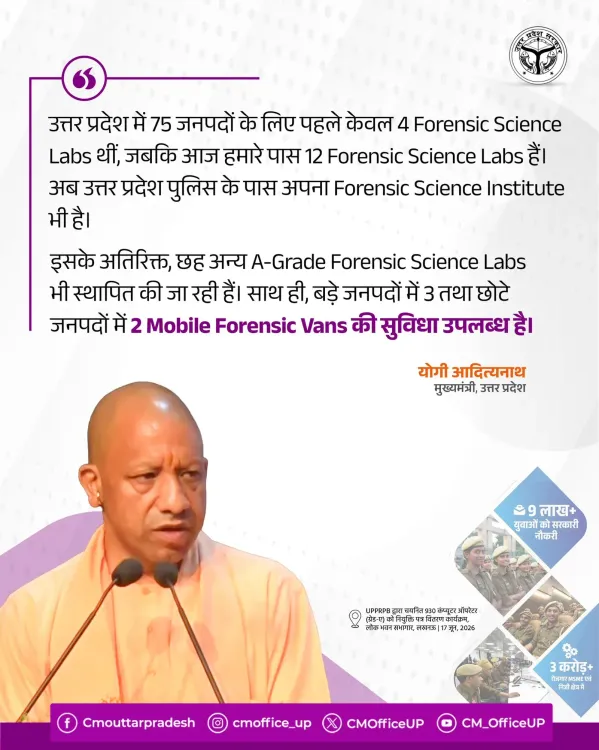
Quoting Chief Minister Yogi Adityanath, the post stated: 'उत्तर प्रदेश में 75 जनपदों के लिए पहले केवल 4 Forensic Science Labs थीं, जबकि आज हमारे पास 12 Forensic Science Labs हैं।' ('Earlier, there were only 4 Forensic Science Labs for 75 districts of Uttar Pradesh, whereas today we have 12 Forensic Science Labs.') The Chief Minister added that the state police force now also possesses its own Forensic Science Institute — a first for Uttar Pradesh.
Beyond the existing 12 labs, the announcement noted that six additional A-Grade Forensic Science Labs are being established. Mobile forensic capacity has also been scaled up: large districts have been provided 3 Mobile Forensic Vans each, while smaller districts have been equipped with 2 Mobile Forensic Vans each.
Policy Backdrop
When the current government took office in March 2017, Uttar Pradesh had only 4 forensic labs to serve all 75 districts — a chronic bottleneck that delayed criminal investigations and weakened evidence chains in court. The Uttar Pradesh Police Modernisation Scheme (2018) first identified forensic capacity as a priority area, setting in motion successive budget allocations to address the deficit.
The push has gained sharper urgency since the passage of new central criminal laws in 2023, which mandate time-bound scientific investigation in serious offences. States are now required to integrate forensic evidence collection with digital case-management systems, making on-ground infrastructure such as mobile vans and accredited labs operationally critical rather than aspirational.
Stakeholders and Impact
District police investigators stand to benefit most directly: with Mobile Forensic Vans now deployed at the scene level, evidence collection no longer depends on transporting material to a centralised lab — reducing delays and the risk of contamination. District administrations in smaller districts, which previously had the least access to forensic support, now have a baseline of two vans each.
The establishment of a dedicated Forensic Science Institute for the UP Police also signals an intent to build in-house expertise — training investigators and lab personnel within the state rather than relying on external institutions. Similar programmes are underway in Maharashtra, Gujarat, and Karnataka, reflecting a national pattern of states racing to raise conviction rates through better evidence handling.
What's Next
The commissioning timeline of the six additional A-Grade labs will be closely watched, as their operationalisation will determine whether every district cluster in Uttar Pradesh achieves parity in forensic access. Integration of the mobile vans and new labs with the state's e-FIR system and the new criminal law modules rolling out from July 2024 onward remains the next critical milestone.
If the expanded infrastructure is fully operationalised and linked to digital case workflows, Uttar Pradesh could emerge as one of the better-equipped large states for forensic-backed prosecution — a metric that directly influences conviction rates and judicial timelines across its 75 districts.
Point of View
Multi-year effort by the Yogi Adityanath government to reframe Uttar Pradesh's law-and-order narrative around institutional capacity rather than policing optics alone. Tripling forensic labs and deploying mobile vans at the district level directly addresses a structural weakness that historically allowed defence lawyers to challenge evidence integrity in court. The timing — with new central criminal laws now in force — gives the expansion both legal necessity and political salience, letting the government claim alignment with national reform. Whether the six pending A-Grade labs are commissioned on schedule will be the real test of whether this infrastructure push translates into measurable improvements in conviction rates.
NationPress
17 Sept 2026
Frequently Asked Questions
How many forensic science labs does Uttar Pradesh have now?
Uttar Pradesh currently has 12 Forensic Science Labs , up from just 4 when the current government took office in 2017, according to an announcement by Chief Minister Yogi Adityanath on 17 June 2026.
Does UP Police have its own Forensic Science Institute?
Yes. Chief Minister Yogi Adityanath confirmed that the UP Police now has its own dedicated Forensic Science Institute , making it one of the few state police forces in India with such an in-house facility.
How many Mobile Forensic Vans does Uttar Pradesh have per district?
Large districts in Uttar Pradesh have been provided 3 Mobile Forensic Vans each, while smaller districts have been equipped with 2 Mobile Forensic Vans each.
How many more forensic labs are being set up in UP?
Six additional A-Grade Forensic Science Labs are currently being established in Uttar Pradesh, which will further expand the state's forensic capacity beyond the existing 12 labs.
Why is Uttar Pradesh expanding its forensic labs?
The expansion responds to both a longstanding infrastructure deficit — only 4 labs for 75 districts — and new central criminal laws passed in 2023 that require time-bound scientific investigation in serious offences, making accredited labs and mobile units operationally essential.