CM Yogi Launches Project Ganga for 8,000 Digital Entrepreneurs
Synopsis
Uttar Pradesh Chief Minister Yogi Adityanath has announced Project Ganga as the operational vehicle to achieve the state's 2026-27 budget target of creating 8,000 digital entrepreneurs, with half the seats reserved for women, reinforcing the state's alignment with India's digital economy goals.
Key Takeaways
The Chief Minister's Office of Uttar Pradesh announced Project Ganga on 9 June 2026 as the scheme to fulfil a budget commitment on digital entrepreneurship.
The UP Budget 2026-27 had pledged to nurture 8,000 digital entrepreneurs across the state.
50 per cent of all beneficiaries — 4,000 individuals — must be women, embedding a gender equity target in the scheme.
Chief Minister Yogi Adityanath framed the initiative under the objective of 'digital empowerment' ( डिजिटल सशक्तिकरण ).
The scheme aligns with the national Digital India programme's broader goals of expanding digital enterprise and literacy.
Operational details including selection criteria and training partners are yet to be released by the state administration.
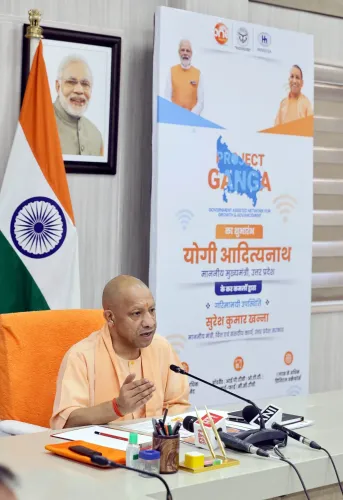
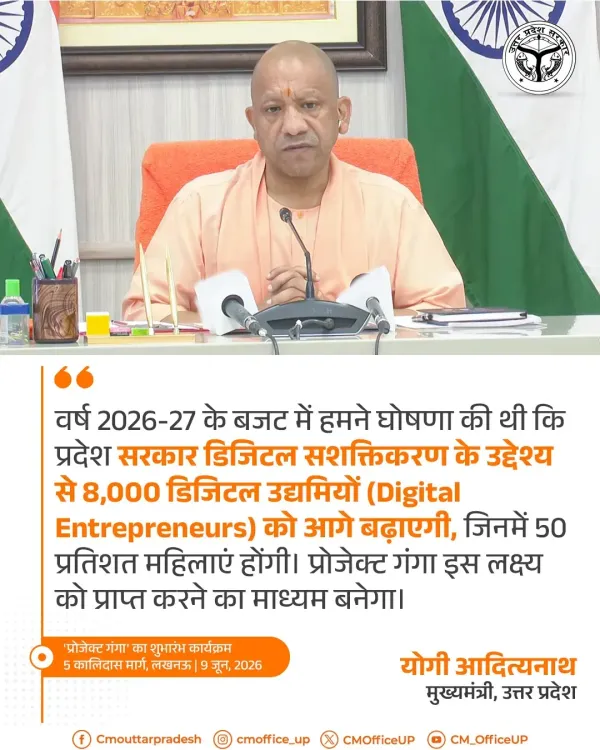
The Chief Minister's Office of Uttar Pradesh, citing Chief Minister Yogi Adityanath, announced on Tuesday, 9 June 2026 that Project Ganga will serve as the primary vehicle to fulfil the state government's budget commitment of nurturing 8,000 digital entrepreneurs, with 50 per cent of those slots reserved for women.
Context
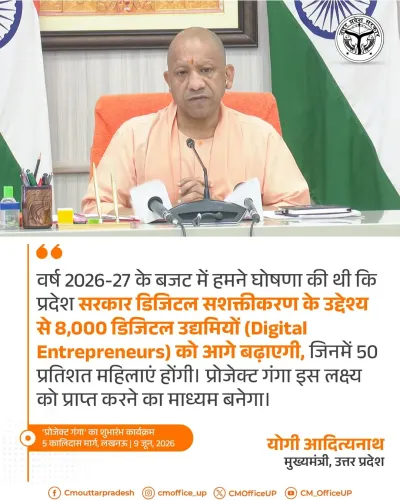
The announcement reaffirms a pledge made in the Uttar Pradesh Budget 2026-27, in which the state government committed to advancing digital empowerment across the state. Chief Minister Adityanath stated, 'प्रदेश सरकार डिजिटल सशक्तिकरण के उद्देश्य से 8,000 डिजिटल उद्यमियों को आगे बढ़ाएगी' ('the state government will advance 8,000 digital entrepreneurs with the objective of digital empowerment'). The explicit gender target — half of all beneficiaries to be women — signals a deliberate push to close the digital participation gap in India's most populous state.
Policy Backdrop
Uttar Pradesh has steadily aligned its state-level digital and entrepreneurship policies with the central Digital India programme, launched in 2015, which aimed to expand digital infrastructure, literacy and enterprise creation nationwide. Successive state budgets have embedded skilling and enterprise targets with explicit gender components, reflecting a broader pattern of Indian states operationalising national digital goals through localised schemes. Project Ganga represents the latest such instrument, translating a budget line into an operational programme with a named structure and a measurable target.
Stakeholders and Impact
The direct beneficiaries are aspiring digital entrepreneurs across Uttar Pradesh, with 4,000 women guaranteed participation under the 50 per cent reservation. For women in semi-urban and rural pockets of the state, access to structured digital entrepreneurship support could translate into income generation and greater economic agency. The scheme also carries significance for the state's broader economic narrative: Uttar Pradesh has positioned itself as an emerging hub for investment and enterprise, and a pipeline of trained digital entrepreneurs feeds into that positioning.
What's Next
Detailed operational guidelines for Project Ganga — including selection criteria, training partners, mentorship structures and disbursement mechanisms — are expected to be released by the state administration. Progress on gender-disaggregated enrolment and enterprise formation will likely be tracked in subsequent budget sessions as a performance metric. How swiftly the government moves from announcement to on-ground implementation will determine whether the 8,000-entrepreneur target is met within the 2026-27 fiscal cycle. The scheme's success could set a template for other large states seeking to blend gender equity with digital economy goals under the national Digital India umbrella.
Point of View
A metric increasingly watched by investors and central government evaluators alike. For Chief Minister Yogi Adityanath, operationalising a 2026-27 budget promise before the fiscal year matures reinforces an image of delivery-oriented governance. The real test, however, will be in the implementation details — training quality, enterprise survival rates and whether the gender target translates into substantive economic participation or merely enrolment numbers.
NationPress
19 Sept 2026
Frequently Asked Questions
What is Project Ganga UP?
Project Ganga is a Uttar Pradesh government scheme announced in June 2026 to create 8,000 digital entrepreneurs across the state, fulfilling a pledge made in the UP Budget 2026-27. It is designed to advance digital empowerment, with 50 per cent of beneficiaries required to be women.
How many digital entrepreneurs will UP create under Project Ganga?
The target is 8,000 digital entrepreneurs, of whom at least 4,000 must be women, as mandated by the 50 per cent gender reservation built into the scheme.
What did the UP Budget 2026-27 say about digital entrepreneurship?
The UP Budget 2026-27 included a commitment to advance 8,000 digital entrepreneurs with the objective of digital empowerment, with an explicit condition that half the beneficiaries would be women. Project Ganga is the vehicle chosen to achieve this target.
How does Project Ganga relate to Digital India?
Project Ganga aligns with the national Digital India programme launched in 2015, which seeks to expand digital infrastructure, literacy and enterprise creation. Uttar Pradesh is operationalising the national framework through this state-level scheme.
Who announced Project Ganga in Uttar Pradesh?
The Chief Minister's Office of Uttar Pradesh announced Project Ganga, citing Chief Minister Yogi Adityanath, through an official post on 9 June 2026.