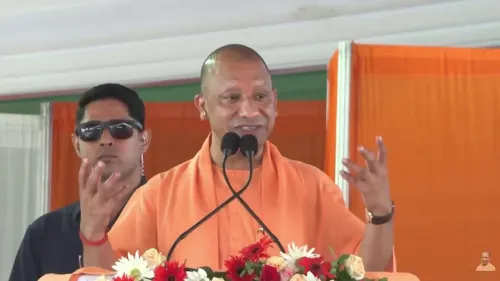
UP bars 'violent regime change' protesters from govt jobs; SP, CPI-M cry foul
Synopsis
The Yogi Adityanath government's move to bar individuals linked to groups advocating violent system change from UP government jobs has ignited a constitutional flashpoint. SP and CPI-M call it an attack on free speech; BJP says it is standard character verification. The real test: how courts interpret 'violent intent' in a rule that critics warn is broad enough to penalise peaceful dissent.
Key Takeaways
Uttar Pradesh government's revised guidelines bar individuals linked to organisations advocating violent changes to the social system from government jobs .
The state clarified that candidates will not be disqualified purely on the basis of political ideology .
SP MPs Harendra Singh Malik and Ramashankar Rajbhar called the order 'dictatorial' and a 'Tughlaqi decree.' CPI-M leader Brinda Karat termed the directive 'unconstitutional' and an attack on Article 19 fundamental rights.
BJP MP Brij Lal defended the order, saying character verification has always been mandatory for government employment.
Legal experts expect the guidelines' definition of 'violent intent' to face judicial scrutiny .
The Samajwadi Party (SP) and Communist Party of India (Marxist) (CPI-M) on Thursday, 29 October sharply criticised the Yogi Adityanath-led Uttar Pradesh government's revised recruitment guidelines, which render individuals associated with organisations advocating violent changes to the existing social system ineligible for government jobs. Opposition leaders called the directive an 'attack' on constitutional freedoms, while the Bharatiya Janata Party (BJP) defended it as a routine character verification measure.
What the New Guidelines State
Under the revised directives, participation in protests or activities aimed at changing the existing system through violence could disqualify a candidate from government employment in Uttar Pradesh. The state government, however, clarified that no candidate would be disqualified solely on the basis of their political ideology — a distinction the opposition dismissed as insufficient.
SP Calls It a Threat to Democracy
SP MP Harendra Singh Malik asked the state government to answer two questions before enforcing the order. 'First, how many government jobs have they provided so far? Second, will they ensure that young people who do not participate in protests are given jobs? Let them guarantee that! We will manage with elderly people at protests,' he said.
Malik accused the state administration of 'strangling' the people and 'murdering' democracy, adding: 'Freedom of expression is our constitutional right, and they are taking that away too, forcing us to remain mere spectators.'
SP MP Ramashankar Rajbhar termed the order a 'Tughlaqi decree,' calling the Adityanath government 'dictatorial.' 'What is the connection between a job and a protest? If an injustice is done to someone who is already employed, can they not protest?' he asked. Rajbhar also said the government had 'adopted a dictatorial approach' every time citizens had taken to the streets — over nine years in Uttar Pradesh and, he alleged, 12 years in Delhi.
CPI-M Flags Constitutional Concerns
CPI-M leader Brinda Karat underlined that freedom of expression is a fundamental right enshrined in the Constitution. 'If I am a student, if I am a young woman protesting for the rights of women, if I am protesting against the government's wrong policies, then I will not get my character certificate. Which law can change this?' she said.
Karat called the directive 'unconstitutional,' arguing it amounted to 'an attack on the fundamental rights, on the democratic right to dissent.'
BJP Defends the Order
BJP Rajya Sabha MP Brij Lal, a former IPS officer, backed the government's position. 'I wholeheartedly welcome the order issued by the Uttar Pradesh government. In every government job, whether it is for a peon or an IPS officer, character verification is mandatory,' he said, adding that those with adverse or criminal records had always been ineligible for public employment.
Broader Context
The controversy comes amid a broader national debate over the limits of protest and state employment eligibility, following prolonged agitations in several states in recent years. Critics argue that vaguely worded guidelines risk penalising peaceful dissent alongside genuinely violent activity — a distinction that courts have repeatedly asked governments to maintain. Notably, the Supreme Court has in past judgments held that the right to protest is an inalienable facet of free speech under Article 19 of the Constitution. How the revised UP guidelines define 'violent intent' will likely face legal scrutiny in the days ahead.
Point of View
Which the Supreme Court has consistently treated as a protected right under Article 19. Vague drafting creates a chilling effect: a young person uncertain whether a past agitation crosses the undefined 'violent intent' line may simply opt out of all protest to protect their employment prospects. That is the quiet, structural harm that headline debates about 'dictatorial' orders tend to miss. The BJP's character-verification defence is legally coherent in principle but sidesteps the precision problem entirely. Courts will likely demand a clearer standard — and how the state responds to that demand will reveal whether this is a genuine anti-extremism measure or a broad-spectrum deterrent to dissent.
NationPress
29 Oct 2026
Frequently Asked Questions
What does UP's new recruitment guideline say about protesters?
The revised Uttar Pradesh guidelines state that individuals associated with organisations that advocate violent changes to the existing social system may be deemed ineligible for government jobs. The state government clarified that political ideology alone will not be grounds for disqualification.
Why are SP and CPI-M opposing the UP government's order?
SP and CPI-M argue the directive violates the constitutional right to free expression and peaceful protest guaranteed under Article 19. Leaders including SP's Ramashankar Rajbhar and CPI-M's Brinda Karat have called it unconstitutional and an attack on the fundamental right to dissent.
What is the BJP's defence of the Uttar Pradesh order?
BJP Rajya Sabha MP Brij Lal, a former IPS officer, said character verification has always been mandatory for government employment at every level. He argued the order simply formalises the existing practice of screening candidates with adverse or criminal records.
Who is likely to be affected by the new UP recruitment rules?
Candidates who have participated in protests or activities that could be categorised as aimed at violent systemic change could be flagged during character verification for government jobs in Uttar Pradesh. Critics warn the vague wording may inadvertently penalise participants in peaceful demonstrations.
Can the UP government's order be challenged in court?
Legal observers expect the guidelines to face judicial scrutiny, particularly over how 'violent intent' is defined. The Supreme Court has consistently held that the right to protest is protected under Article 19 of the Constitution, which could form the basis of a legal challenge.