White House: Republicans deliver biggest tax cut, zero tax on tips

Synopsis
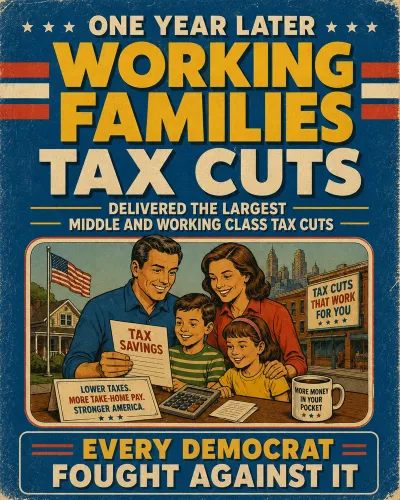
The White House claims Republicans have enacted the largest tax cut in US history, with a key provision eliminating federal taxes on tips for millions of service and hospitality workers — a campaign promise now declared delivered.
Key Takeaways
The White House announced on October 29, 2026 that Republicans have passed what it calls the largest tax cut in US history.
The legislation includes a zero federal income tax on tips , directly benefiting an estimated 4 million-plus tipped workers in service and hospitality industries.
The benchmark this claim challenges is the Tax Cuts and Jobs Act of 2017 , which cut the corporate tax rate from 35% to 21% . 'No tax on tips' was a flagship Republican campaign proposal in 2024 , making this announcement a direct claim of election-promise fulfilment.
Implementation guidance from the US Treasury and the IRS will determine how the exemption applies to 2026 tax returns .
The policy's final economic scale and the 'largest in history' designation await independent verification.
A promise made to millions of American service workers has, according to the White House, now become law — and it comes packaged as the single largest tax cut in United States history. The White House announced on Thursday, October 29, 2026 that Republicans have delivered legislation eliminating taxes on tips for tipped workers across the country, framing it as a defining economic achievement.
What the 'no tax on tips' policy means for workers
For the roughly 4 million tipped workers in the United States — waitstaff, bartenders, hotel porters, rideshare drivers, and salon workers among them — gratuities have historically been treated as ordinary income by the Internal Revenue Service (IRS), subject to federal income tax just like a base wage. The new policy, as claimed by the White House, removes that federal tax obligation on tip income entirely. The immediate effect: a worker earning a $15,000 annual base wage plus $20,000 in tips would no longer owe federal income tax on the tip portion.
The hospitality and service sectors, which employ a disproportionately large share of lower-to-middle income earners, have long argued that tip taxation effectively penalises workers whose wages are structured to rely on customer generosity. The policy directly answers that grievance.
How this fits the Republican tax-cut lineage
The claim of 'largest tax cut in history' is a significant one. The benchmark it implicitly challenges is the Tax Cuts and Jobs Act (TCJA) of 2017, which slashed the corporate rate from 35% to 21% and restructured individual income brackets — itself billed at the time as the most consequential overhaul of the US tax code in decades. For Republicans to now claim an even larger cut suggests the current legislation combines extensions or expansions of the TCJA's provisions with the new tip-tax exemption and potentially other rate adjustments.
The 'no tax on tips' proposal had been a centrepiece of Republican campaign rhetoric heading into 2024, aimed squarely at mobilising service-industry voters — a demographic that crosses traditional political lines. Translating that campaign promise into enacted law is the signal the White House is now sending: delivery, not just rhetoric.
What comes next: Treasury guidance and your 2026 return
The political announcement is only the first step. Workers and employers will be watching the US Treasury and the IRS for implementation guidance — specifically, how tip income will be classified and reported on 2026 tax returns. Will all gratuities qualify, or only those in specific sectors? Does the exemption have an income cap? The fine print will determine how broadly the benefit lands.
Congressional Republicans are likely to use this moment as a springboard heading into the midterm cycle, with the White House framing the achievement in the most sweeping possible terms. Whether the 'largest in history' label survives independent economic scrutiny remains an open question — but for a bartender in Chicago or a food-delivery worker in Phoenix, the arithmetic on their next tax filing may tell the story more plainly than any headline.
Point of View
Worker-facing benefit at the centre of what has traditionally been a business-oriented tax agenda. The 'no tax on tips' provision is strategically shrewd: it targets a geographically and demographically diverse workforce that does not align neatly with either party, making it a potential crossover win. For India-watchers, the development is a signal that US consumer spending power in the hospitality sector could see a modest boost, with downstream effects on tourism-linked and remittance-connected households. The larger question is whether the policy's macroeconomic footprint — and its revenue cost — will reshape the fiscal debate in Washington for the next legislative cycle.
NationPress
30 Oct 2026
Frequently Asked Questions
What does 'no tax on tips' mean in the US?
It means tipped workers — such as waitstaff, bartenders, and hotel employees — will no longer owe federal income tax on gratuities they receive from customers. Tips were previously treated as ordinary taxable income by the IRS.
Is this the biggest tax cut in US history?
The White House has claimed it is the largest tax cut in US history. The previous benchmark was the Tax Cuts and Jobs Act of 2017, which cut the corporate rate from 35% to 21%. Independent verification of the 'largest ever' claim is pending.
Who benefits from the no-tax-on-tips law?
Primarily workers in service industries — restaurants, hotels, salons, and transportation — whose compensation includes customer gratuities. These workers tend to be lower-to-middle income earners who rely significantly on tip income.
When does the no-tax-on-tips policy take effect?
The White House announcement was made on October 29, 2026. The IRS and US Treasury are expected to issue guidance on how the exemption will apply to 2026 tax returns, though exact implementation timelines are yet to be publicly confirmed.
Was 'no tax on tips' a Republican campaign promise?
Yes. Eliminating federal taxes on tip income was a prominent Republican campaign proposal during the 2024 election cycle, specifically aimed at mobilising service-sector workers. The White House announcement frames the legislation as fulfilment of that pledge.