White House Hails GOP Tax Cut as Largest in History
Synopsis
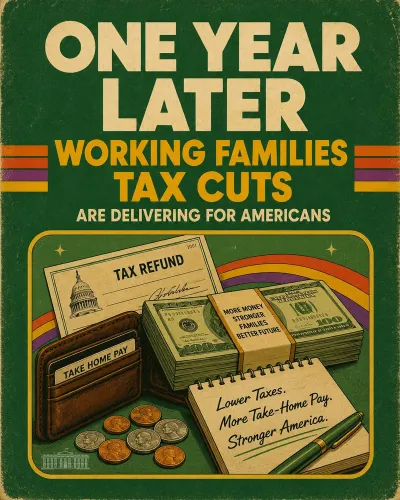
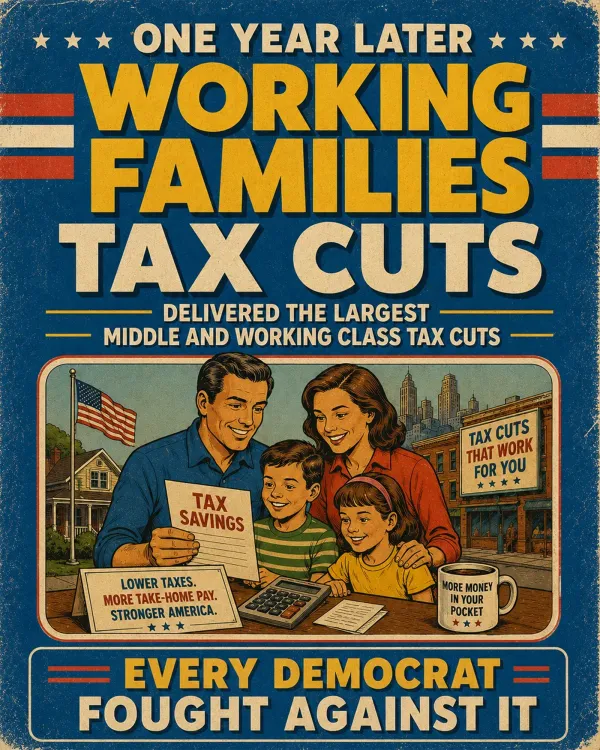
The White House on 8 July 2026 declared Republicans passed 'the largest tax cut in history' under President Trump with no Democratic support, framing the Tax Cuts and Jobs Act as a reward for working Americans — a message that signals a fresh push to extend expiring 2017 tax provisions.
Key Takeaways
The White House posted on 8 July 2026 claiming Republicans passed the largest tax cut in U.S. history.
The post asserts every Democrat voted against the legislation, drawing a sharp partisan contrast.
The legislation referenced is the Tax Cuts and Jobs Act , signed in December 2017 , which cut the corporate rate from 35% to 21% .
Several individual and pass-through provisions of the 2017 law were set to expire after 2025 , making extension a live congressional issue.
Republican tax-cut messaging follows a pattern dating to the 1981 Reagan cuts, consistently framing lower rates as rewards for productive citizens.
The thread format of the post signals a sustained White House communications campaign on the tax issue.
The White House posted on X on Wednesday, 8 July 2026, asserting that Republicans passed 'the largest tax cut in history' while every Democrat voted against it, framing the legislation as a reward for hard work and a restoration of the American Dream.
Context
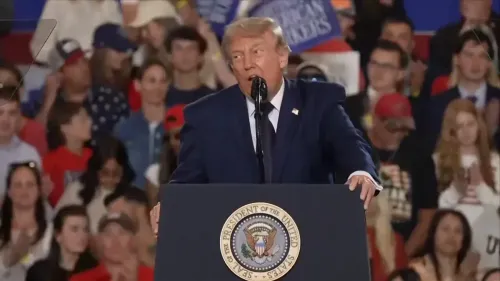
The post, attributed to the official White House communications account, declares: 'Americans won't forget: Republicans passed the largest tax cut in history while every Democrat voted against it.' It positions President Donald Trump and the Republican Party as champions of working Americans, arguing the legislation puts 'more money back in the pockets of those who earned it.'
The statement is part of a thread — signalled by the 🧵 emoji — suggesting additional detail on specific provisions or beneficiaries was shared in subsequent posts.
Policy Backdrop
The legislation at the centre of this claim is the Tax Cuts and Jobs Act (TCJA), signed into law in December 2017 during Trump's first term, under unified Republican control of Congress and the White House. The law slashed the corporate tax rate from 35% to 21% and restructured individual income brackets, passing without a single Democratic vote in either chamber.
Republican messaging around tax policy follows a well-established arc stretching from the Reagan administration's 1981 cuts through the Bush-era reductions of 2001 and 2003: frame lower rates as a direct dividend for productive citizens and a driver of broader economic growth. The TCJA fits squarely in that lineage.
Critically, several individual and pass-through provisions of the 2017 law were set to expire after 2025, making congressional action on extensions or modifications a live legislative question at the time of this post. White House messaging of this nature typically intensifies when fiscal deadlines approach or new tax legislation is under active debate.
Stakeholders and Impact
American middle-income workers, small-business owners, and U.S. corporations are the constituencies the White House rhetoric centres on. Supporters of the TCJA argue reduced corporate rates spurred investment and wage growth; critics, primarily Democrats, have long contended the cuts disproportionately benefited high earners and added to the federal deficit.
The partisan framing — 'every Democrat voted against it' — is designed to draw a sharp electoral contrast, reminding voters of the unified Republican authorship of the cuts ahead of any legislative renewal fight. For Indian observers and global markets, U.S. corporate tax policy has downstream effects on multinational investment flows, technology sector valuations, and the broader dollar-denominated economy.
What's Next
Congressional Republicans are expected to pursue legislation to make expiring TCJA provisions permanent or extend them further, a battle that will test party unity and force Democrats to publicly defend or modify their opposition. The White House thread format suggests a sustained communications push is underway to build public support for that effort.
How the debate resolves will shape U.S. fiscal policy for years, with implications for the federal deficit, interest rates, and global capital allocation — all variables watched closely by investors and policymakers worldwide, including in India.
Point of View
A classic incumbent tactic when an administration wants to own a legislative achievement before it faces expiry or revision. Anchoring the message in 'hard work' and the 'American Dream' signals the White House is pitching the tax debate as a values contest, not merely a fiscal one. For observers tracking U.S. legislative dynamics, this kind of sustained executive messaging usually precedes a concrete floor vote or a budget reconciliation push.
NationPress
7 Oct 2026
Frequently Asked Questions
What is the largest tax cut in US history that the White House is referring to?
The White House is referring to the Tax Cuts and Jobs Act , signed by President Trump in December 2017 , which reduced the corporate tax rate from 35% to 21% and restructured individual income brackets — the most sweeping overhaul of the U.S. tax code in decades.
Did any Democrats vote for the Trump tax cut?
No. The Tax Cuts and Jobs Act of 2017 passed without a single Democratic vote in either the House of Representatives or the Senate, a fact the White House post explicitly highlights.
Why is the White House talking about the 2017 tax cut in 2026?
Several key provisions of the 2017 TCJA — particularly those affecting individual filers and pass-through businesses — were set to expire after 2025 , making their extension a major congressional priority and prompting renewed White House messaging to build public support.
How does the US tax cut affect India and global markets?
U.S. corporate tax rates influence where multinationals invest, affecting technology sector valuations, foreign direct investment flows, and dollar liquidity — all of which have indirect consequences for Indian equity markets and export-oriented industries.
What happens next with US tax policy after this White House announcement?
Congressional Republicans are expected to push legislation to make expiring TCJA provisions permanent; the outcome will shape U.S. fiscal policy, the federal deficit trajectory, and global capital flows for years ahead.