White House Marks One Year of Working Families Tax Cuts
Synopsis
The White House on 3 July 2026 celebrated the first anniversary of President Trump's Working Families Tax Cuts, claiming the law is delivering a 'blue-collar boom.' The administration framed it as once-in-a-generation legislation, with wage and employment data expected to be cited as evidence in the months ahead.
Key Takeaways
The White House on 3 July 2026 marked one year since President Donald Trump signed the Working Families Tax Cuts into law.
The administration described the legislation as 'once-in-a-generation' and credited it with unleashing a 'blue-collar boom.' The law's stated focus on working families and blue-collar workers distinguishes it rhetorically from the broader corporate focus of the 2017 Tax Cuts and Jobs Act .
Upcoming quarterly data on wages, employment, and manufacturing will serve as independent tests of the administration's economic claims.
The anniversary post was timed one day before 4 July , linking the economic message to national celebration.
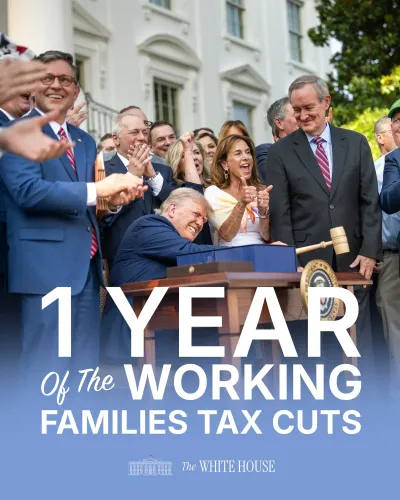
The White House on Friday, 3 July 2026 marked the first anniversary of President Donald Trump's Working Families Tax Cuts legislation, declaring that the law is delivering on its promises and fuelling what it called a 'blue-collar boom' across the United States.
Context
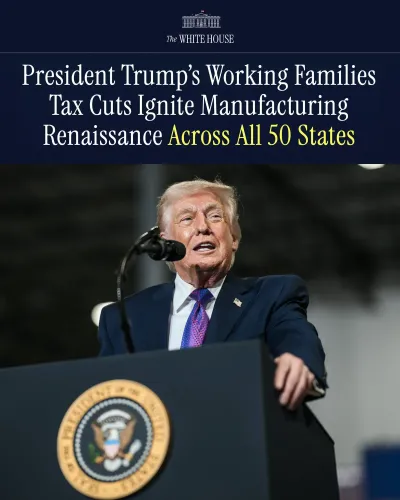
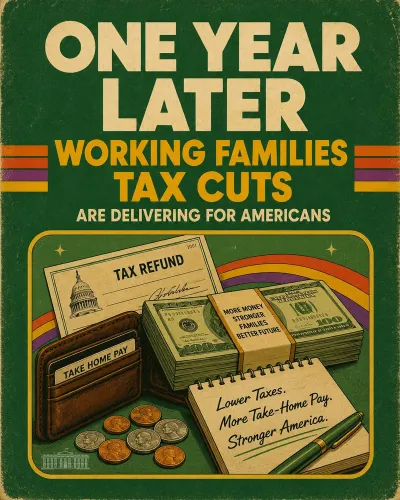
The official White House account posted that 'one year after President Trump signed the Working Families Tax Cuts into law, this once-in-a-generation legislation is delivering on its promises and unleashing a blue-collar BOOM.' The post accompanied an image and a link, framing the anniversary as a milestone for working and industrial-class Americans.
The administration's language — 'once-in-a-generation legislation' — signals an effort to position the law alongside landmark tax reforms in American history. The explicit focus on 'blue-collar' workers reflects a deliberate political framing aimed at the industrial and manufacturing workforce.
Policy Backdrop
The Working Families Tax Cuts is presented by the administration as a successor to the broader tradition of Republican tax reform. The most recent comparable overhaul before this legislation was the Tax Cuts and Jobs Act signed by President Trump in December 2017, which reduced individual and corporate tax rates and restructured several deductions.
Republican administrations have historically framed tax-rate reductions as pro-growth measures that benefit middle-income and industrial workers. That argument was central to the 2017 overhaul as well, though economists and policy analysts have continued to debate its distributional outcomes and long-term revenue effects.
The current legislation, per the White House's own characterisation, appears to sharpen that focus specifically on working families and blue-collar employment — a rhetorical and policy shift from the broader corporate emphasis that defined the 2017 act.
Stakeholders and Impact
The primary beneficiaries cited by the administration are working families and blue-collar workers — a constituency that spans manufacturing, construction, logistics, and service industries. The White House's framing suggests the law includes provisions specifically structured to benefit lower- and middle-income wage earners rather than primarily high-income households or corporations.
Upcoming quarterly data on wages, employment, and manufacturing output will be closely watched as independent indicators of whether the administration's claims of a 'blue-collar boom' are borne out in official economic statistics. The administration is expected to cite favourable data releases in the months ahead to reinforce its anniversary messaging.
What's Next
With the 4 July Independence Day holiday falling the following day, the timing of the White House post appears deliberate — linking economic patriotism with national celebration. The administration is likely to continue amplifying anniversary milestones and economic data points through the summer to sustain momentum around the legislation.
Congressional debates over tax policy, federal revenue, and social spending will continue to shape how the Working Families Tax Cuts are evaluated beyond the White House's own narrative. Independent economic assessments of wage growth and employment trends will be critical in determining the law's broader legacy.
Point of View
The Trump administration is reinforcing its repositioning of the Republican Party as a working-class vehicle, a strategic shift that has defined its electoral coalition since 2016. The invocation of 'once-in-a-generation' stakes the law's place in history before independent economic verdicts are fully in. How quarterly wage and manufacturing data land in the coming months will determine whether this framing holds or becomes a liability.
NationPress
2 Oct 2026
Frequently Asked Questions
What is the Working Families Tax Cuts law signed by Trump?
The Working Families Tax Cuts is a federal tax reform legislation signed by President Donald Trump, which the White House says is specifically designed to benefit working families and blue-collar workers in the United States.
When did Trump sign the Working Families Tax Cuts?
According to the White House's anniversary post on 3 July 2026, the law was signed one year prior, placing its enactment in mid-2025.
What is the blue-collar boom the White House is referring to?
The White House used the phrase 'blue-collar boom' to describe what it says is an economic expansion benefiting industrial and working-class workers following the passage of the Working Families Tax Cuts.
How is the Working Families Tax Cuts different from the 2017 Tax Cuts and Jobs Act?
While the 2017 Tax Cuts and Jobs Act broadly reduced individual and corporate tax rates, the Working Families Tax Cuts is framed by the administration as more specifically targeted at working families and blue-collar wage earners rather than corporations.
How will economists judge the impact of the Working Families Tax Cuts?
Independent assessments will rely on quarterly government data covering wage growth, employment levels, and manufacturing output — figures the administration is expected to highlight when favourable.