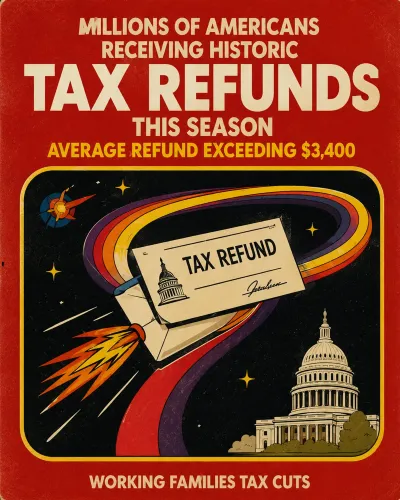
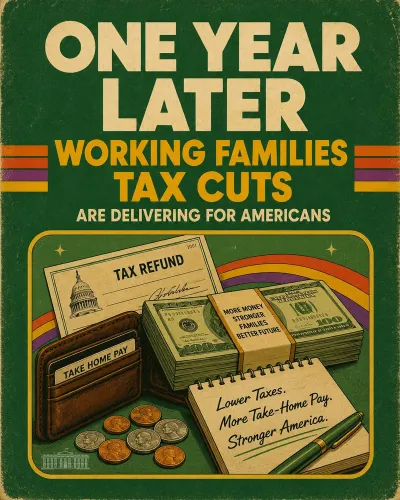
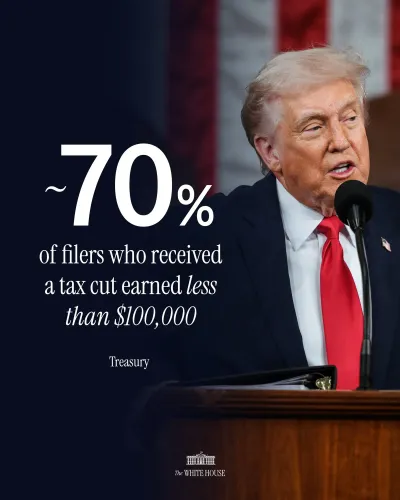
White House Touts 'Record Tax Cuts' Boosting Worker Pay
Synopsis
The White House declared on 23 May 2026 that President Trump is delivering 'record tax cuts' to boost household take-home pay, intensifying messaging around worker-focused tax policy as Congressional debates over extending the 2017 Tax Cuts and Jobs Act continue.
Key Takeaways
The White House posted on 23 May 2026 claiming President Trump is enacting 'record tax cuts' for American workers.
The post was accompanied by a video, indicating a coordinated communications campaign.
The messaging is rooted in the Tax Cuts and Jobs Act , signed in December 2017 , the largest US tax overhaul in decades.
Key individual provisions of the TCJA were scheduled to expire after 2025 , making their extension a live legislative issue.
The administration frames lower taxes as directly increasing household take-home pay for American workers .
Congressional action on tax extension legislation remains the critical next step.
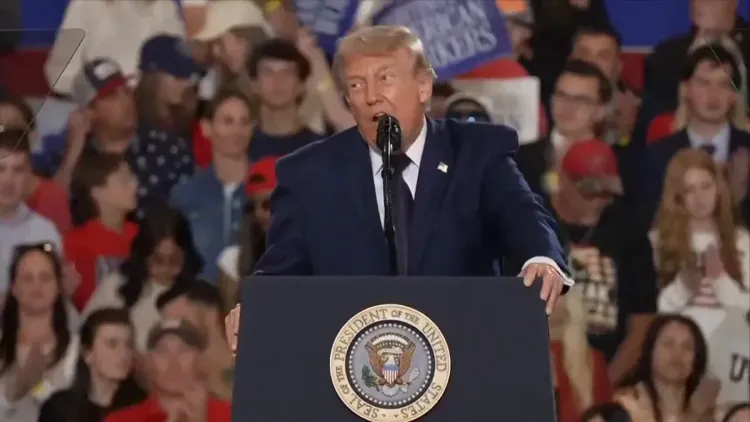
The White House on Saturday, 23 May 2026 posted a direct message on X claiming that President Donald Trump is delivering 'record tax cuts' and boosting household take-home pay, framing the policy as a fight for American workers.
Context
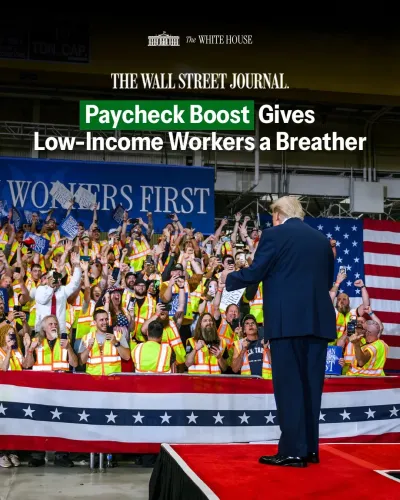
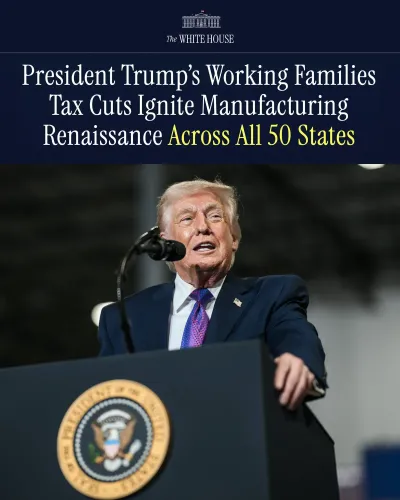
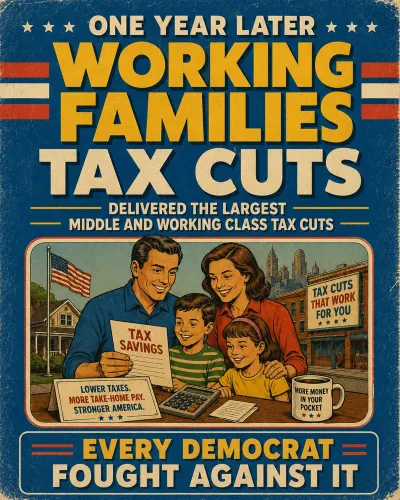
The post states plainly: 'RECORD tax cuts. Boosting household take-home-pay. President Trump is fighting for American workers.' The all-caps emphasis on 'RECORD' signals an effort to frame current tax policy as historically significant, positioning the administration as a champion of working-class income.
The message was accompanied by a video, suggesting a broader communications push aimed at amplifying the tax-cut narrative to a wide audience ahead of expected legislative activity.
Policy Backdrop
The messaging draws a direct line from Trump's first-term signature legislation, the Tax Cuts and Jobs Act (TCJA), signed into law in December 2017. That law represented the most sweeping overhaul of the United States federal tax code in decades, lowering both individual income tax rates and the corporate tax rate.
Key individual provisions of the TCJA were set to expire after 2025, making their extension a central legislative battleground. Congressional debates over whether to make those cuts permanent — or allow them to lapse — have kept tax policy at the forefront of economic messaging from the executive branch.
The White House's framing — that lower taxes directly translate into higher take-home pay for households — is a long-standing supply-side argument that has anchored Republican economic policy since the Reagan era and was revived prominently during the first Trump administration.
Stakeholders and Impact
American workers and households are the stated beneficiaries of the policy. Proponents argue that reduced withholding and lower marginal rates leave more money in workers' paychecks each month, stimulating consumer spending and economic growth.
Critics have historically countered that the largest gains from such cuts flow disproportionately to higher-income earners and corporations, while adding to the federal deficit. The debate over distributional impact remains active in Congressional Budget Office analyses and academic research.
For India, which counts the United States as its largest export destination and hosts a significant Indian-American professional community, shifts in US household income and corporate tax structures can influence bilateral trade flows, investment patterns, and remittances.
What's Next
Congressional action on extending or expanding the TCJA provisions remains the key legislative watch-point. The White House's social media push signals the administration intends to build public pressure in favour of its tax agenda.
How US lawmakers respond — and whether a tax package moves through Congress — will determine whether the 'record cuts' framing translates into durable policy or remains a campaign-style message ahead of future electoral cycles.
Point of View
All-caps post is textbook base-mobilisation messaging — designed to cut through policy complexity and anchor the administration's economic identity around worker benefit rather than corporate gain. By invoking 'record' cuts without a specific figure, the communication trades precision for emotional resonance, a deliberate choice that keeps the narrative broad enough to absorb any legislative outcome. This fits a wider pattern of executive social media being used to shape the terms of Congressional debate before a vote is called. For observers tracking US fiscal policy, the intensity of this messaging is itself a signal that the administration sees tax extension as both a legislative priority and an electoral asset.
NationPress
21 Sept 2026
Frequently Asked Questions
What tax cuts is the White House referring to in its May 2026 post?
The White House is referencing tax reductions associated with President Trump's administration, building on the Tax Cuts and Jobs Act signed in December 2017 , which lowered individual and corporate tax rates. The post claims these amount to 'record' cuts boosting worker take-home pay.
What is the Tax Cuts and Jobs Act and why does it matter in 2026?
The Tax Cuts and Jobs Act (TCJA) was a sweeping 2017 federal tax overhaul under President Trump's first term. Many of its individual income tax provisions were set to expire after 2025 , making their extension a major point of Congressional debate and a central plank of White House economic messaging.
How do Trump's tax cuts affect household take-home pay?
The administration argues that lower marginal income tax rates reduce withholding, leaving workers with more money in each paycheck. Critics note that the distribution of benefits varies significantly by income level, with higher earners receiving proportionally larger absolute gains.
Does the US tax policy affect India?
Yes, indirectly. The United States is India 's largest export market, and US corporate tax rates influence American investment decisions abroad, including in India. Additionally, changes in US household income can affect remittances sent by the large Indian-American professional community.
What happens next with US tax cuts in Congress?
Congressional lawmakers are debating whether to make expiring TCJA provisions permanent or allow them to lapse. The White House's public messaging campaign is widely seen as an effort to build political pressure on legislators ahead of a potential vote on a tax extension package.