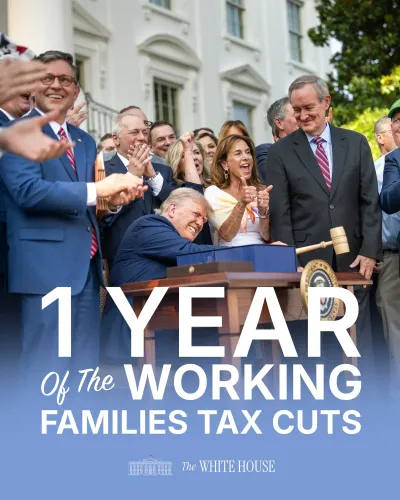
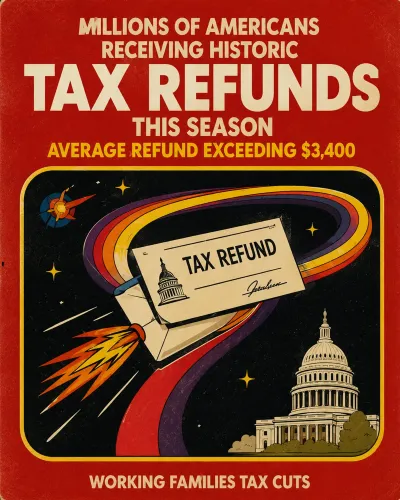
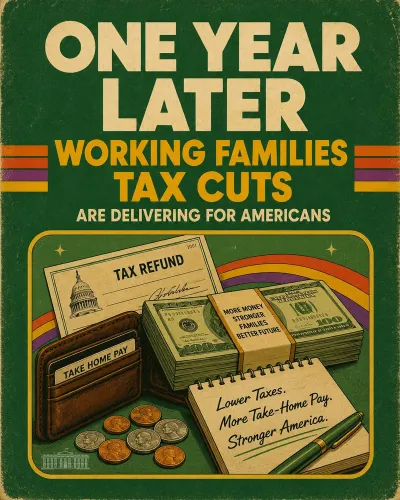
White House Claims Historic Tax Refunds One Year After Working Families Cuts
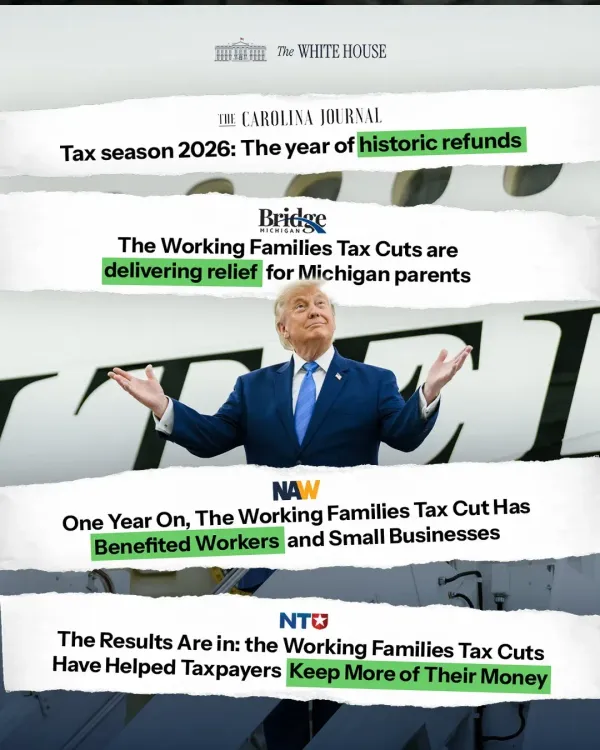
Synopsis
The White House has declared that the Working Families Tax Cuts have delivered historic refunds across America in their first year, marking the milestone on July 3, 2026. The announcement precedes Independence Day and is expected to anchor the administration's economic messaging ahead of the next political cycle.
Key Takeaways
The White House announced on July 3, 2026 that the Working Families Tax Cuts have completed one year of implementation.
The administration claims the policy has produced 'historic refunds' for households across America , though no specific figures were cited in the post.
The announcement follows a well-established pattern of administrations highlighting IRS refund data after the first filing cycle post-legislation.
The Tax Cuts and Jobs Act of 2017 is the most recent comparable precedent, having lowered individual rates and expanded the Child Tax Credit .
Full verification of the 'historic' refund claim will depend on the release of complete IRS 2025-26 filing-season statistics .
Debates over revenue impact and distributional effects are expected to intensify as congressional scrutiny of the legislation continues.
The White House, the official communications account of the Executive Office of the President of the United States, declared on Thursday, July 3, 2026, that the Working Families Tax Cuts have delivered what it called 'historic refunds' across America in their first year of implementation.
Context
The post, shared via the official @WhiteHouse account, marks the one-year milestone of the Working Families Tax Cuts, stating the legislation has produced 'HISTORIC REFUNDS across America.' The announcement arrives ahead of Independence Day on July 4, 2026, a timing that amplifies its political resonance. No specific refund figures were cited in the post itself.
Tax refund messaging of this kind typically draws on data released by the Internal Revenue Service (IRS) during the annual filing season. Administrations routinely highlight such statistics as evidence of relief delivered to middle-income households, particularly after the first full filing cycle following a legislative change.
Policy Backdrop
The Working Families Tax Cuts represent the latest in a line of U.S. tax legislation aimed at reducing the burden on lower- and middle-income earners. The most significant recent precedent was the Tax Cuts and Jobs Act of 2017, which lowered individual income tax rates and expanded the Child Tax Credit, benefiting a broad swathe of American households.
The current measure appears to follow a similar structural approach — rate reductions and credit expansions marketed as targeted relief. Such legislation has historically sparked parallel debates over long-term revenue effects and whether the distributional benefits are concentrated among higher earners or genuinely reach working families.
Stakeholders and Impact
Working families and individual tax filers across the United States are the primary beneficiaries cited in the White House's framing. A larger-than-usual refund in a given filing season can indicate that withholding tables were adjusted to reflect lower tax liability, resulting in more money returned at year-end settlement.
Critics of such policies, however, often argue that larger refunds can also reflect over-withholding rather than a net gain for households, and that the revenue cost of broad tax cuts can constrain future public spending. Any full assessment would depend on the complete IRS filing-season statistics for 2025-26, which have not yet been independently verified.
What's Next
Attention will now turn to the IRS release of full 2025-26 filing-season data, which would provide the granular breakdown of average refund sizes, the number of filers who benefited, and the distributional spread across income brackets. Congressional hearings on the revenue impact of the Working Families Tax Cuts and any proposals for extension or modification are also expected to follow.
The White House's one-year anniversary messaging signals that the administration intends to make this tax legislation a centrepiece of its economic record heading into the next political cycle, setting up a broader debate over fiscal sustainability and household relief in the months ahead.
Point of View
Designed to lock in a narrative of household relief before independent data can complicate the picture. By leading with the word 'historic' without attaching a specific figure, the administration claims the headline while leaving the verification burden to others. This mirrors a long-standing pattern in U.S. fiscal politics where the first filing cycle after a tax change becomes the primary battleground for public opinion. The timing — the eve of Independence Day — amplifies the patriotic resonance and makes counter-messaging politically costly in the short term.
NationPress
1 Oct 2026
Frequently Asked Questions
What are the Working Families Tax Cuts?
The Working Families Tax Cuts are a U.S. tax legislation measure that, according to the White House, is designed to reduce the tax burden on working and middle-income households through rate reductions and credit expansions. The policy completed its first year in mid-2026.
What does 'historic refunds' mean in the White House tax cuts post?
The White House used the phrase 'historic refunds' to suggest that tax filers received unusually large or widespread refunds during the first filing season after the Working Families Tax Cuts took effect. Specific figures were not provided in the post itself.
How do US tax cuts affect ordinary American families?
Tax cuts that lower individual rates or expand credits like the Child Tax Credit typically reduce the amount of tax owed, which can result in larger refunds at year-end if withholding tables are adjusted. The net benefit depends on a household's income level and the structure of the specific legislation.
What is the IRS filing season and why does it matter for tax cut claims?
The IRS filing season is the annual period when Americans submit their tax returns, typically from January to April. Governments use IRS aggregate data from this period — including average refund sizes — to demonstrate the real-world impact of tax legislation on households.
How does the Working Families Tax Cuts compare to the 2017 Tax Cuts and Jobs Act?
Both measures follow a similar approach of lowering individual income tax rates and expanding credits for households. The 2017 Tax Cuts and Jobs Act is the most significant recent precedent and also sparked debates over its distributional impact and long-term revenue effects, debates that are now re-emerging around the 2026 legislation.