White House Touts 'Working Families Tax Cuts' as Top Relief Driver
Synopsis
The White House on June 2, 2026 said a new analysis confirms its branded 'Working Families Tax Cuts' delivered the largest share of tax relief to American families and wage earners. The post did not cite the issuing agency, but lands as Congress debates extending individual provisions of the 2017 Tax Cuts and Jobs Act set to expire after 2025.
Key Takeaways
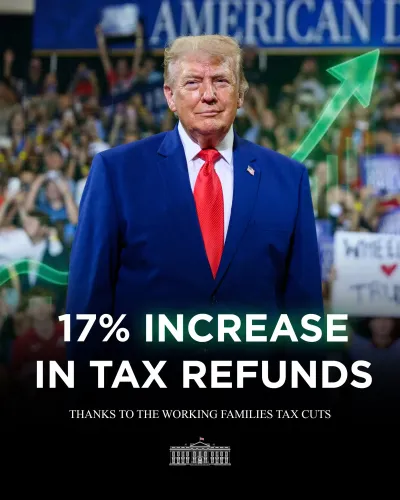
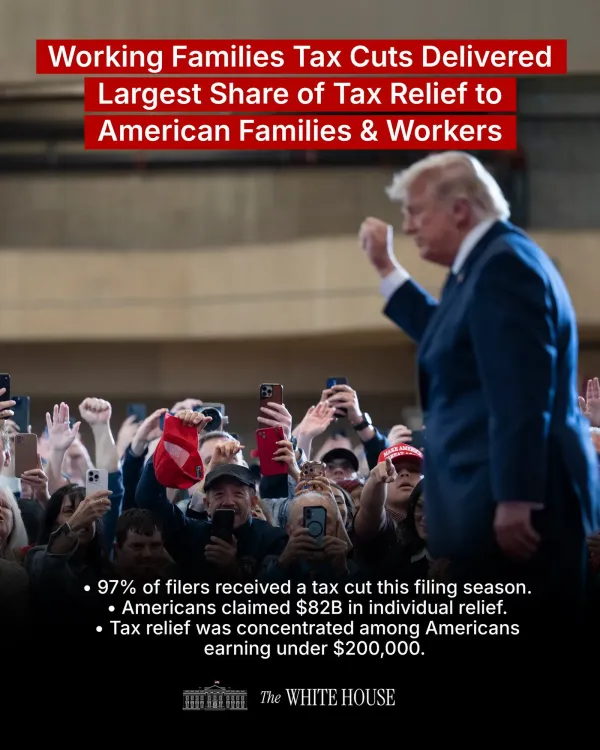
The White House posted the claim on June 2, 2026 via its official X handle, with one accompanying image.
It branded the relief package as the 'Working Families Tax Cuts' and said working people received the largest share.
The post did not name the analysing agency or specify the income bands used in the distribution.
The backdrop is the scheduled expiry of individual provisions of the Tax Cuts and Jobs Act of 2017 after 2025 .
Treasury Department and the Joint Committee on Taxation typically produce such distributional scorecards.
Implications extend to Indian exporters and IT services firms exposed to U.S. household demand.
The White House, the official communications arm of the Executive Office of the President of the United States, on Tuesday, June 2, 2026, posted a message on X claiming that a package it branded the 'Working Families Tax Cuts' has delivered the largest share of tax relief to American families and wage earners. The post, accompanied by a single image, framed the development as the result of a fresh distributional analysis.
In its post, the White House stated: 'NEW ANALYSIS CONFIRMS: The Working Families Tax Cuts just delivered the LARGEST share of tax relief to American families and hardworking people across the country!' It added that the measure puts 'more money back in your pocket where it belongs.' The message did not specify the issuing agency, the time period covered, or the income cohorts referenced.
Context
The post is part of a broader communications push from the executive branch highlighting the household-level effects of recent federal tax policy. By emphasising the share of relief flowing to working and middle-income earners, the administration is positioning the package as a wage-earner-focused intervention rather than one tilted toward higher brackets.
The branding 'Working Families Tax Cuts' is being used by the White House as the marketing umbrella for the relief measures it credits with the outcome. Distributional claims of this kind are typically backed by tables prepared by federal scoring bodies, though the X post itself did not link to the underlying document.
Policy backdrop
U.S. tax policy in recent years has been shaped by the Tax Cuts and Jobs Act of 2017, which permanently reduced the corporate income tax rate while temporarily lowering individual brackets, expanding the standard deduction, and enlarging the child tax credit through 2025. The expiration of those individual provisions has driven a fresh round of legislative activity and political messaging around who benefits most from any extension or replacement.
The U.S. Treasury Department and the Joint Committee on Taxation routinely publish distributional analyses that break down tax relief by income decile. Such analyses have been a staple of White House communications since the Reagan- and Bush-era cuts, with each administration using the data to frame its preferred policy narrative.
Stakeholders and impact
The primary cohorts cited in the post are middle-income families and hourly and salaried wage earners. For these households, the practical effect of the relief depends on factors such as filing status, the size of the standard deduction, the value of the child tax credit, and marginal rate changes within their bracket.
Employers, payroll processors, and tax preparers are the secondary stakeholders, as withholding tables and quarterly estimated-tax calculations must be aligned with any rate or credit adjustments. State revenue departments that piggyback on federal definitions of taxable income will also need to recalibrate.
For Indian readers, the development matters mainly through two channels: the impact of U.S. household disposable income on consumption-driven demand for Indian exports and IT services, and the signalling effect on global tax-policy debates, where distributional fairness has become a central theme.
What's next
Attention now shifts to whether the administration releases the full underlying analysis, including methodology and the income bands used to define 'working families'. Congressional committees are expected to weigh in with their own scorecards, particularly as lawmakers debate the future of the individual provisions of the 2017 law that are set to lapse.
The forward-looking question is whether the framing of the 'Working Families Tax Cuts' will hold up under independent scrutiny and whether it shapes the next legislative round on extending, modifying, or replacing the expiring individual tax measures.
Point of View
A tactic U.S. administrations have used since the Reagan era to brand tax legislation around a sympathetic cohort. The decision to lead with 'largest share' language, without citing the issuing body in the post itself, suggests the message is calibrated for political mobilisation rather than technical disclosure. The real test arrives when independent scorers publish their own breakdowns and when Congress turns to the expiring 2017 individual provisions. For India-watchers, the relevant signal is U.S. household demand strength, which feeds directly into export and services revenues.
NationPress
23 Sept 2026
Frequently Asked Questions
What are the 'Working Families Tax Cuts' mentioned by the White House?
It is the branding the White House is using for a package of federal tax relief measures it credits with delivering the largest share of benefits to American families and wage earners. The June 2, 2026 X post did not detail the statutory components or the analysing agency.
How is this linked to the Tax Cuts and Jobs Act of 2017?
The 2017 law permanently cut the U.S. corporate tax rate and temporarily lowered individual rates, expanded the standard deduction, and enlarged the child tax credit through 2025. The expiry of those individual provisions has driven the current round of tax-policy messaging and legislative debate.
Why does U.S. tax policy matter for India?
Changes to U.S. household disposable income influence consumption demand for Indian exports and IT services, and broader U.S. tax debates shape global norms on distributional fairness that Indian policymakers track closely.
Did the White House post cite a specific analysis?
The post referred to a 'new analysis' but did not name the issuing agency, the time period, or the income bands used. Such distributional studies are typically prepared by the U.S. Treasury Department or the Joint Committee on Taxation.
What happens next in U.S. tax policy?
Congress is expected to act on extending, modifying, or allowing the expiry of the individual provisions of the 2017 Tax Cuts and Jobs Act, with new distributional scorecards likely to accompany each legislative draft.