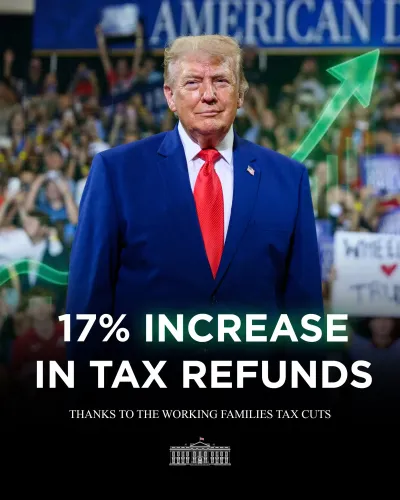
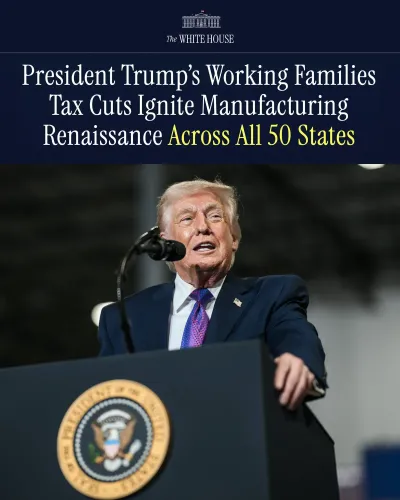
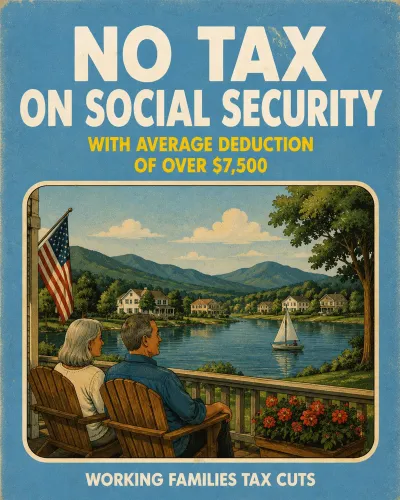
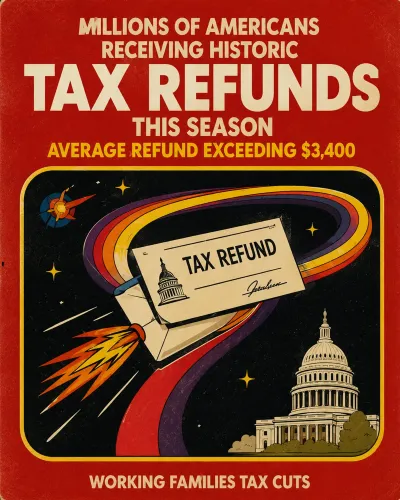
White House marks 1 year of Working Families Tax Cuts law
Synopsis
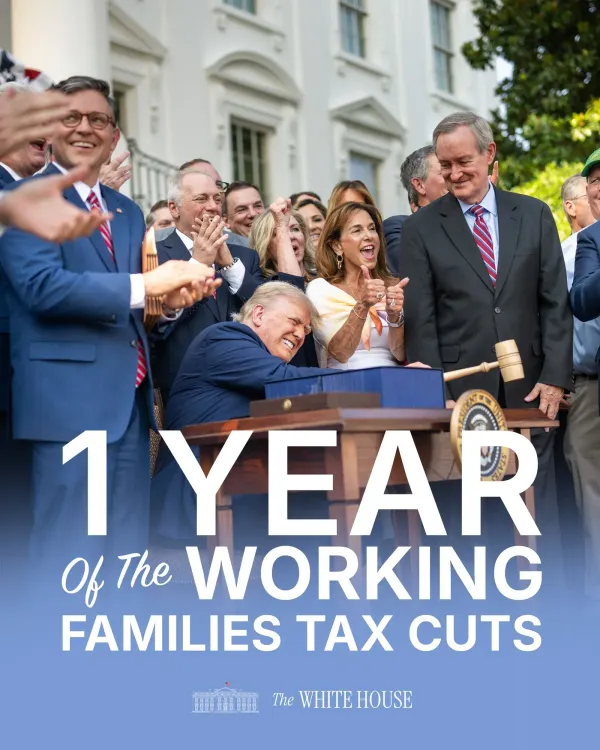
The White House marked one year since the Working Families Tax Cuts were signed into law, calling it the largest tax relief for working families in US history. The 4 July 2026 announcement also credited the legislation with improving national safety and expanding economic opportunity.
Key Takeaways
The White House marked one year since the Working Families Tax Cuts were signed into law on 4 July 2026 .
The administration called it the largest tax cut for working families in US history.
The law is also credited with making the nation safer and expanding economic opportunities, per the White House.
The announcement was timed to Independence Day , amplifying its political symbolism.
Congressional oversight hearings on the law's implementation are expected ahead of the 2027 filing season .
The 'promise made, promise kept' framing positions the legislation as a key plank in the administration's electoral messaging.
The White House marked the first anniversary of the Working Families Tax Cuts on 4 July 2026, declaring the legislation had delivered the largest tax relief to working families in the nation's history while also improving public safety and expanding economic opportunity.
Context
The White House post stated: 'It's been 1 YEAR since the Working Families Tax Cuts were signed into law! In just 365 days, this historic legislation delivered the largest tax cuts to working families, made our nation safer, and opened up more opportunities for everyone.' The announcement was framed as a 'promise made, promise kept' moment, timed to coincide with Independence Day — a symbolically charged date for domestic policy messaging.
The legislation, signed into law in July 2025, represents the most significant overhaul of the federal tax code since the Tax Cuts and Jobs Act of December 2017, which had previously lowered individual and corporate rates and restructured deductions for American households.
Policy Backdrop
US tax policy has historically featured recurring cycles of rate reductions advanced under arguments of economic growth and family relief. The 2017 Tax Cuts and Jobs Act, the 2003 Bush-era cuts, and the 2001 Economic Growth and Tax Relief Reconciliation Act each carried similar messaging centred on returning money to working households.
The Working Families Tax Cuts follows that lineage, with the administration positioning the law as the most consequential iteration yet. The White House's framing on the anniversary — emphasising both economic relief and national safety — suggests the law contains provisions spanning fiscal and public-security domains, though the specific legislative text and revenue figures have not been independently detailed in this announcement.
Stakeholders and Impact
Working families and individual taxpayers are identified as the primary beneficiaries of the legislation. The administration's claim of 'largest tax cuts to working families' signals that the relief is targeted at lower and middle-income earners rather than corporations alone — a distinction that has political salience ahead of future budget cycles.
The reference to the law making 'our nation safer' indicates the legislation may have included funding or provisions linked to public safety, though the White House post does not specify the mechanism. Congressional tax-writing committees are expected to schedule oversight hearings on implementation effects ahead of the 2027 filing season, which will provide a fuller accounting of the law's economic impact.
What's Next
With the one-year milestone now marked, attention will turn to measurable outcomes: wage growth data, household disposable income figures, and any safety-related metrics tied to the law's provisions. The administration is likely to use this anniversary as a campaign-season anchor, reinforcing the 'promise kept' narrative heading into the next electoral cycle.
Budget debates in Congress will also test the law's durability, as opposition lawmakers may challenge revenue projections or seek modifications during upcoming appropriations discussions. The broader trajectory of US tax policy — and whether these cuts are extended, expanded, or rolled back — remains a defining question for Washington DC in the months ahead.
Point of View
Fusing patriotic symbolism with a domestic policy win. The 'promise made, promise kept' framing is a standard re-election-cycle device, echoing the messaging architecture used around the 2017 tax overhaul. The addition of a 'safer nation' claim is notable — it broadens the law's political footprint beyond fiscal policy and pre-empts criticism that tax cuts benefit only the wealthy. Congressional oversight hearings ahead of the 2027 filing season will be the first real stress test of these claims.
NationPress
3 Oct 2026
Frequently Asked Questions
What are the Working Families Tax Cuts?
The Working Families Tax Cuts is a US federal law signed in July 2025 that the White House describes as delivering the largest tax relief to working families in American history, along with provisions linked to public safety and economic opportunity.
When was the Working Families Tax Cuts signed into law?
The White House confirmed the law was signed one year before 4 July 2026 , placing the signing date in July 2025 .
How does the Working Families Tax Cuts compare to the 2017 Tax Cuts and Jobs Act?
The administration has positioned the Working Families Tax Cuts as the most significant federal tax overhaul since the Tax Cuts and Jobs Act of December 2017 , with a sharper focus on relief for working and middle-income households.
Who benefits from the Working Families Tax Cuts?
The White House identifies working families and individual taxpayers as the primary beneficiaries, with the framing emphasising lower and middle-income earners over corporations.
What happens next after the one-year anniversary of the Working Families Tax Cuts?
Congressional tax-writing committees are expected to hold oversight hearings ahead of the 2027 filing season , and upcoming budget debates in Congress will test whether the cuts are extended, modified, or challenged.