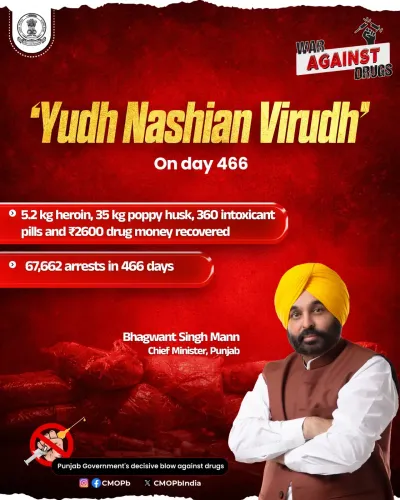
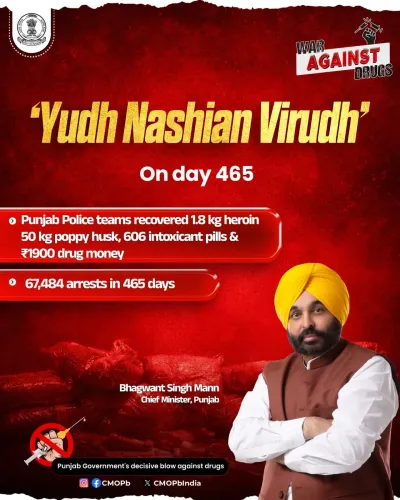
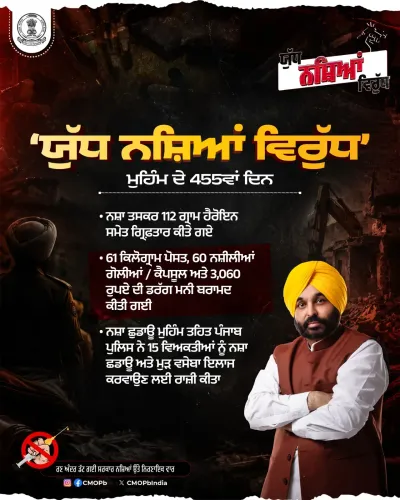
Punjab Police Marks 494 Days of Yudh Nashian Virudh Drive
Synopsis
Punjab Police's 'Yudh Nashian Virudh' anti-narcotics drive entered its 494th day on July 8, 2026, with cumulative arrests reaching 72,519. Fresh recoveries included heroin, opium, poppy husk, and intoxicant pills. Twenty-four persons were referred for de-addiction treatment, underscoring the campaign's dual enforcement-and-rehabilitation approach.
Key Takeaways
Punjab Police completed 494 consecutive days of the 'Yudh Nashian Virudh' anti-narcotics drive as of July 8, 2026 .
Cumulative arrests of drug smugglers under the campaign have reached 72,519 .
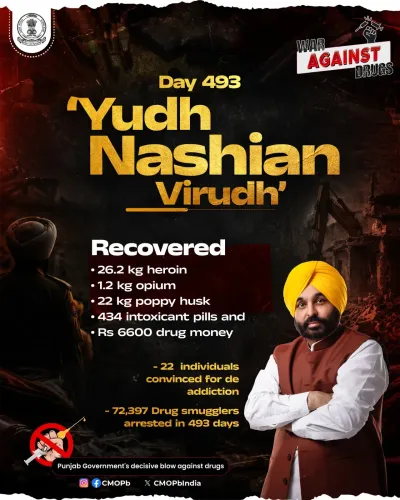
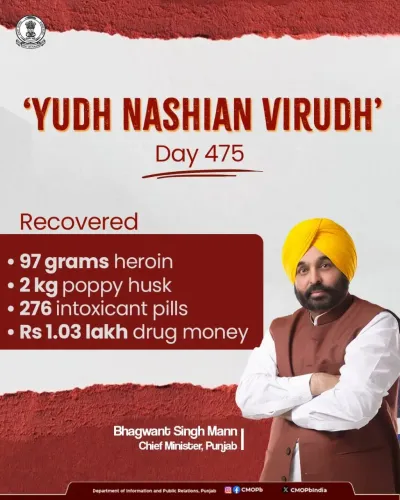
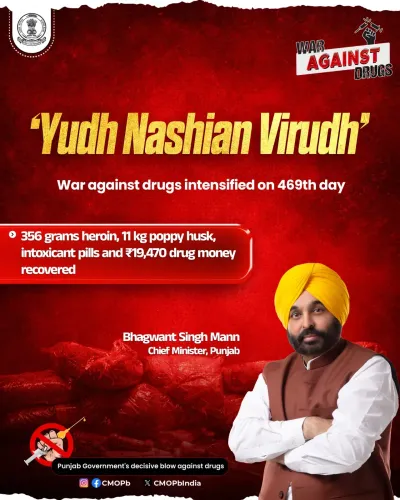
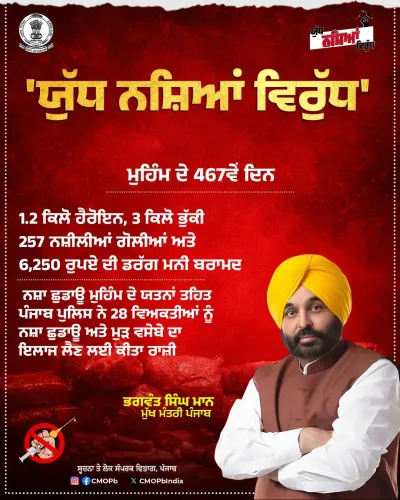
Day-494 seizures included 1.3 kg heroin , 790 grams opium , 1.7 kg poppy husk , 677 intoxicant pills , and Rs 1,800 in drug money.
24 persons were counselled and referred for voluntary de-addiction and rehabilitation treatment on the same day.
The drive was launched in June 2022 by the AAP government under Chief Minister Bhagwant Mann as Punjab's flagship anti-drug initiative.
The campaign combines daily enforcement operations with a rehabilitation referral component targeting drug-dependent individuals.
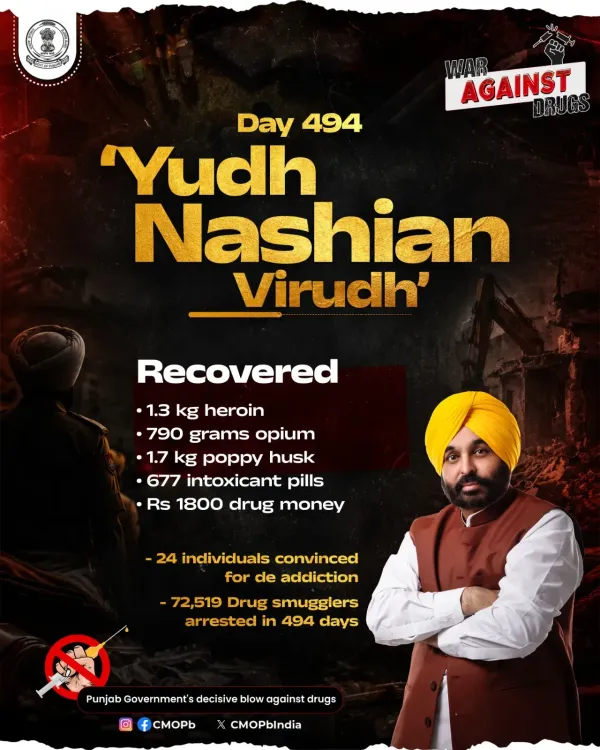
Punjab Police continued its flagship anti-narcotics campaign 'Yudh Nashian Virudh' into its 494th consecutive day on Wednesday, July 8, 2026, with the Chief Minister's Office of Punjab announcing fresh seizures and arrests that pushed the cumulative tally of drug smugglers apprehended to 72,519. The latest operational sweep yielded 1.3 kg heroin, 790 grams opium, 1.7 kg poppy husk, 677 intoxicant pills, and Rs 1,800 in drug money recovered from the possession of arrested smugglers.
Context
The Chief Minister's Office shared the update on X, stating: 'Police teams have continued its drive against drugs 'Yudh Nashian Virudh' for 494th day. With this, the number of total drug smugglers arrested has reached to 72,519 in 494 days.' The post also noted that 24 persons were convinced by Punjab Police to voluntarily undergo de-addiction and rehabilitation treatment as part of the campaign's welfare component.
The campaign, running without a single break since its launch, reflects the Aam Aadmi Party government's stated commitment to making daily, publicly accountable enforcement a cornerstone of its anti-drug strategy in Punjab.
Policy Backdrop
Yudh Nashian Virudh — meaning 'War Against Drugs' in Punjabi — was formally launched in June 2022 by the AAP administration under Chief Minister Bhagwant Mann, who took office in March 2022. The drive was designed as the government's primary institutional response to Punjab's decades-long narcotics crisis, which is structurally linked to the state's proximity to trafficking corridors originating in Pakistan and Afghanistan.
Punjab governments across different political dispensations since the 1990s have cycled between enforcement-heavy crackdowns and rehabilitation-centred models. The current administration has sought to combine both approaches — sustained daily policing paired with voluntary de-addiction referrals — in a bid to demonstrate visible, measurable governance outcomes.
Stakeholders and Impact
The primary beneficiaries of the campaign are Punjab's youth, particularly in border districts that have historically recorded the highest rates of drug dependency and trafficking activity. Each daily update from the CMO serves a dual function: operational accountability for law enforcement and a public deterrence signal to smuggling networks.
The rehabilitation strand of the drive — in which police personnel counsel individuals to seek treatment — addresses a critical gap that pure enforcement models have historically failed to close. The addition of 24 persons referred for de-addiction on day 494 illustrates the campaign's attempt to treat addiction as a public health issue alongside a law-and-order one.
What's Next
Analysts and civil society groups tracking the campaign will watch whether Punjab scales up rehabilitation bed capacity and outpatient infrastructure to absorb the growing number of individuals being referred for treatment. Cross-border coordination mechanisms with central agencies such as the Narcotics Control Bureau remain a longer-term policy lever that could determine whether supply-side pressure is sustained beyond the state's jurisdiction.
As the drive approaches the 500-day milestone, the CMO's daily disclosures will likely face heightened scrutiny on the quality of rehabilitation outcomes, not just the volume of arrests and seizures.
Point of View
519-arrest figure, now approaching a symbolic 75,000, will be a key datapoint the government deploys ahead of any electoral cycle. However, the rehabilitation referral numbers — 24 persons on day 494 — remain modest relative to the scale of the enforcement operation, signalling that the harder, less visible work of recovery infrastructure is still lagging the optics of arrests. The approaching 500-day milestone will test whether the narrative shifts from volume of seizures to verifiable outcomes in de-addiction.
NationPress
9 Jul 2026
Frequently Asked Questions
What is Yudh Nashian Virudh?
'Yudh Nashian Virudh' is Punjab Police's ongoing anti-narcotics enforcement and rehabilitation campaign, launched in June 2022 by the AAP government under Chief Minister Bhagwant Mann. The name means 'War Against Drugs' in Punjabi.
How many drug smugglers have been arrested in Punjab's anti-drug drive?
As of day 494 of the Yudh Nashian Virudh drive on July 8, 2026, a cumulative total of 72,519 drug smugglers have been arrested by Punjab Police.
What drugs were seized on day 494 of the Punjab anti-drug campaign?
On the 494th day of the drive, Punjab Police recovered 1.3 kg heroin, 790 grams opium, 1.7 kg poppy husk, 677 intoxicant pills, and Rs 1,800 in drug money.
What is the de-addiction component of Punjab's Yudh Nashian Virudh?
Alongside enforcement, Punjab Police officers counsel drug-dependent individuals and convince them to voluntarily enter de-addiction and rehabilitation treatment. On day 494, 24 such persons were referred for treatment.
Why is Punjab particularly affected by drug trafficking?
Punjab shares a border with Pakistan and lies along major trafficking routes from Pakistan and Afghanistan, making it structurally vulnerable to heroin and synthetic drug smuggling. The state has grappled with narcotics-related challenges since the 1990s.