White House Backs Rep. Smith's Push for Nebraska Tax Cuts

Synopsis
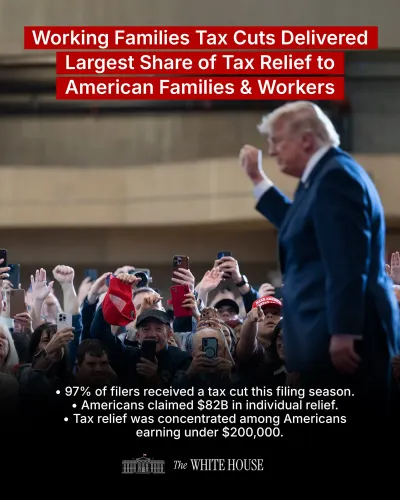
The White House amplified a column by Rep. Adrian Smith of Nebraska on 8 July 2026, asserting that Republican tax cuts are working for the state. The post ties into broader GOP efforts to defend the 2017 Tax Cuts and Jobs Act as Congress faces pressure over expiring provisions.
Key Takeaways
The White House shared Rep.
Adrian Smith 's column on 8 July 2026 backing Republican tax cuts for Nebraska .
Smith represents Nebraska's 3rd congressional district and sits on the House Ways and Means Committee , the primary tax-writing body in Congress.
The column references the Tax Cuts and Jobs Act (TCJA) , signed in December 2017 , which cut the corporate rate from 35 per cent to 21 per cent .
Several TCJA provisions were scheduled to expire after 2025 , making their extension a live legislative issue.
The White House's amplification signals executive-congressional coordination to build public support for extending the tax cuts.
The White House on Wednesday, 8 July 2026 amplified a column by Republican Representative Adrian Smith of Nebraska, sharing his argument that the tax cuts Republicans promised are delivering results for the state.
Context
The post, shared from the official White House account on X, linked to an opinion column authored by Rep. Adrian Smith, who represents Nebraska's 3rd congressional district and has served in the U.S. House of Representatives since 2007. Smith sits on the House Ways and Means Committee, the principal tax-writing body in Congress, giving his commentary on tax policy particular institutional weight. The column's headline, as cited in the post, reads: 'The Tax Cuts Republicans Promised Are Working for Nebraska.'
Policy Backdrop
The tax cuts in question trace directly to the Tax Cuts and Jobs Act (TCJA), signed into law in December 2017 — the largest overhaul of the U.S. federal tax code in three decades. The law reduced the corporate tax rate from 35 per cent to 21 per cent and restructured individual income brackets, with Republicans arguing it would stimulate growth, raise wages, and expand investment. Critics, however, raised concerns about its long-term effects on federal revenue and whether its benefits were distributed equitably across income groups.
Nebraska's economy is anchored in agriculture, manufacturing, and finance — sectors that Republican lawmakers have consistently cited as direct beneficiaries of the 2017 reforms. The White House amplifying Smith's column continues a pattern of using state-level economic narratives to defend the TCJA's record ahead of a critical legislative deadline: several key provisions of the law are scheduled to expire after 2025, making the debate over their extension one of the most consequential tax fights in Congress.
Stakeholders and Impact
Nebraska taxpayers and local businesses are the primary stakeholders named in this messaging. For small agricultural operations and mid-sized manufacturers in the state, the reduced corporate rate and adjusted pass-through deductions under the TCJA were presented as meaningful relief. Republican lawmakers have leaned on such state-specific testimonials to build the political case for making the tax cuts permanent.
The White House's decision to repost Smith's column signals that the administration is actively coordinating with congressional Republicans to sustain public support for the TCJA's legacy and its potential extension. Such coordination between the executive branch and lawmakers on the Ways and Means Committee is significant, as that committee holds jurisdiction over any future tax legislation.
What's Next
The immediate legislative focus is on whether Congress will extend or modify the TCJA provisions set to lapse. With the 2025 expiry window now passed, any extension would require fresh legislation, making the political groundwork being laid by posts like this directly relevant to ongoing negotiations. State-level economic data from Nebraska and other Midwestern states will likely be cited by both sides as the debate intensifies. Rep. Adrian Smith's position on the Ways and Means Committee places him at the centre of those deliberations.
Point of View
The administration is building a state-by-state evidentiary record designed to pressure Congress into extending expiring provisions. The move also elevates Rep. Smith's profile at precisely the moment his committee's decisions matter most. For observers of U.S. fiscal policy, this signals that the executive branch views the TCJA extension battle as a political priority, not merely a technical tax question.
NationPress
7 Oct 2026
Frequently Asked Questions
What tax cuts is the White House promoting for Nebraska?
The White House is promoting the Tax Cuts and Jobs Act (TCJA) of 2017 , which cut the corporate tax rate from 35 per cent to 21 per cent and adjusted individual income brackets, with Rep. Adrian Smith arguing the cuts have benefited Nebraska.
Who is Rep. Adrian Smith?
Rep. Adrian Smith is a Republican who has represented Nebraska's 3rd congressional district since 2007 . He serves on the House Ways and Means Committee , which has jurisdiction over U.S. tax legislation.
What is the Tax Cuts and Jobs Act?
The Tax Cuts and Jobs Act (TCJA) , signed in December 2017 , was the largest overhaul of the U.S. tax code in three decades, reducing the corporate rate from 35 per cent to 21 per cent and restructuring individual tax brackets.
Why is the TCJA in the news in 2026?
Several key provisions of the TCJA were set to expire after 2025 , and Congress is under pressure to either extend or modify them, making 2026 a critical period for U.S. tax policy decisions.
How does Nebraska's economy relate to the Republican tax cut debate?
Nebraska 's economy is centred on agriculture, manufacturing, and finance — sectors Republicans have cited as direct beneficiaries of the TCJA . State-level examples like Nebraska are being used to build political support for extending the tax cuts.