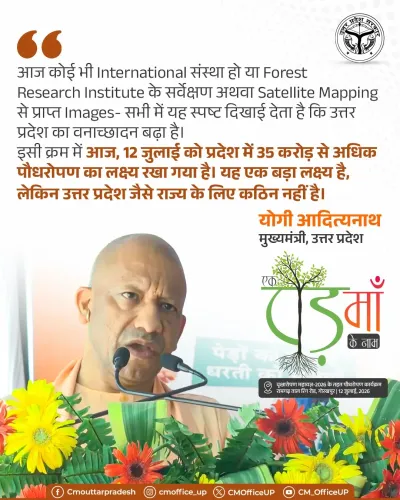
CM Yogi's Tree Drive Absorbs 6.37 Cr Tonnes of CO2 in UP
Synopsis
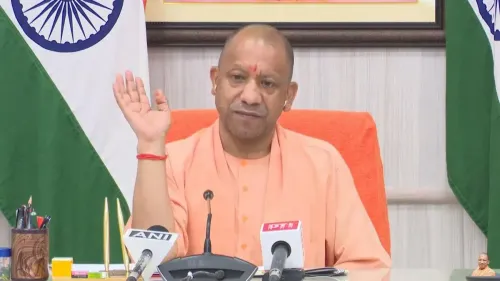
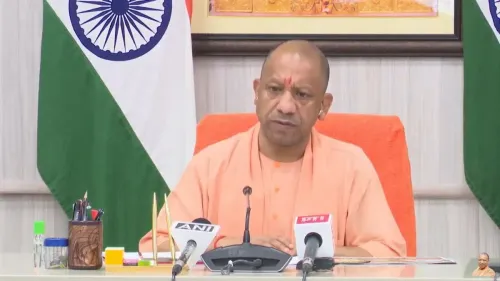
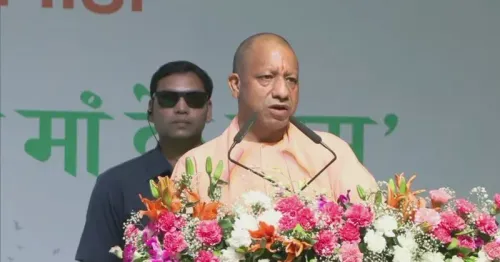
The Chief Minister's Office of Uttar Pradesh says the state's mass tree-plantation drive has absorbed over 6.37 crore tonnes of CO2, sequestered 1.73 crore tonnes of carbon, and released 4.63 crore tonnes of oxygen, citing CM Yogi Adityanath's campaign under the Ek Ped Maa Ke Naam initiative.
Key Takeaways
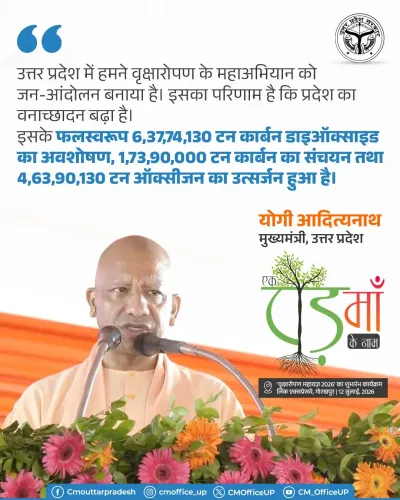
The Vrikshaaropan Maha Abhiyan in Uttar Pradesh has resulted in absorption of 6,37,74,130 tonnes of CO2 , per the Chief Minister's Office.
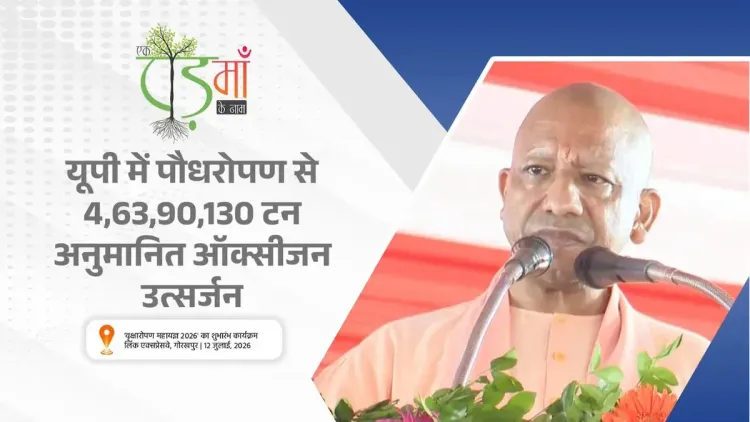
The campaign has sequestered 1,73,90,000 tonnes of carbon and generated 4,63,90,130 tonnes of oxygen .
Chief Minister Yogi Adityanath has overseen annual mega plantation drives in UP since 2017 .
The Ek Ped Maa Ke Naam campaign, launched nationally in 2024 , added a citizen-participation layer to the state's afforestation effort.
UP's figures contribute to India's commitment to achieve 33 per cent forest and tree cover under the National Forest Policy .
Independent verification of outcomes is expected through the next Forest Survey of India annual report.
The Chief Minister's Office of Uttar Pradesh announced on Sunday, 12 July 2026 that the state's mass tree-plantation campaign — Vrikshaaropan Maha Abhiyan — has resulted in the absorption of 6,37,74,130 tonnes of carbon dioxide, the sequestration of 1,73,90,000 tonnes of carbon, and the release of 4,63,90,130 tonnes of oxygen across Uttar Pradesh.
Context
The post, attributed to Chief Minister Yogi Adityanath, was shared under the hashtags #एक_पेड़_माँ_के_नाम ('One Tree in Mother's Name'), #PragatiBhiPrakritiBhi ('Progress as well as Nature'), and #GoGreen_UP. The figures represent cumulative environmental outcomes of the state's large-scale afforestation efforts, framing tree-planting not merely as an ecological gesture but as a measurable climate intervention. The announcement positions Uttar Pradesh — India's most populous state — as an active contributor to national and global carbon reduction goals.
Policy Backdrop
The Uttar Pradesh Forest Department has conducted annual mega plantation drives every year since 2017, when Chief Minister Yogi Adityanath assumed office, targeting tens of millions of saplings per season. The state adopted the slogan 'Pragati Bhi Prakriti Bhi' in 2022 to formally link infrastructure expansion with environmental conservation benchmarks. The Ek Ped Maa Ke Naam ('One Tree in Mother's Name') campaign — launched nationally in 2024 — added a citizen-participation dimension, encouraging individuals to plant trees as a tribute to their mothers, and was actively promoted by the state government.
India's National Forest Policy sets a target of 33 per cent forest and tree cover nationally. State-level drives such as Uttar Pradesh's are designed to contribute to this goal while also supporting India's commitments under the Paris Agreement and domestic green credit initiatives. Similar campaigns are under way in Madhya Pradesh, Rajasthan, and Maharashtra.
Stakeholders and Impact
The primary beneficiaries of the campaign span UP's rural and urban communities, who gain from improved air quality, reduced urban heat-island effects, and enhanced groundwater recharge linked to increased tree cover. Forest department staff, local gram panchayats, and citizen volunteers have been the operational backbone of the plantation drives. The reported oxygen output figure — 4,63,90,130 tonnes — underscores a direct public-health dimension to what is often framed as a purely ecological programme.
For the broader Indian climate policy landscape, Uttar Pradesh's scale matters: as the country's most populous state, measurable carbon sequestration here carries disproportionate weight in national accounting under India's Nationally Determined Contributions submitted to the United Nations Framework Convention on Climate Change.
What's Next
Attention will now turn to the next annual report by the Forest Survey of India, which independently assesses state-level forest and tree cover and provides a third-party check on plantation outcomes. State budget allocations for 2026-27 for plantation maintenance — ensuring survival rates of saplings already planted — will be a key indicator of whether the campaign's gains are sustained beyond the planting phase. If the sequestration trajectory continues, Uttar Pradesh could emerge as a benchmark for other large, densely populated states seeking to balance rapid development with credible environmental commitments.
Point of View
Carbon sequestration, and oxygen output — signals a shift in how the Yogi administration frames its plantation campaigns: less as symbolic green gestures and more as quantified climate deliverables. This data-first communication style is designed to align state action with the language of India's Paris Agreement commitments and emerging green credit markets. For a state historically associated with agricultural stress and stubble burning, these figures serve a dual purpose — domestic optics ahead of budget season and an external signal to multilateral climate forums. The critical test, however, remains independent corroboration by the Forest Survey of India and on-ground sapling survival audits.
NationPress
11 Oct 2026
Frequently Asked Questions
What is the Vrikshaaropan Maha Abhiyan in Uttar Pradesh?
The Vrikshaaropan Maha Abhiyan is Uttar Pradesh's mass tree-plantation campaign, conducted annually since 2017 under Chief Minister Yogi Adityanath, aimed at expanding green cover and contributing to national carbon reduction targets.
How much CO2 has UP's tree plantation drive absorbed?
According to the Chief Minister's Office of Uttar Pradesh, the campaign has resulted in the absorption of 6,37,74,130 tonnes of carbon dioxide.
What is Ek Ped Maa Ke Naam?
Ek Ped Maa Ke Naam ('One Tree in Mother's Name') is a national tree-plantation campaign launched in 2024 that encourages citizens to plant trees as a tribute to their mothers; it has been actively promoted by the Uttar Pradesh government.
How does UP's afforestation drive help India's climate goals?
Uttar Pradesh's plantation drives contribute to India's National Forest Policy target of 33 per cent tree and forest cover and support India's Nationally Determined Contributions under the Paris Agreement by sequestering carbon at scale.
Who verifies UP's tree plantation and carbon sequestration data?
The Forest Survey of India conducts independent annual assessments of state-level forest and tree cover, providing third-party verification of plantation outcomes reported by state governments.