Has the US Deal Marked Another Failure for the Yunus-Led Interim Government in Bangladesh?
Synopsis
The interim government of Bangladesh, under Muhammad Yunus, has faced criticism for conceding to US demands in a recent trade deal. This agreement raises questions about its implications for the nation’s economic sovereignty and the future burden on subsequent governments. Explore the insights from a revealing report on this controversial agreement.
Key Takeaways
Muhammad Yunus and his government have faced criticism for conceding to US demands.
The trade deal includes extensive purchases at inflated prices.
Concerns exist regarding the future burden on upcoming political administrations.
Over 200 garment factories have closed, impacting employment.
Labour laws have been amended to facilitate union activities.
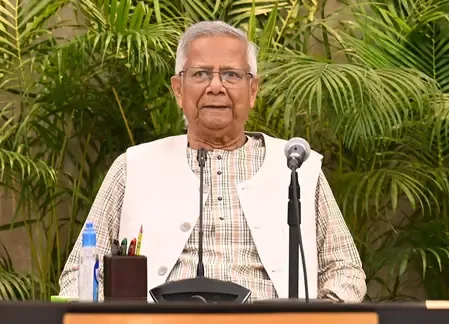
New Delhi, Feb 10 (NationPress) The interim government of Bangladesh, led by Muhammad Yunus, has seemingly acquiesced to most of the US demands regarding the trade agreement, despite the ongoing challenges faced by the nation, as reported by a new study.
Known as a prominent economist, Yunus, along with his Advisory Council, has added yet another failure to their portfolio, according to the report published on the digital platform Northeast News.
The US has only reduced the reciprocal tax on Bangladesh by a mere 1 percent—from 20 to 19 percent.
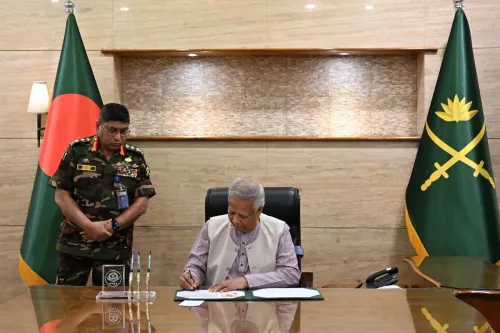
The existing tax rate stands at 15 percent, bringing the total tax burden to 34 percent. To secure this minimal reduction, the government entered into a Non-Disclosure Agreement (NDA), effectively compromising its ability to govern the nation’s economic interests, the report noted.
This trade deal involves the acquisition of 25 Boeing aircraft for BDT 53,000 crore; a commitment to purchase 3.5 million tonnes of wheat from the US at prices significantly above the market rate over the next five years, as well as a purchase of LNG valued at nearly BDT 1 lakh crore from Excelerate Energy over the next 15 years, also at inflated prices.
The report further disclosed that amendments were made to labour laws to facilitate the formation of trade unions in factories, even permitting union activities within export processing zones (EPZs).
This raises a critical question: Why did the Yunus-led interim government feel compelled to finalize a trade agreement with the US near the end of its tenure?
Economist Anu Muhammad expressed to BBC Bangla that, “This is an interim government whose main duty should have been justice, reform, and conducting elections. Yet, they are continuously signing agreements with foreign nations. No government without an electoral mandate should have the authority to make such crucial decisions for the nation.”
The report conveys concerns that while these significant agreements are being signed by the interim government, the impending political administrations may inherit the repercussions.
Bangladesh secured duty-free benefits in the textile sector under the condition of importing cotton from the US at elevated prices.
“However, in reality, over 200 garment and textile factories have closed in the past 18 months, leading to the loss of 200,000 jobs,” the report indicates.
Point of View
It's crucial to acknowledge that the ongoing trade negotiations led by the Yunus administration raise significant concerns. While some may argue for economic advancement, the lack of a democratic mandate in these decisions calls for a vigilant examination of how they will affect future governance and the citizens of Bangladesh. The nation’s integrity must always be the priority.
NationPress
16 Sept 2026
Frequently Asked Questions
What are the key components of the trade deal with the US?
The trade deal includes the purchase of 25 Boeing aircraft, 3.5 million tonnes of wheat at inflated prices over five years, and a significant LNG purchase from Excelerate Energy.
What concerns have been raised about the Yunus-led interim government?
Critics argue that the interim government lacks the mandate to make such significant agreements, which may impose long-term burdens on future administrations.
How has the textile sector been affected?
Due to the trade deal, Bangladesh has imposed high cotton import prices, resulting in the closure of over 200 factories and the loss of 200,000 jobs.