Uttarakhand CM Dhami's Apple Mission turns Almora farmer self-reliant

Synopsis
Uttarakhand's Apple Mission, championed by CM Pushkar Singh Dhami, has helped Almora farmer Gopal Singh build apple cultivation into viable self-employment, illustrating the state's push to make high-altitude horticulture an anchor against out-migration from mountain districts.
Key Takeaways
Gopal Singh , a farmer from Almora district , has adopted apple cultivation as self-employment through Uttarakhand's Apple Mission .
The initiative operates under CM Pushkar Singh Dhami's broader drive to promote agriculture and horticulture in Uttarakhand's hilly regions.
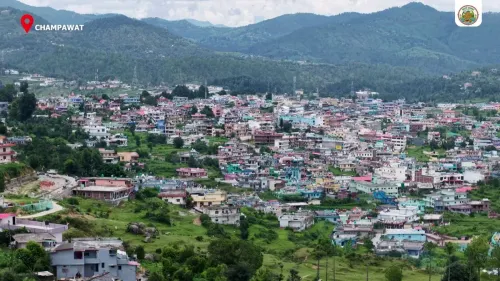
Almora 's high-altitude geography in the Kumaon Himalayas provides naturally suitable conditions for apple production.
Uttarakhand has promoted horticulture in its mountains since state formation in 2000 to counter out-migration and create rural income.
The Apple Mission aligns with a wider Himalayan-state pattern of using targeted fruit schemes to make mountain farming economically viable.
In the apple orchards of Almora, a quiet revolution is unfolding — one tree at a time. Gopal Singh, a farmer from Almora district in Uttarakhand's Kumaon hills, has transformed apple cultivation from a subsistence gamble into a steady livelihood, riding the Uttarakhand government's Apple Mission under Chief Minister Pushkar Singh Dhami. The Chief Minister's Office of Uttarakhand shared his story on Sunday, September 27, 2026, spotlighting it as proof that high-altitude horticulture can anchor mountain families to their land.
What the Apple Mission promises hill farmers
The Apple Mission is part of a broader Uttarakhand government push to make horticulture economically competitive in its hilly terrain — terrain that is often inhospitable to conventional cereal farming but ideally suited to temperate fruits. The programme channels state support toward apple growers, helping farmers like Gopal Singh treat orcharding not as a hobby but as a viable, scalable business. The CMO's post described his journey as making apple production a 'swayrozgar ka zariya' — a means of self-employment — under the state's drive to expand agriculture and horticulture in mountain regions.
Almora's geography — an orchard hiding in plain sight
Almora, nestled in the Kumaon Himalayas at elevations that range from 1,500 to over 2,000 metres, offers the cold winters and temperate summers that apple trees demand. Uttarakhand has pursued horticulture promotion in its hills since state formation in 2000, recognising that flat-land crop economics simply do not translate to mountain agriculture. Apple cultivation offers something rare in these districts: a high-value crop that leverages geography rather than fighting it.
Out-migration and the stakes behind a fruit tree
The story of one farmer carries policy weight far beyond a single orchard. Uttarakhand's mountain districts have faced persistent out-migration for decades, as young people leave for plains cities in search of income. Targeted crop missions like the Apple Mission are designed precisely to break that cycle — making it economically rational to stay, farm, and build something local. When a scheme produces a Gopal Singh, it becomes the government's most persuasive argument against demographic hollowing of the hills.
CM Dhami has consistently framed agricultural self-reliance as central to his government's mountain-development agenda, and stories of individual entrepreneurship through state schemes form a core plank of that communication. The Almora farmer's example fits squarely into that narrative — and into a pattern visible across other Himalayan states that have used fruit missions to stabilise rural economies.
The real test will be whether Gopal Singh's success is isolated or whether the Apple Mission can replicate it across Almora's villages and beyond — and whether production data eventually validates the ambition.
Point of View
Spotlighting individual beneficiaries of the Apple Mission serves a dual purpose: validating state investment in horticulture and countering the persistent narrative of demographic decline in hill districts. This approach mirrors a broader strategy seen across BJP-governed hill states, where scheme success stories are amplified as proof of governance dividend ahead of electoral cycles. The deeper policy question — whether such missions are scaling fast enough to meaningfully reverse out-migration trends — remains open, and will likely be answered only by district-level production and participation data.
NationPress
27 Sept 2026
Frequently Asked Questions
What is Uttarakhand's Apple Mission?
The Apple Mission is an Uttarakhand government programme that promotes apple cultivation in the state's mountainous districts, providing support to farmers to make orchard farming a viable livelihood and reduce rural out-migration.
Who is Gopal Singh and why is he in the news?
Gopal Singh is a farmer from Almora district in Uttarakhand who joined the state's Apple Mission and successfully turned apple production into a self-employment source, earning recognition from the Chief Minister's Office.
Why is apple farming promoted in Uttarakhand's hills?
Uttarakhand's high-altitude regions, including Almora in the Kumaon Himalayas, have agro-climatic conditions well-suited to apple cultivation. The state promotes it as a high-value crop that can make mountain farming economically competitive.
What is CM Pushkar Singh Dhami's role in Uttarakhand's Apple Mission?
Chief Minister Pushkar Singh Dhami has championed the Apple Mission as part of his government's broader agenda to promote agriculture and horticulture in Uttarakhand's hilly regions and create self-employment opportunities for mountain farmers.
How does the Apple Mission help address out-migration from Uttarakhand's hill districts?
By making apple cultivation economically viable, the Apple Mission aims to give rural families a reason to stay and farm locally, directly countering the long-term trend of young people migrating from mountain districts to plains cities for income.