CM Dhami Links Skill Training to Self-Employment in Uttarakhand
Synopsis
Uttarakhand's Chief Minister's Office says CM Pushkar Singh Dhami is linking skill development to self-employment, with RSETI Almora conducting regular vocational training for rural youth and women in a bid to curb out-migration from hill districts.
Key Takeaways
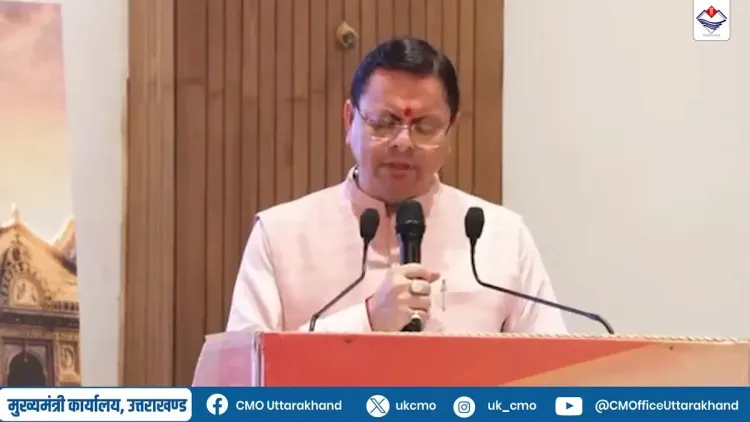
The Chief Minister's Office of Uttarakhand announced on 4 July 2026 that skill development is being linked to self-employment under CM Pushkar Singh Dhami's leadership.
RSETI Almora , a Rural Self-Employment Training Institute under the Ministry of Rural Development , is conducting periodic employment-oriented training programmes.
Rural youth and women in Almora district are the primary target groups for these interventions.
The initiative draws on the national Deen Dayal Upadhyaya Grameen Kaushalya Yojana (launched 2014 ) and the Skill India Mission (launched 2015 ).
The broader policy goal is to reduce high youth out-migration from Uttarakhand's hill districts by enabling local micro-enterprise creation.
Expansion of similar institutes to other Uttarakhand districts may be considered in the next state budget cycle.
The Chief Minister's Office of Uttarakhand announced on Saturday, 4 July 2026 that the state government under Chief Minister Pushkar Singh Dhami is actively connecting skill development with self-employment to create new opportunities for youth and women across the state. The Rural Self-Employment Training Institute, RSETI Almora, has been conducting regular employment-oriented training programmes as part of this initiative.
The official post stated: 'कौशल विकास को स्वरोजगार से जोड़कर युवाओं और महिलाओं के लिए नए अवसर तैयार किए जा रहे हैं' ('skill development is being linked to self-employment to create new opportunities for youth and women').
Context
Almora is a predominantly rural, hilly district in Uttarakhand with persistently high rates of youth out-migration — a structural challenge that state governments have sought to address through localised employment creation. RSETI Almora operates under the framework of the Ministry of Rural Development, delivering short-duration, free vocational training to rural populations with the aim of enabling bank-linked self-employment.
The institute's periodic training programmes are part of a broader effort to retain skilled youth within the state rather than see them migrate to plains cities in search of livelihoods. Women in hill districts have been specifically identified as a priority demographic in these interventions.
Policy Backdrop
The Rural Self-Employment Training Institute network was established by the Ministry of Rural Development from 2005 onwards, providing a nationwide infrastructure for grassroots vocational training. In 2014, the Deen Dayal Upadhyaya Grameen Kaushalya Yojana gave renewed momentum to RSETI-style programmes, specifically targeting rural youth and women for placement-linked skilling.
At the state level, the Uttarakhand Skill Development Mission, established around 2013, coordinates vocational training and placement efforts. The current administration under CM Dhami has aligned these frameworks with the national Skill India Mission — launched in 2015 — to ensure that training translates directly into micro-enterprise creation and self-employment rather than remaining a standalone certificate programme.
This approach mirrors a wider national pattern in less-industrialised Himalayan states, where the absence of large-scale industry makes self-employment and micro-enterprise the most viable pathway to local livelihood generation.
Stakeholders and Impact
The primary beneficiaries of RSETI Almora's programmes are rural youth and women from Almora district and its surrounding areas. By pairing skills training with access to bank credit and self-employment support, the model seeks to reduce dependence on wage labour in distant cities and strengthen local economies in the hills.
Women entrepreneurs in particular stand to benefit from training in trades suited to the local economy — including food processing, handicrafts, and service-sector skills — which can be converted into home-based or community-based enterprises with relatively low capital requirements.
What's Next
Observers will watch for district-level data on the number of RSETI Almora trainees who have successfully launched micro-enterprises or accessed bank credit under self-employment schemes. The Uttarakhand government may also announce expansion of similar institutes to other hill districts in the next state budget cycle, as part of a sustained push to address youth unemployment and out-migration at scale.
The integration of skill development with self-employment financing represents a long-term structural bet by the Dhami administration — one whose success will ultimately be measured not by training enrolments but by the durability of the enterprises that graduates go on to build.
Point of View
DDU-GKY), the CM's office is simultaneously signalling alignment with central government priorities and demonstrating localised delivery. The focus on women as a distinct beneficiary group also fits a broader pattern of welfare-linked political messaging in hill-state governance. Whether these programmes translate into measurable enterprise creation, however, remains the critical test that official communications rarely address directly.
NationPress
3 Oct 2026
Frequently Asked Questions
What is RSETI Almora and what does it do?
RSETI Almora is a Rural Self-Employment Training Institute in Almora district, Uttarakhand, operating under the Ministry of Rural Development. It provides free, short-duration vocational training to rural youth and women, linking skills to bank-supported self-employment and micro-enterprise creation.
What is CM Pushkar Singh Dhami's skill development initiative in Uttarakhand?
Under CM Pushkar Singh Dhami, Uttarakhand is connecting skill development programmes with self-employment opportunities, particularly for rural youth and women. RSETI Almora is one of the key institutions conducting regular employment-oriented training as part of this effort.
What is the Deen Dayal Upadhyaya Grameen Kaushalya Yojana?
The Deen Dayal Upadhyaya Grameen Kaushalya Yojana is a central government scheme launched in 2014 that funds placement-linked skill training for rural youth and women, including through RSETI-style training institutes across India.
Why is self-employment training important for Uttarakhand's hill districts?
Uttarakhand's hill districts like Almora have high rates of youth out-migration due to limited local employment. Self-employment training linked to bank credit helps create local livelihood options, reducing the need for youth to migrate to cities.
Which scheme funds skill training for rural youth in India?
The Skill India Mission (launched 2015) and the Deen Dayal Upadhyaya Grameen Kaushalya Yojana (launched 2014) are the primary central government frameworks funding vocational and self-employment training for rural youth and women across India, including in Uttarakhand.