Uttarkashi Apple Processing Unit Turns C-Grade Fruit Into Income
Synopsis
The Uttarakhand Government's self-employment scheme has powered an apple processing unit in Uttarkashi that now converts C-grade apples — previously unsellable — into income for local farmers, addressing long-standing post-harvest losses in the Himalayan district.
Key Takeaways
An apple processing unit in Uttarkashi district is now operational under a Uttarakhand Government self-employment promotion scheme.
The unit generates income from C-grade apples that were previously discarded or sold at negligible prices.
The initiative targets post-harvest losses, a chronic problem for hill horticulture in Uttarakhand.
The model supports local self-employment and rural income without requiring changes to existing farming practices.
Uttarakhand has backed agro-processing as a hill-economy priority since statehood in 2000 .
Success in Uttarkashi could pave the way for replication across other apple-growing districts in the state.
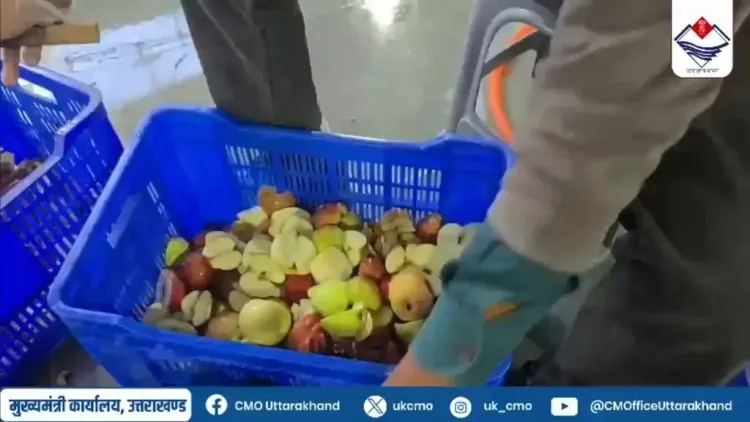
Apples that once rotted unsold on Himalayan slopes are now generating real income for farmers in Uttarkashi — and a self-employment scheme run by the Uttarakhand Government is the reason why. The Chief Minister's Office of Uttarakhand announced on Monday, 26 October 2026 that an apple processing unit operating in Uttarkashi district is now converting C-grade apples — fruit too blemished or small for direct retail — into a viable revenue stream for local growers.
The post states: 'Uttarakhand sarkar ki swarozgar ko badhawa dene wali yojana se Uttarkashi janpad mein Apple Processing Unit ke sanchalan se ab C grade ke sebon se bhi aamdani hone lagi hai' — ('Through the Uttarakhand Government's scheme to promote self-employment, the operation of an Apple Processing Unit in Uttarkashi district has now begun generating income even from C-grade apples.')Why C-Grade Apples Were a Dead Loss — Until Now
Apple cultivation is central to the hill economy of Uttarkashi, a high-altitude district nestled in the upper Garhwal Himalayas. But grading has always been brutal: only A- and B-grade fruit fetches market prices, while C-grade apples — typically smaller, misshapen, or lightly bruised — were largely discarded or sold for a fraction of their potential value. Post-harvest losses in hill horticulture have long eaten into farmer margins, making the economics of orchard cultivation precarious for small growers.
The processing unit changes that equation. By converting C-grade fruit into processed products — such as juice, pulp, or preserves — the unit unlocks value from a portion of the harvest that previously contributed nothing to farm income. For small apple growers in the district, this represents a direct addition to household earnings without requiring any change in cultivation practices.
Self-Employment at the Core of the Model
The unit is part of the Uttarakhand Government's broader push to promote self-employment in rural areas through agro-processing infrastructure. Since statehood in 2000, Uttarakhand has consistently backed horticulture and value-addition schemes to strengthen hill economies — a policy priority driven by the twin challenges of out-migration and limited arable land. Small-scale processing units sit at the intersection of both goals: they create local employment and give farmers a reason to stay.
This model also mirrors what other Himalayan states have attempted — building micro-processing clusters that reduce dependence on distant wholesale markets and cut the post-harvest losses that disproportionately hurt marginal farmers.
Uttarkashi as a Test Case for Scaling
Uttarkashi district sits at the heart of Uttarakhand's apple belt, making it a natural pilot ground for such interventions. If the processing unit demonstrates sustained income generation for C-grade produce, the model carries clear potential for replication across other apple-growing districts in the state. The government's move to publicly highlight this outcome — through the Chief Minister's Office — signals an intent to build political and public momentum around the scheme ahead of any wider rollout.
For the orchardists of Uttarkashi, the arithmetic is simple: every kilogram of C-grade apple that once had no buyer now has a destination. That shift — small on paper, transformative on the ground — is what this unit represents.
Point of View
And no amount of productivity gain at the farm level compensates for it. By anchoring this announcement to a self-employment scheme, the Uttarakhand Government is threading a politically useful needle — framing rural agro-processing as entrepreneurship rather than subsidy. The broader significance lies in whether this remains a one-district story or becomes the template for a state-wide value-addition network; in hill states facing acute out-migration, keeping rural income diversified and local is not just an economic question — it is a demographic one.
NationPress
26 Oct 2026
Frequently Asked Questions
What is the apple processing unit in Uttarkashi doing?
The unit processes C-grade apples — fruit too small or blemished for direct retail sale — into value-added products, generating income for apple growers in Uttarkashi district that would otherwise be lost to wastage.
Which government scheme is behind the Uttarkashi apple processing unit?
The unit operates under the Uttarakhand Government's self-employment promotion scheme, though the specific name of the scheme has not been officially confirmed in public announcements.
Why were C-grade apples not earning money for farmers before?
C-grade apples are too blemished or small to fetch standard market prices, so they were largely discarded or sold at minimal value, representing a significant post-harvest loss for Uttarkashi growers.
Will more apple processing units open in other Uttarakhand districts?
The government has flagged the Uttarkashi unit as a success, suggesting potential replication across other apple-growing districts, though no formal expansion announcement has been made yet.
How does apple processing help with self-employment in Uttarakhand?
Processing units create local jobs in grading, operating machinery, and supply logistics, while also giving farmers a reliable buyer for lower-grade produce — both effects directly supporting rural self-employment in hill districts.