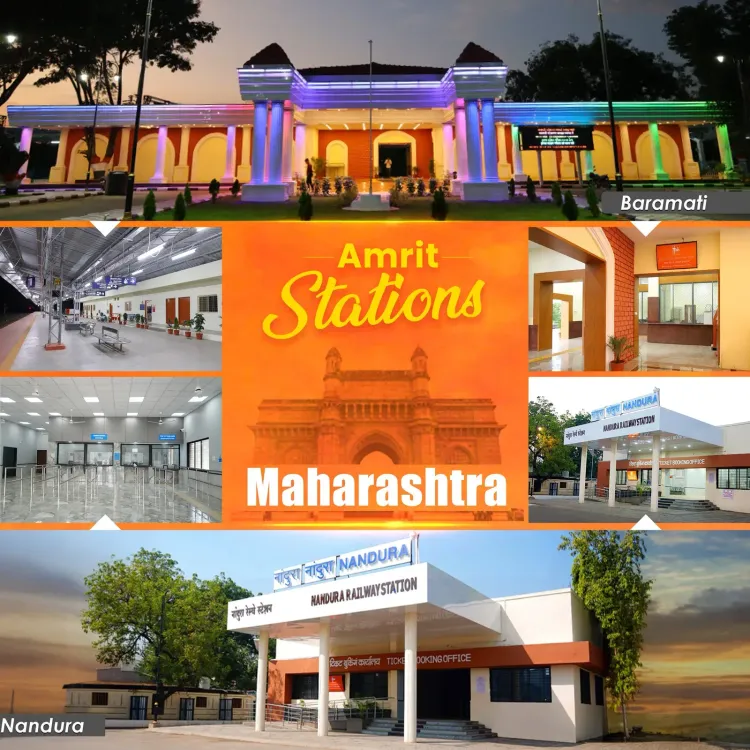
Vaishnaw flags Nandura, Baramati as Maharashtra Amrit Stations
Synopsis
Union Minister Ashwini Vaishnaw highlighted Nandura and Baramati as Amrit Bharat stations on 17 July 2026, saying the redeveloped facilities honour Maharashtra's diversity — from Vidarbha's cotton heritage to western Maharashtra's agricultural innovation — through improved amenities and region-inspired architecture.
Key Takeaways
Nandura and Baramati railway stations are being redeveloped under the Amrit Bharat Station Scheme .
The scheme, launched in February 2023 , targets redevelopment of 1,275 stations nationwide.
Nandura draws on Vidarbha's cotton-industry heritage for its architectural identity.
Baramati's design reflects western Maharashtra's agricultural innovation and cooperative farming legacy.
Both stations are to receive improved passenger amenities alongside region-inspired facades.
The announcement is part of a broader thread by Vaishnaw on Maharashtra's Amrit stations.
Union Minister Ashwini Vaishnaw on Friday, 17 July 2026 highlighted the redevelopment of Nandura and Baramati railway stations under the Amrit Bharat Station Scheme, describing them as showcases of Maharashtra's regional diversity — from Vidarbha's cotton-trade heritage to western Maharashtra's agricultural innovation.
Context
The Minister's post — part of a thread on Maharashtra's Amrit stations — stated in Marathi: 'विदर्भाच्या कापूस उद्योगाच्या वारशापासून ते पश्चिम महाराष्ट्राच्या कृषी-नवोन्मेषापर्यंत' ('from the heritage of Vidarbha's cotton industry to the agricultural innovation of western Maharashtra'). He noted that the two redeveloped stations honour the state's 'diverse unity' through improved passenger amenities and region-inspired architecture.
Nandura is a station in the Vidarbha belt, a region historically defined by its cotton economy and the livelihoods of thousands of farming families. Baramati, in western Maharashtra, is synonymous with cooperative farming, the sugar industry, and decades of agrarian enterprise.
Policy Backdrop
The Amrit Bharat Station Scheme was launched in February 2023 with a mandate to redevelop 1,275 stations across India, blending modern passenger infrastructure with local cultural motifs. The programme is among Indian Railways' most ambitious station-upgrade initiatives, covering waiting halls, lighting, signage, landscaping, and facade design rooted in regional identity.
Maharashtra, with its mix of agrarian, industrial, and coastal geographies, offers a wide canvas for the scheme's regional-architecture philosophy. Selecting stations from both the cotton-dominant Vidarbha and the cooperative-farming west signals an intent to distribute infrastructure visibility across the state's distinct economic zones.
Stakeholders and Impact
Railway passengers at Nandura and Baramati stand to benefit most directly from upgraded waiting areas, better accessibility, and improved amenities. For Vidarbha's cotton farmers and traders, a modernised Nandura station can ease logistics and commuter movement in a region that has long sought greater infrastructure attention.
In Baramati, enhanced station facilities support the district's active agricultural trade corridors and the movement of workers and produce tied to its cooperative economy. The architecture brief — drawing from each region's identity — also carries a symbolic dimension, positioning infrastructure as a vehicle for cultural acknowledgement.
What's Next
Further announcements on remaining Maharashtra stations under the Amrit Bharat programme are expected as the scheme's rollout continues nationwide. The next Railway Budget allocation for Amrit Bharat projects will be closely watched by state stakeholders seeking clarity on timelines and funding tranches. Vaishnaw's thread format suggests additional Maharashtra stations may be highlighted in subsequent posts.
Point of View
Reflecting the BJP's effort to project equitable infrastructure attention across Maharashtra's diverse regions. The Amrit Bharat scheme has consistently served a dual purpose: genuine station modernisation and a visible branding of central-government investment in state-level constituencies. Anchoring station design in local heritage is a soft-power layer that distinguishes this programme from earlier utilitarian upgrades. As the 2026 cycle of rollout announcements continues, the choice of which stations get highlighted and when will remain a telling indicator of political and economic priorities within the broader railway modernisation agenda.
NationPress
17 Jul 2026
Frequently Asked Questions
What is the Amrit Bharat Station Scheme?
The Amrit Bharat Station Scheme is an Indian Railways programme launched in February 2023 to redevelop 1,275 stations across India with modern passenger amenities and architecture inspired by local cultural heritage.
Why is Nandura station significant under the Amrit Bharat scheme?
Nandura is a station in Maharashtra's Vidarbha region, historically linked to the cotton trade. Under the Amrit Bharat scheme, its redevelopment is designed to reflect that cotton-industry heritage through region-inspired architecture.
What makes Baramati station special in the Amrit Bharat programme?
Baramati, in western Maharashtra, is known for cooperative farming and the sugar industry. Its Amrit Bharat redevelopment is meant to celebrate the district's agricultural innovation through improved facilities and locally rooted design.
How many stations are being redeveloped under the Amrit Bharat Station Scheme?
The scheme covers 1,275 stations nationwide, making it one of Indian Railways' largest station-upgrade initiatives since its launch in February 2023.
What did Ashwini Vaishnaw say about Maharashtra's Amrit stations?
On 17 July 2026, Vaishnaw posted that the redeveloped Nandura and Baramati stations honour Maharashtra's 'diverse unity' — from Vidarbha's cotton heritage to western Maharashtra's agricultural innovation — through better passenger amenities and region-inspired architecture.