Vaishnaw Highlights 3 Tamil Nadu Amrit Station Redevelopments
Synopsis
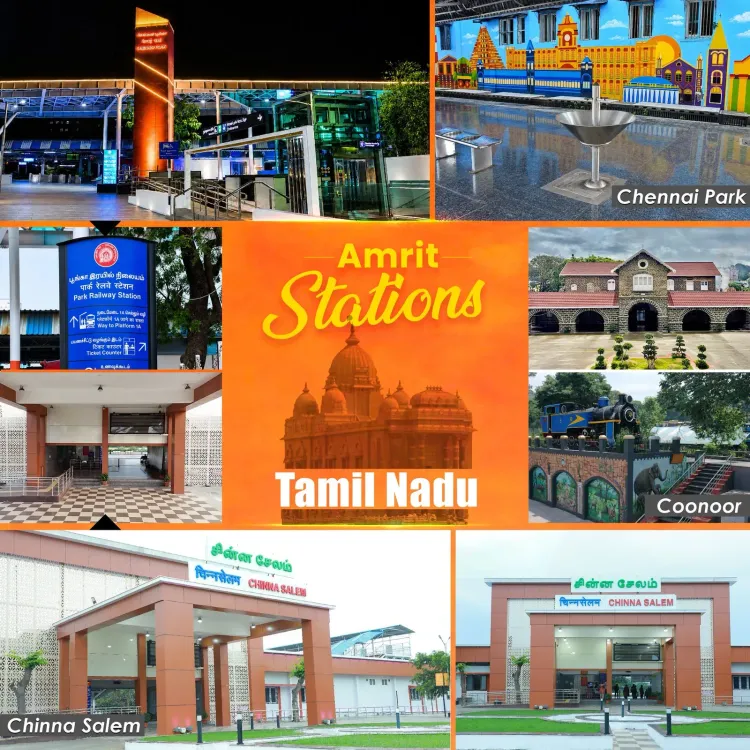
Union Minister Ashwini Vaishnaw has highlighted the Amrit Bharat redevelopment of three Tamil Nadu stations — Chennai Park, Coonoor, and Chinnasalem — integrating regional heritage and the UNESCO-listed Nilgiri Mountain Railway into their redesigned architecture.
Key Takeaways
Three Tamil Nadu stations — Chennai Park , Coonoor , and Chinnasalem — are being redeveloped under the Amrit Bharat Station Scheme .
The redesigns are intended to reflect Tamil Nadu's cultural and architectural legacy, including elements tied to the Nilgiri Mountain Railway .
The Nilgiri Mountain Railway is a UNESCO World Heritage Site , making Coonoor's redevelopment heritage-sensitive.
The Amrit Bharat Station Scheme , launched in February 2023 , covers more than 1,200 stations across India with a mandate for local cultural integration.
Union Minister Ashwini Vaishnaw shared the update on 17 July 2026 as part of a series of posts on Amrit Bharat stations.
Union Minister Ashwini Vaishnaw on Friday, 17 July 2026 showcased the redevelopment of three Tamil Nadu railway stations — Chennai Park, Coonoor, and Chinnasalem — under the Amrit Bharat Station Scheme, emphasising their integration of regional heritage and the UNESCO-recognised Nilgiri Mountain Railway.
Context
The minister's post, the third in a series (marked '3/'), highlighted the redesigned stations in Tamil Tamil Nadu as exemplars of the Amrit Bharat programme's cultural mandate. In Tamil, the post described how the stations blend 'பாரம்பரியச் சிறப்பு' (heritage excellence) with the identity of the Nilgiri Mountain Railway — a UNESCO World Heritage Site — and 'unique regional architectural elements' to reflect the state's 'rich cultural and architectural legacy.'
The three stations — Chennai Park, Coonoor, and Chinnasalem — represent a cross-section of Tamil Nadu's rail geography, from a major urban terminal to a hill-railway heritage node.
Policy Backdrop
The Amrit Bharat Station Scheme was announced in February 2023 to modernise more than 1,200 railway stations across India. A defining feature of the scheme is the requirement that redesigns incorporate local cultural motifs and architectural traditions rather than adopting a uniform national template.
Coonoor station sits on the Nilgiri Mountain Railway, a narrow-gauge line of colonial-era engineering that received UNESCO World Heritage status as part of the Mountain Railways of India inscription. Its inclusion in the Amrit programme carries particular sensitivity, as any redesign must respect the heritage conditions attached to the UNESCO designation.
Chennai Park is among the prominent urban stations in Tamil Nadu selected to reflect Dravidian and regional Tamil architectural vocabulary in its upgraded form. Chinnasalem has been included for its distinctive regional architectural character.
Stakeholders and Impact
Rail passengers across Tamil Nadu stand to benefit from upgraded amenities that the Amrit Bharat Scheme mandates alongside aesthetic improvements — including better waiting areas, accessibility features, and passenger facilities. The heritage tourism sector, particularly around the Nilgiri hills, has a direct stake in how Coonoor station is redeveloped, given its role as a gateway for visitors to the UNESCO-listed railway.
Cultural and architectural communities in Tamil Nadu have watched the scheme closely to ensure that 'regional integration' translates into substantive design choices rather than superficial ornamentation.
What's Next
Completion timelines and formal inauguration events for the three Tamil Nadu stations have not been publicly confirmed. The Ministry of Railways is expected to announce phased inaugurations as redevelopment work concludes at individual stations across the country. Tamil Nadu's heritage-focused designs could serve as a template for similar UNESCO-adjacent stations in other states, such as those on the Darjeeling Himalayan Railway and the Kalka-Shimla Railway.
With the Amrit Bharat programme covering over 1,200 stations nationwide, the pace of rollout and the fidelity of cultural integration at each site will remain under scrutiny from both heritage advocates and infrastructure watchers.
Point of View
Signalling that the Centre's flagship station-modernisation programme is sensitive to regional identity — not just infrastructure metrics. Highlighting the UNESCO-linked Coonoor station is politically astute: it frames the BJP-led government as a steward of heritage, not merely a builder of concrete. The Amrit Bharat Scheme's emphasis on cultural motifs has become a soft-power tool for the Railways Ministry, allowing it to counter narratives of homogenisation. How faithfully the final designs deliver on that promise will determine whether the initiative earns lasting goodwill in a state where the Centre's rail record is closely watched.
NationPress
17 Jul 2026
Frequently Asked Questions
What is the Amrit Bharat Station Scheme?
The Amrit Bharat Station Scheme is an Indian Railways initiative announced in February 2023 to redevelop more than 1,200 railway stations across India, upgrading passenger facilities while incorporating local cultural and architectural themes.
Which Tamil Nadu stations are being redeveloped under Amrit Bharat?
Chennai Park, Coonoor, and Chinnasalem are among the Tamil Nadu stations being redeveloped under the Amrit Bharat Station Scheme, as highlighted by Union Minister Ashwini Vaishnaw.
Why is Coonoor station significant in the Amrit Bharat programme?
Coonoor station is on the Nilgiri Mountain Railway, a UNESCO World Heritage Site. Its redevelopment under Amrit Bharat must preserve the heritage character associated with the UNESCO designation while modernising passenger amenities.
What is the Nilgiri Mountain Railway and why is it a UNESCO site?
The Nilgiri Mountain Railway is a narrow-gauge railway in Tamil Nadu's Nilgiri hills, recognised as a UNESCO World Heritage Site as part of the Mountain Railways of India for its colonial-era engineering and scenic significance.
When will the redeveloped Tamil Nadu Amrit Bharat stations be inaugurated?
Specific completion timelines and inauguration dates for Chennai Park, Coonoor, and Chinnasalem stations have not been officially confirmed; the Ministry of Railways is expected to announce phased inaugurations as work concludes.