VP Radhakrishnan at NISER: Science must drive Viksit Bharat 2047 vision
Synopsis
At NISER's convocation in Bhubaneswar, Vice-President C.P. Radhakrishnan made the case that scientific capability is non-negotiable for India's Viksit Bharat 2047 ambition — invoking the legacy of Dr. Homi Bhabha and calling on graduates to ask the right questions, not just find answers. With AI, climate change, and quantum computing reshaping the world, the address was as much a policy signal as a graduation speech.
Key Takeaways
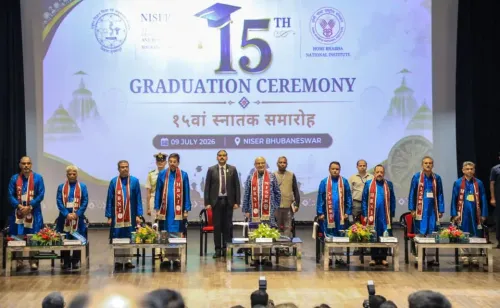
Radhakrishnan addressed the NISER convocation in Bhubaneswar on 9 July .
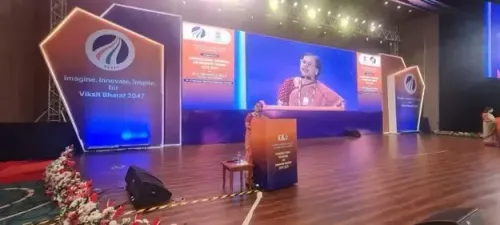
He called scientific capability 'foundational' — not optional — for achieving Viksit Bharat 2047 .
Radhakrishnan highlighted India's achievements in space, vaccines, digital infrastructure, and renewable energy as markers of growing global recognition.
He paid tribute to Dr.
Homi Bhabha , expressing hope that NISER graduates would match his legacy in science and atomic research.
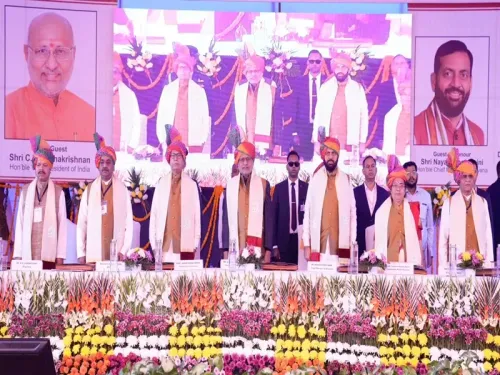
The event was attended by Odisha Governor Hari Babu Kambhampati , CM Mohan Charan Majhi , and Union Education Minister Dharmendra Pradhan .
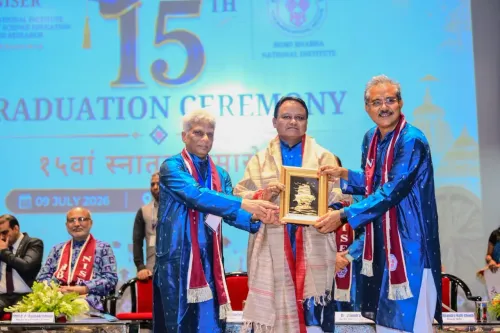
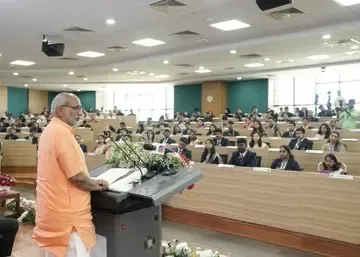
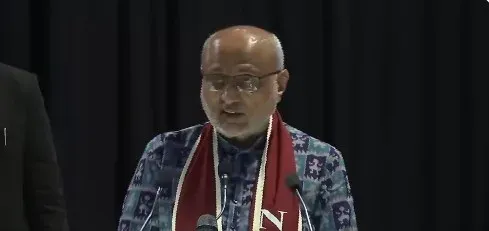
Vice-President C.P. Radhakrishnan on Thursday, 9 July called on young scientists to deploy science and technology as the primary lever for tackling global challenges, asserting that scientific capability is not optional but foundational to realising India's Viksit Bharat 2047 vision. He was addressing the convocation of the National Institute of Science Education and Research (NISER) in Bhubaneswar.
Key Developments at the NISER Convocation
Radhakrishnan told graduating students that the world today faces an unprecedented convergence of opportunities and threats — from climate change and emerging diseases to rapid advances in artificial intelligence, quantum computing, and advanced materials. In this context, he said, science must not merely generate knowledge but actively guide policy and ensure long-term sustainability.
He underscored the imperative of interdisciplinary collaboration, arguing that no single discipline can adequately address the complexity of contemporary challenges. The Vice-President urged graduates to nurture curiosity, uphold integrity, embrace difficulty, and orient their expertise toward the broader good of society.
What the Vice-President Said
'Science is not only about finding answers but also about asking the right questions,' Radhakrishnan remarked, encapsulating the spirit of his address. He called on the graduates to balance ambition with responsibility and progress with compassion, emphasising that their research, ideas, and integrity would shape the trajectory of society.
Highlighting India's expanding global stature in science and innovation, Radhakrishnan cited the country's achievements in space missions, vaccine development, digital public infrastructure, and renewable energy as evidence of the nation earning increasing international recognition.
Tribute to Dr. Homi Bhabha and India's Scientific Legacy
The Vice-President paid tribute to the legacy of Dr. Homi Bhabha, recalling a personal memory of the day his father informed him of Bhabha's passing — a moment he described as a major setback for India's atomic research programme. He noted, however, that India emerged stronger from that loss and has since risen to become one of the world's leading nations in atomic research.
Radhakrishnan praised institutions such as NISER for carrying forward India's rich scientific tradition across fundamental sciences, atomic energy, healthcare physics, and emerging interdisciplinary fields. He expressed hope that many of the day's graduates would go on to make contributions comparable to those of Dr. Bhabha.
Dignitaries Present
The convocation was attended by Odisha Governor Hari Babu Kambhampati, Chief Minister Mohan Charan Majhi, and Union Education Minister Dharmendra Pradhan, among other dignitaries — signalling the significance the Centre and the state government attach to NISER's role in India's scientific ecosystem.
As India accelerates toward its 2047 centenary goals, the Vice-President's address reinforces a broader national consensus that science, technology, and homegrown research institutions must sit at the heart of the country's development strategy.
Point of View
Well short of the 2% target — a gap that convocation speeches alone cannot close. The invocation of Homi Bhabha is a recurring motif at science gatherings, but the harder question is whether institutions like NISER receive the sustained funding and autonomy to produce the next generation of foundational researchers, or whether talent continues to migrate abroad. The presence of the Education Minister alongside the Vice-President suggests political will; translating that into budget allocations is the real test.
NationPress
8 Oct 2026
Frequently Asked Questions
What did Vice-President Radhakrishnan say at the NISER convocation?
Vice-President C.P. Radhakrishnan urged graduating scientists at NISER in Bhubaneswar to harness science and technology to address global challenges such as climate change, AI, and emerging diseases. He stressed that scientific capability is foundational — not optional — to achieving India's Viksit Bharat 2047 vision.
What is NISER and where is it located?
The National Institute of Science Education and Research (NISER) is a premier autonomous institution located in Bhubaneswar, Odisha. It focuses on fundamental sciences and interdisciplinary research, and operates under the Department of Atomic Energy.
Why did Radhakrishnan mention Dr. Homi Bhabha?
Radhakrishnan paid tribute to Dr. Homi Bhabha to highlight India's scientific legacy and the importance of institutions like NISER in carrying it forward. He recalled learning of Bhabha's death as a personal memory and expressed hope that NISER graduates would make similarly landmark contributions to atomic research and science.
Who attended the NISER convocation on 9 July?
The convocation was attended by Odisha Governor Hari Babu Kambhampati, Chief Minister Mohan Charan Majhi, and Union Education Minister Dharmendra Pradhan, along with other dignitaries, reflecting both state and central government support for the institution.
What is the Viksit Bharat 2047 vision that Radhakrishnan referenced?
Viksit Bharat 2047 is India's national goal of becoming a fully developed nation by the centenary of its independence in 2047. Radhakrishnan argued that achieving this vision requires science and technology to be placed at the centre of policy, innovation, and national development strategy.