Does safety reside in being captured by camera? Woman assault case ignites debate in Kerala
Click to start listening
Synopsis
The recent shocking incident in Kerala, where a pregnant woman was assaulted at a police station, raises critical questions about police accountability. This event underscores the urgent need for systemic reforms in law enforcement and challenges the notion of safety within the very institutions meant to protect citizens.
Key Takeaways
- The incident highlights the misuse of police power.
- Public outrage is crucial for accountability.
- Political interference complicates law enforcement.
- Reforms in policing are urgently needed.
- Surveillance should not be the only means of ensuring justice.
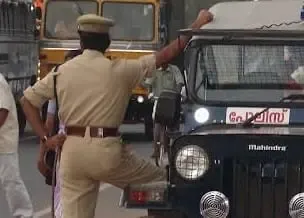
Thiruvananthapuram, Dec 19 (NationPress) The alarming footage from a police station in Kerala depicting a pregnant woman being mistreated and assaulted has sparked significant public outrage and compelled authorities to take action.
The footage, which emerged on Thursday evening in Kochi, has prompted numerous inquiries. The police uniform is intended to represent safety, trust, and the assurance that the state is there for its citizens. However, when this uniform is misused, the repercussions extend far beyond one incident; it undermines public confidence in the legal system.
This troubling event that came to light in Kochi, recorded on CCTV, serves as a stark reminder of how easily those meant to protect can become aggressors.
The footage from the Ernakulam police station shows a pregnant woman undergoing humiliation and assault.
The officer, Prathapachandran, was suspended shortly after his misconduct was broadcast on news channels.
Yet, the pressing question lingers: would any disciplinary measures have been taken had the cameras not been present?
This inquiry leads to a deeper, more unsettling truth about the persistent issue of police misconduct in Kerala.
A significant part of the dilemma lies in the unhealthy alliance between political authority and certain factions of the police force. Over time, allegiance to political figures—rather than to the Constitution—has become a form of currency that grants certain officers with protection, placements, and immunity. This misplaced allegiance empowers some officials to act with a sense of invulnerability.
When police personnel begin to perceive themselves as tools of political power instead of servants of justice, excesses become simpler to rationalize and tougher to penalize. Ordinary citizens, particularly the vulnerable and disenfranchised, ultimately bear the brunt of this.
Despite the Kerala Police often advocating for reform and community-friendly policing, incidents like the one in Kochi shatter that narrative.
For every incident captured on CCTV, countless others disappear into unreported complaints, intimidated victims, and systemic silence.
Suspensions that follow public exposure are merely reactive damage control, not a genuine correction of systemic issues.
What is lacking are independent oversight mechanisms, substantial consequences, and the political will to let justice unfold, even when it is inconvenient.
Expressing his profound discontent, Leader of Opposition V.D. Satheesan stated that for nearly a decade, the Home Department has been firmly under the control of Chief Minister Pinarayi Vijayan.
“Incidents of lock-up violence, human rights violations, and routine abuse of power have occurred not despite this control, but under it. The assertion of 'people-friendly policing' rings hollow when citizens repeatedly confront intimidation instead of protection within police stations,” remarked Satheesan.
A democracy cannot rely on surveillance cameras for justice. Nor can it support a police force that derives confidence from political patronage rather than constitutional accountability. Until that relationship is redefined, every new video will reinforce a troubling belief: that safety today lies not in the police station but in being visible to a camera.
Point of View
We must strive for a system where justice prevails, and citizens feel safe within the very institutions designed to protect them.
NationPress
20/12/2025
Frequently Asked Questions
What happened in the Kerala police station?
A pregnant woman was seen being assaulted and humiliated in a police station in Kerala, prompting widespread outrage.
Who is the officer involved in the incident?
The officer involved, Prathapachandran, has been suspended following the public outcry over the incident.
What are the implications of this incident?
This incident raises serious questions about police accountability and the need for reforms in law enforcement practices in Kerala.